This is a free online guitar tuner, already set to Open D minor. The strings become D A D F A D, often written DADFAD, and the open strings ring out a full D minor chord. Press Start, tap the button of the string you are tuning, play it, and turn the peg until the reading sits at 0 cents. Open D, DADGAD and standard are in the menu above the tuner. No account, no download. It sits alongside the rest of our free guitar tools.
What Open D minor tuning is
An open tuning is one where the open strings already form a chord. Open D minor is built on D minor: D is the root, F the minor third, A the fifth. Strum all six strings without fretting anything and you hear the chord in root position, with three Ds anchoring it at three different octaves.
From standard tuning, four strings go down a whole step and two do not move at all. Nothing goes up, so the guitar ends up under less tension than it started with.
| String | Standard | Open D minor | Move | Target, at A 440 |
|---|---|---|---|---|
| Sixth, the thickest | E | D | down one whole step | D2, 73.42 Hz |
| Fifth | A | A | stays | A2, 110.00 Hz |
| Fourth | D | D | stays | D3, 146.83 Hz |
| Third | G | F | down one whole step | F3, 174.61 Hz |
| Second | B | A | down one whole step | A3, 220.00 Hz |
| First, the thinnest | E | D | down one whole step | D4, 293.66 Hz |
Reference tones, A4 = 440 Hz
One button per string in Open D minor, from the thickest to the thinnest. Play the string on the guitar and bring it to the same pitch.
Each tone is synthesized by your browser at the exact frequency, with A4 at 440 Hz as the reference, so it stands in for a tuning fork. No audio file is downloaded.
The third string is the one that sets the mood. F is the minor third of D, and it is the only note in the chord that is not a D or an A. Raise it a half step to F# and you are in Open D, which is major. That single fret is the whole difference between the two tunings.
The reference pitch menu offers A at 432, 440 and 442 Hz, and opens on 440, which is what the frequencies above assume. Change it and all six targets move together.
Open D minor across the neck: every note on 12 frets
D A D F A D from the thickest string to the thinnest. The Ds, Fs and As are highlighted: they are the three notes of the open D minor chord, wherever they fall on the neck.
How to tune to Open D minor from standard
Start from an accurate standard tuning, then lower the four strings that move one at a time. Each one goes down a whole step, and that distance matters for the way the tuner reads it.
- Press Start and allow the microphone. The tuner is already on Open D minor.
- Tap the button for the sixth string, D2. You hear its note, and the tuner now aims at that string. Do this before you turn anything: in automatic mode the tuner only locks onto a string within a little less than a whole step, so a low E that has not moved yet is read as an E, and an E in tune looks like good news.
- Play the string and loosen slowly. The message tells you whether to tighten or loosen. Stop at 0 cents.
- Do the same for the third string, F3, then the second, A3, then the first, D4. Tap each string's button before you start turning its peg.
- Go round all six strings a second time. Four strings losing tension lets the neck relax a little, and the others drift while you work.
There is an ear check for each step, useful when you have no tuner at hand. In Open D minor the gaps between strings are 7, 5, 3, 4 and 5 frets, reading upwards. The seventh fret of the sixth string gives the open fifth, the fifth fret of the fifth gives the open fourth, the third fret of the fourth gives the open third, the fourth fret of the third gives the open second, and the fifth fret of the second gives the open first.
One string from Open D, one string from DADGAD
Open D minor has two close relatives, and it sits exactly between them. All three share the same five strings: D and A in the bass, A and D on top. Only the third string changes, and that one string decides whether the open chord is major, minor or neither.
| Tuning | Notes, thickest to thinnest | Third string | Open chord | To reach Open D minor |
|---|---|---|---|---|
| Open D minor | D A D F A D | F, the minor third | D minor | This page |
| Open D | D A D F# A D | F#, the major third | D major | Third string down a half step |
| DADGAD | D A D G A D | G, a fourth | Neither major nor minor | Third string down a whole step |
Coming from Open D. Lower the third string a half step, from F# to F. Here the tuner needs no help: F# is close enough to the F target that it locks on by itself, reads about 100 cents sharp, and tells you to loosen. The Open D tuner covers the major version in full.
Coming from DADGAD. Lower the third string a whole step, from G to F. Tap the F3 button first: a G sits exactly a whole step from both the F and the A of this tuning, so in automatic mode the tuner aims at neither. The DADGAD tuner opens on that tuning if you want to go back.
Chords in Open D minor: one finger across the neck
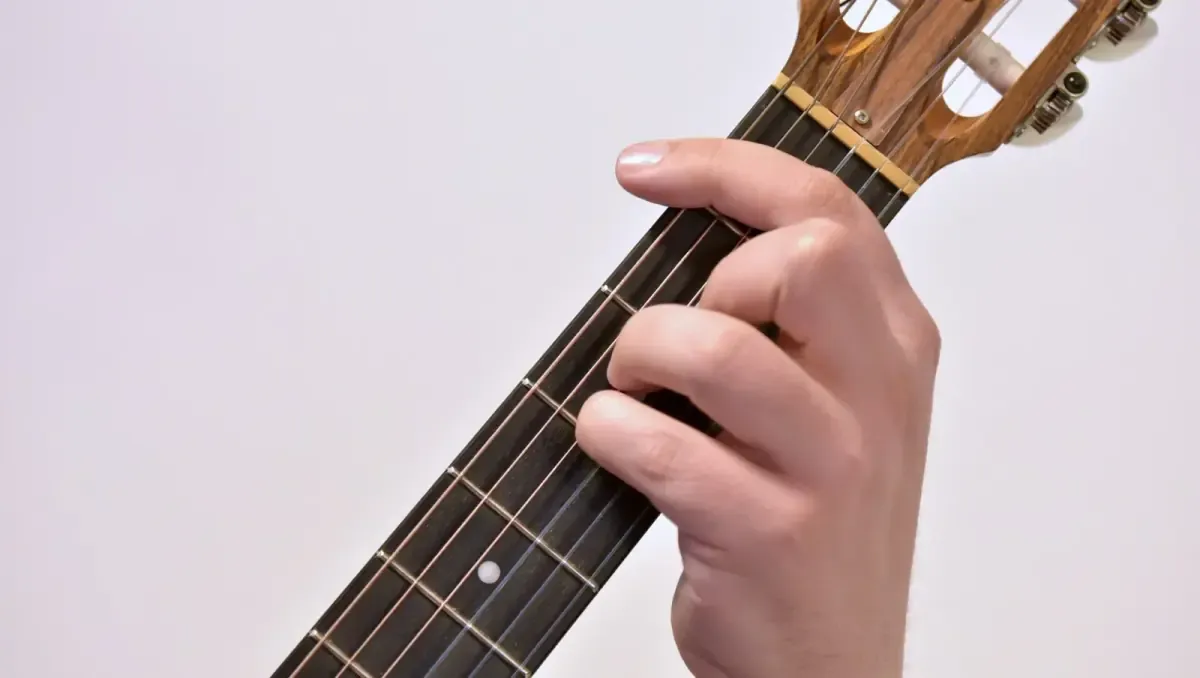
Because the open strings are a D minor chord with the root at the bottom, laying one finger flat across all six strings at any fret gives you another minor chord, in tune and in root position. The chord moves up one half step per fret.
| Barre at fret | Chord |
|---|---|
| Open strings | D minor |
| 2 | E minor |
| 3 | F minor |
| 5 | G minor |
| 7 | A minor |
| 10 | C minor |
| 12 | D minor, an octave up |
D minor at the open strings, G minor at the fifth fret, A minor at the seventh: those are the three chords of a minor key in D, and you can play them all with one finger or one slide.
Major chords need one adjustment, the mirror image of what you do in Open D. The third of the chord sits on the third string, so fret that string one fret above the barre and the minor third becomes a major third. At the seventh fret, for example, the barre gives A minor; put the third string on the eighth fret and you have A major, the chord that pulls hardest back to D minor. In the open position, the first fret of the third string turns F into F# and gives you D major.
These diagrams are drawn for Open D minor, not for standard tuning. Read the open strings as D A D F A D: the same shapes in standard would give different chords.
A capo works normally and changes the key without retuning: at the first fret the open strings sound Eb minor, at the second E minor, at the third F minor. The barre positions move with it, counted from the capo rather than the nut.
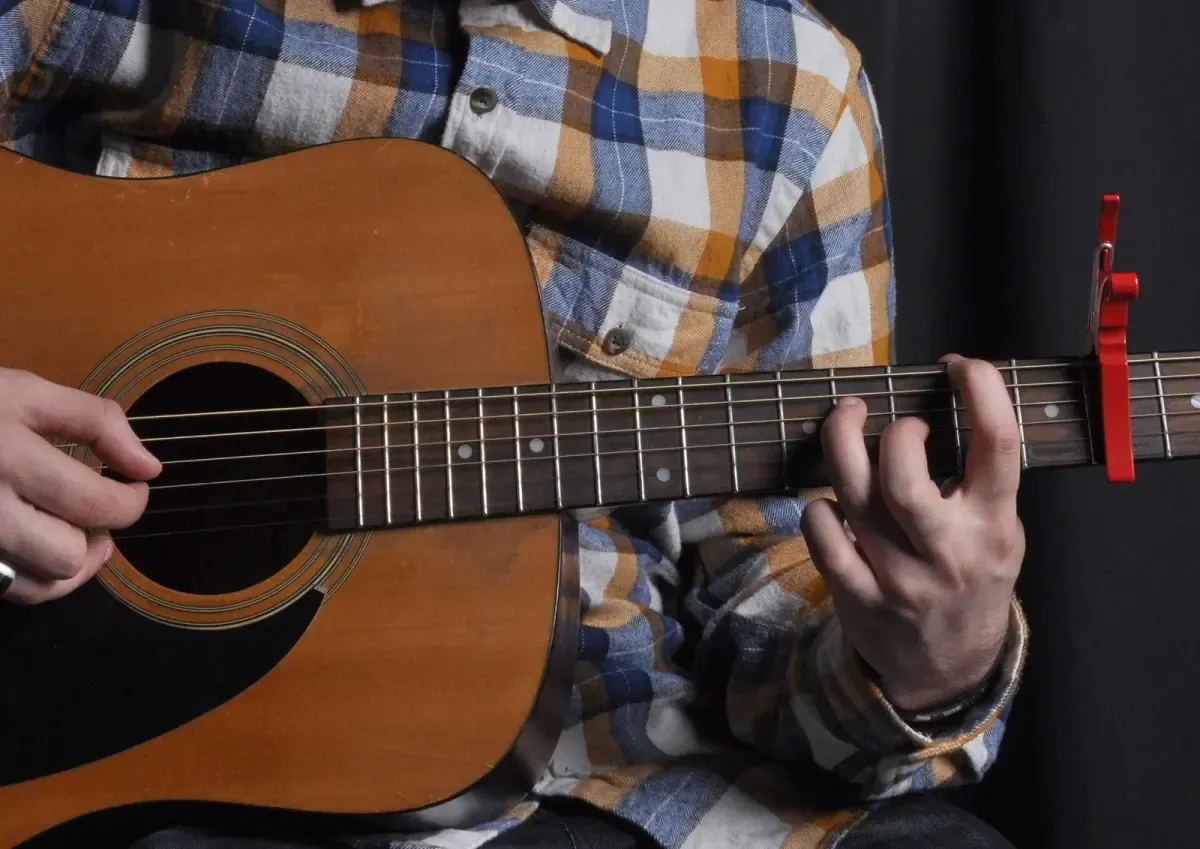
If you need the plain D minor chord in standard tuning, it is x x 0 2 3 1: fourth string open, then the second fret of the third string, the third fret of the second and the first fret of the first.
Slide and drones in Open D minor
Open D minor rewards slow playing. The three D strings ring as a drone under everything, and the minor third colors every note you put on top of them. You do not need many notes to make it sound like music; most of the work is deciding which strings to let ring and which to stop.
- Fingerpicking. Keep the thumb on the low D and let the open D strings sustain while the fingers draw a melody on the thinner strings.
- Slide over the fret, not behind it. A slide is a straight bar, and in this tuning a straight bar is a minor chord at every fret. Sit it directly above the metal, with almost no pressure.
- Mute behind the slide. Let the trailing fingers touch the strings lightly, or everything between the slide and the nut rings along.
- A slightly higher action helps a slide. If you only play slide on this guitar, raising the strings a little stops the buzz on the thinner strings. If you switch between slide and fretted playing, leave the setup alone and press more gently instead.
Tuning matters more with a slide than without it, because there is no finger pressure to pull a slightly flat string into line. Get each string to 0 cents, strum the open strings, and listen for one that wobbles against the rest.
Open G has a minor version too, one string away from it in the same way: Open G minor, D G D G Bb D. For every other preset, go to the online guitar tuner, and if tuning by ear is new to you, how to tune a guitar is the place to start.
Frequently asked questions
Which strings do I change for Open D minor?
Is DADFAD the same as Open D minor?
What is the difference between Open D and Open D minor?
Is Open D minor hard on the guitar?
Why does the tuner say my string is in tune when I have not changed it yet?
How do I get back to standard tuning?

Who made this
Guitar Social Club is the work of Yohann Abbou, a guitar teacher in Paris. He teaches adults, which shapes everything here: people with jobs, limited practice time and a clear idea of the songs they want to play. The tools come out of his lessons, which is why none of them asks you to sign up before it works, and why this one shows you cents rather than a green light. The rest of our free guitar tools work the same way.
More about Yohann on his page, and about why Guitar Social Club exists.