This is a free online guitar tuner, already set to Double Drop D: D A D G B D. Two strings move from standard, both E strings down a whole step to D, and the four in the middle stay put. Press Start, play one string on its own, let it ring, then aim for 0 cents. No account, no download. It sits alongside the rest of our free guitar tools.
What Double Drop D tuning is
Double Drop D is Drop D taken one string further. In Drop D you lower the sixth string from E to D. In Double Drop D you lower the first string from E to D as well. The result reads D A D G B D, from the thickest string to the thinnest.
What you gain is a D at both ends of the guitar. The low D gives you the weight of Drop D and the one finger power chord across the bottom three strings. The high D rings above everything you play in the key of D, like a bell that never stops. Between the two, the fifth, fourth, third and second strings are exactly where they were in standard tuning, so the middle of the neck still feels like home.
That is why players reach for it on both electric and acoustic guitar. Neil Young's Cinnamon Girl is the reference most people know: heavy chords with the two Ds droning around them. Led Zeppelin's Going to California shows the other face of the tuning, fingerpicked and quiet, with the outside strings framing the melody.
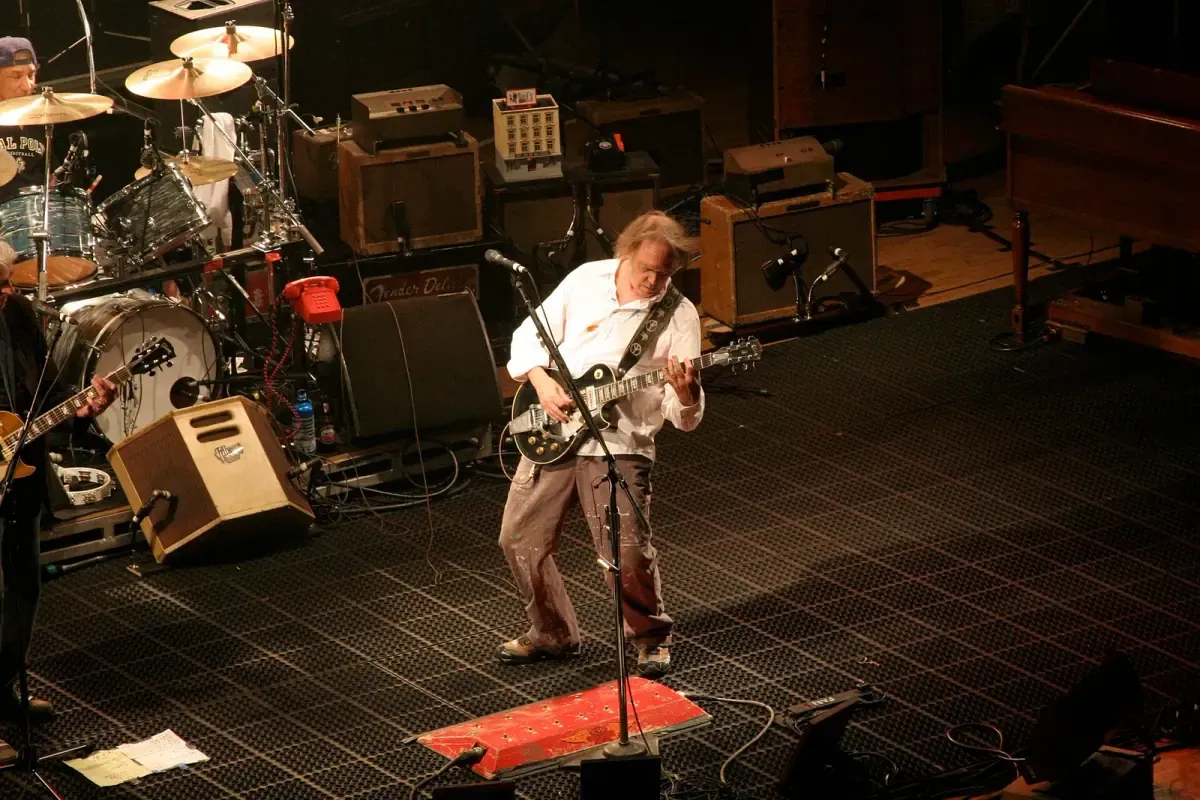
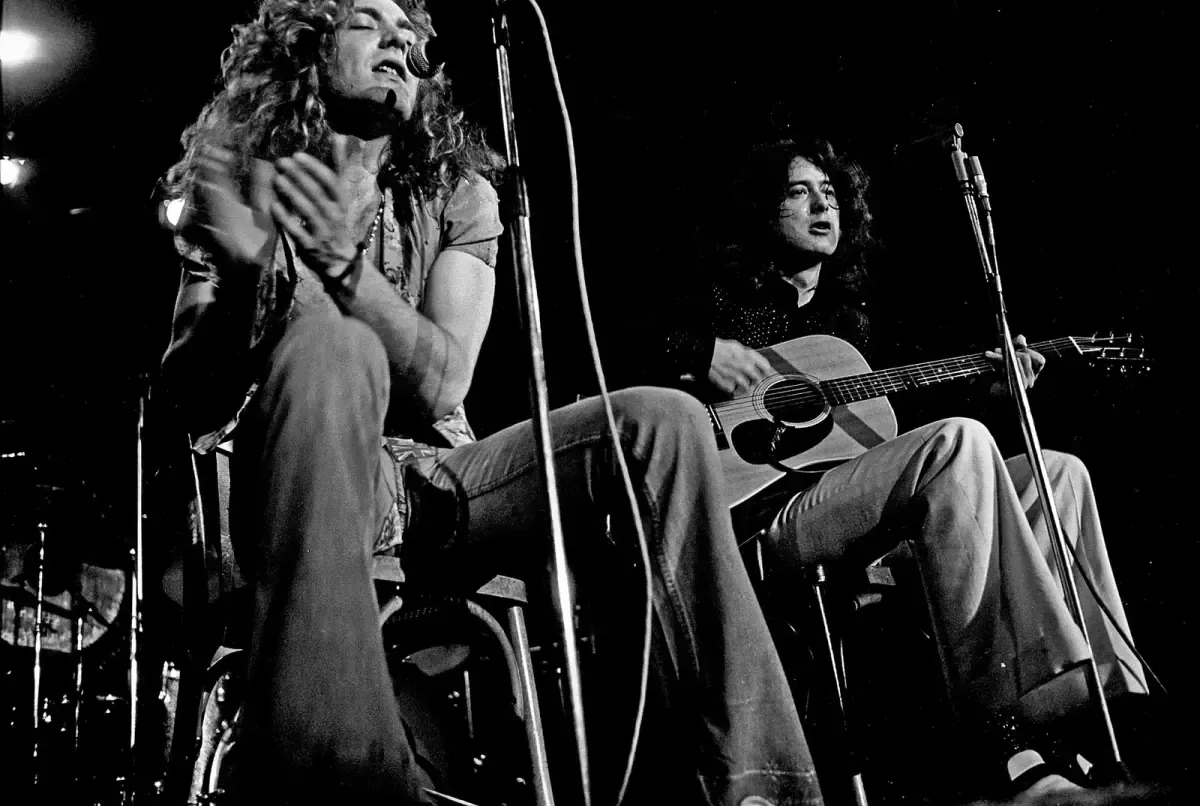
Double Drop D across the neck: every note on 12 frets
D A D G B D from the thickest string to the thinnest. Every D is highlighted: the two outside strings and the fourth string all ring it open, and those are the drones the tuning is built around.
How to tune to Double Drop D from standard
Start from standard tuning that is actually in tune. Then only two pegs turn: the sixth string and the first string, each down a whole step.
| String | Standard | Double Drop D | Change | Target, at A 440 |
|---|---|---|---|---|
| Sixth, the thickest | E | D | down a whole step | D2, 73.42 Hz |
| Fifth | A | A | unchanged | A2, 110.00 Hz |
| Fourth | D | D | unchanged | D3, 146.83 Hz |
| Third | G | G | unchanged | G3, 196.00 Hz |
| Second | B | B | unchanged | B3, 246.94 Hz |
| First, the thinnest | E | D | down a whole step | D4, 293.66 Hz |
Reference tones, A4 = 440 Hz
One button per string in Double Drop D, from the low D up to the high D. Play the string on the guitar and bring it to the same pitch.
Each tone is synthesized by your browser at the exact frequency, with A4 at 440 Hz as the reference, so it stands in for a tuning fork. No audio file is downloaded.
- Open Settings, below the tuning menu, and tick Open string sound. Six string buttons appear, one per string of the preset. Tapping one plays its reference tone, so let it fade before you play.
- Tap the button for the high D, labeled D D4, then play the first string. It still reads E, and with the button selected the tuner measures it against D and tells you to loosen it. Without the button, the tuner sees a perfectly good E, a full whole step from any string it is looking for, and simply names it.
- Loosen the first string until it reads D at 0 cents. Go slightly below, then tighten the last few cents back up: the string holds better when the final move is upward.
- Tap D D2, play the sixth string and bring it down to D the same way.
- Go round all six strings once more. Two strings losing tension pull the neck back a little, and the other four can drift by a few cents.
You can check it by ear too. The seventh fret of the sixth string gives the open fifth string, A. The fifth fret of the fifth gives the open fourth, the fifth fret of the fourth gives the open third, the fourth fret of the third gives the open second, and the third fret of the second string gives the open first string, D. That last one is the check that matters here: the same D, fretted and open, should sound as one note.
The reference pitch menu offers A at 432, 440 and 442 Hz and opens on 440, which is what the targets above assume.
Double Drop D and its neighbors
Double Drop D sits in the middle of a family of D tunings, and most of them are one string away. That is worth knowing, because it means you can try one of them from here with a single turn of a peg, and come back just as fast.
| Tuning | Strings, 6th to 1st | Difference from Double Drop D | Preset key |
|---|---|---|---|
| Standard | E A D G B E | Two strings: the 6th and the 1st are E, a whole step higher. | ?tuning=standard |
| Drop D | D A D G B E | One string: the 1st is still E. | ?tuning=dropd |
| Double Drop D | D A D G B D | This page. | ?tuning=doubledropd |
| Open G | D G D G B D | One string: the 5th goes down a whole step, A to G. | ?tuning=openg |
| DADGAD | D A D G A D | One string: the 2nd goes down a whole step, B to A. | ?tuning=dadgad |
| Open D | D A D F# A D | Two strings: the 3rd goes down a half step, G to F#, and the 2nd a whole step, B to A. | ?tuning=opend |
Read the table as a ladder. Standard to Drop D is one string. Drop D to Double Drop D is one more. From here, lower the second string to A and you are in DADGAD, the folk and Celtic tuning. Lower the fifth string to G instead and you are in Open G, where the open strings sound a G chord. Take DADGAD one step further, the third string down to F#, and you reach Open D, where the open strings sound a full D major chord.
Every one of them is in the tuning menu above, so you can follow the ladder string by string with the tuner open.
Chords in Double Drop D
The rule is simple: any shape that uses the sixth or the first string needs that string fretted two frets higher than in standard, because it now sits a whole step lower. Shapes that avoid both outside strings do not change at all.
| Chord | Frets, 6th to 1st | Notes | What changed |
|---|---|---|---|
| D | 0 0 0 2 3 4 | D A D A D F# | The open D shape, with the first string fretted at 4 instead of 2. |
| G | 5 2 0 0 0 0 | G B D G B D | The top four strings ring open. Only the two bass notes are fretted. |
| Em | 2 2 2 0 0 2 | E B E G B E | The standard E minor, with both outside strings fretted at 2. |
D and Em from the table, drawn. They are written for Double Drop D: in standard tuning the open outside strings would be E, and the shapes would not give these chords. The G is left as text: its low G sits at the fifth fret while the other strings ring open, too wide for one diagram.
The other habit worth building is leaving the outside strings open. Fret a chord shape on the middle four strings and let both Ds ring around it: as long as you stay in the key of D or G, the drones fit, and that open sound is the reason to be in this tuning at all.
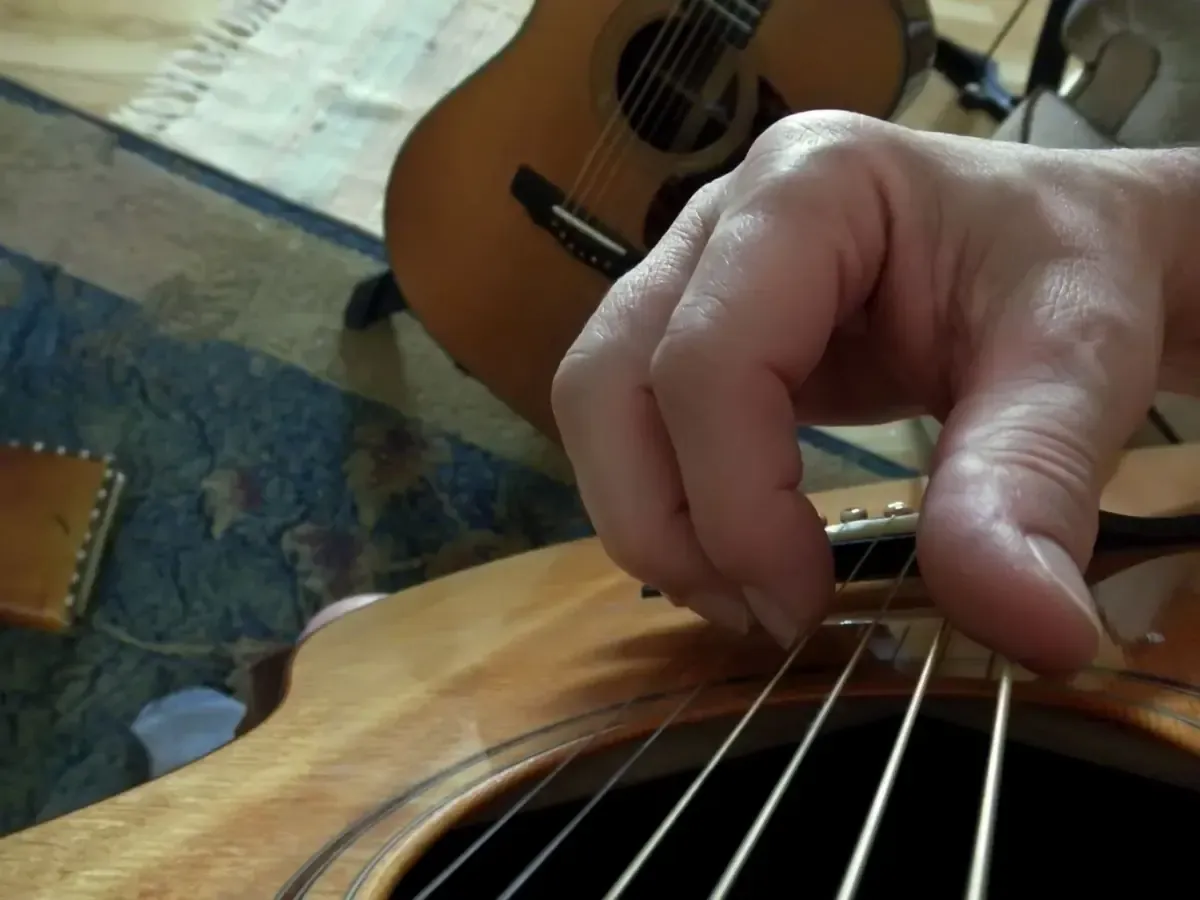
The bottom three strings, D A D, are still a ready made power chord, as in Drop D. One finger flat across them at any fret gives you a power chord with no shape to learn. The power chords page covers how to play them cleanly.
Frequently asked questions
What is Double Drop D tuning?
How is Double Drop D different from Drop D?
Do I need different strings for Double Drop D?
Is there a Double Drop D preset in this tuner?
What songs use Double Drop D?
How do I get back to standard tuning?

Who made this
Guitar Social Club is the work of Yohann Abbou, a guitar teacher in Paris. He teaches adults: people with jobs, limited practice time and a clear idea of the songs they want to play. The tools come out of his lessons, which is why none of them asks you to sign up before it works, and why this one shows you cents rather than a green light. The rest of our free guitar tools work the same way.
More about Yohann on his page, and about why Guitar Social Club exists.