This is a free online dobro tuner that listens through your microphone. It opens on open G high bass, G B D G B D, the standard tuning for a squareneck dobro in bluegrass. Press Start, play one open string, let the note settle, then bring it to 0 cents. If you play a roundneck resonator in Open G, Open D or Open E, those presets are in the same menu. No account, no download. It sits alongside the rest of our free guitar tools.
Dobro tuning: open G high bass, G B D G B D
The standard dobro tuning reads G B D G B D from the thickest string to the thinnest. Strum the six open strings and you hear a G major chord in root position: G at the bottom, then the third and the fifth, then the same three notes an octave up. Bluegrass players call it open G high bass, to tell it apart from the open G most guitarists know, which starts on a low D.
A squareneck dobro is played flat, with a steel bar sliding over the strings. Because the open strings are a major chord, laying the bar straight across all six gives you another major chord at every fret: C at the fifth fret, D at the seventh, and G again, an octave up, at the twelfth. Those are the three chords of a song in G.
| String | Note | Target, at A 440 | Role in the chord |
|---|---|---|---|
| Sixth, the thickest | G2 | 98.00 Hz | The root, G |
| Fifth | B2 | 123.47 Hz | The major third |
| Fourth | D3 | 146.83 Hz | The fifth |
| Third | G3 | 196.00 Hz | The root again |
| Second | B3 | 246.94 Hz | The third again |
| First, the thinnest | D4 | 293.66 Hz | The fifth again |
Reference tones, A4 = 440 Hz
One button per string in open G high bass, from the low G up to the high D. Play the string on the dobro and bring it to the same pitch.
Each tone is synthesized by your browser at the exact frequency, with A4 at 440 Hz as the reference, so it stands in for a tuning fork. No audio file is downloaded.
The reference pitch menu, next to the tuning menu, offers A at 432, 440 and 442 Hz. It opens on 440, which is what the frequencies above assume. Change it and all six targets move together.
Dobro fretboard in G B D G B D: every note
Open G high bass over 12 frets, from the thickest string to the thinnest. The three notes of the G chord, G, B and D, are highlighted. They line up across all six strings at the open position and again at the twelfth fret.
Dobro tuning vs guitar open G: two strings apart
Both tunings are G major, and the top four strings are identical. Only the two bass strings change. Dobro tuning puts the root and the third down there, G and B. Guitar open G, D G D G B D, puts the fifth and the root there, D and G. That is the whole difference, and it is why the dobro version is called high bass.
| String | Dobro, high bass | Guitar open G | Same note? |
|---|---|---|---|
| Sixth | G2 | D2 | No |
| Fifth | B2 | G2 | No |
| Fourth | D3 | D3 | Yes |
| Third | G3 | G3 | Yes |
| Second | B3 | B3 | Yes |
| First | D4 | D4 | Yes |
Each has its own preset: Dobro for the high bass version, Open G for the guitar version. Load the one you are tuning to. If you go from one to the other, only the sixth and fifth strings need to move: the sixth between D and G, the fifth between G and B.
How to tune to dobro tuning from standard
If your resonator is in standard tuning, three strings move. Two of them go up, and that has a cost in tension worth knowing before you start.
| String | Standard | Dobro | Move | Tension |
|---|---|---|---|---|
| Sixth | E | G | up one and a half steps | about 41 percent more |
| Fifth | A | B | up one whole step | about 26 percent more |
| Fourth | D | D | stays | same |
| Third | G | G | stays | same |
| Second | B | B | stays | same |
| First | E | D | down one whole step | about 21 percent less |
The tension figures are not guesses. On the same string at the same scale length, tension rises with the square of the pitch, so one and a half steps up means about 41 percent more pull on the sixth string.
- Press Start and allow the microphone. The tuner is already on the Dobro preset.
- Open Settings and tick Open string sound. One button per string appears. This matters here: in automatic mode the tuner only aims at a string within a little less than a whole step, and your sixth string starts one and a half steps under G.
- Tap G2. You hear the note, and the tuner now measures against the sixth string even from that far away. Play it and tighten slowly until the reading sits at 0 cents.
- Tap B2 and bring the fifth string up a whole step the same way. Then tap D4 and loosen the first string down a whole step.
- Go round all six strings a second time. Raising two bass strings pulls the neck forward a little, and the others drift while you work.
Squareneck or roundneck: which tuning
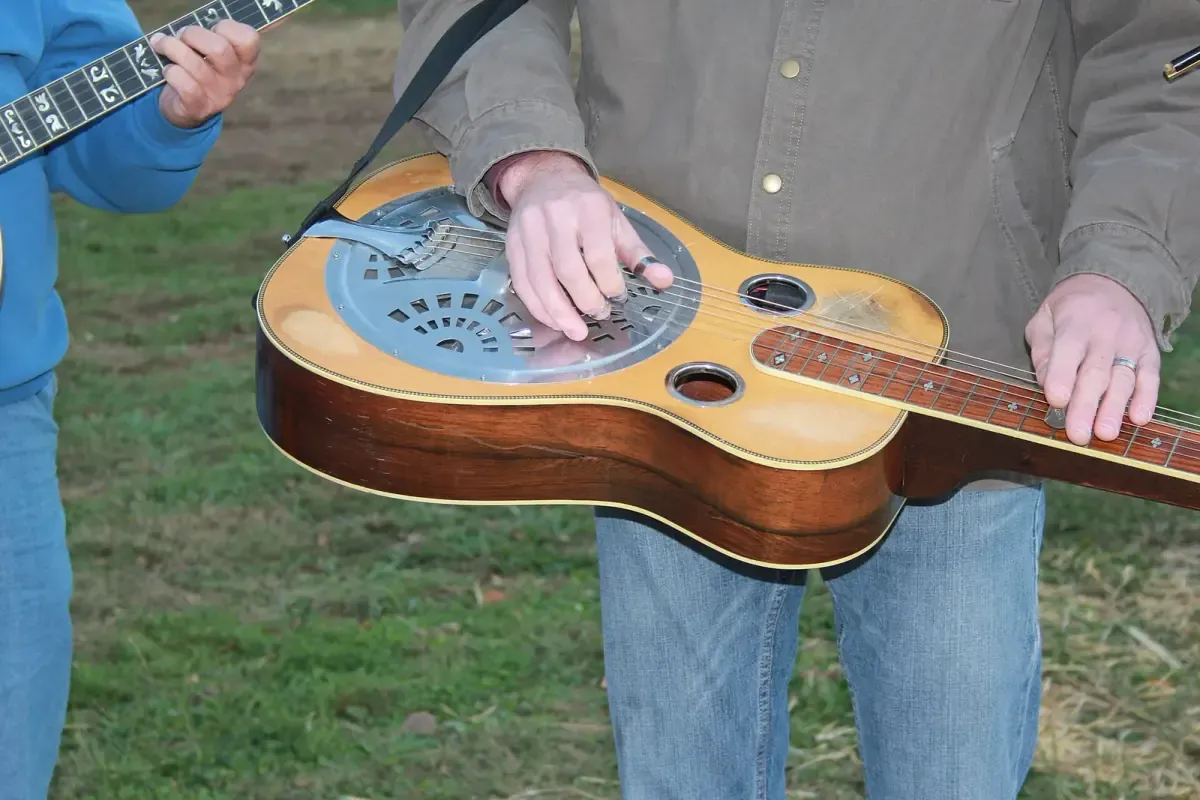
A resonator guitar is played two ways, and the tuning usually follows. The squareneck kind lies flat on your lap and is played with a steel bar: that is the bluegrass dobro, in high bass G. The roundneck kind is held like a guitar and played with a bottleneck slide or fretted chords: that is the blues resonator, most often in Open G, Open D or Open E.
| Tuning | Notes, low to high | Typical use | Preset to load |
|---|---|---|---|
| Open G high bass | G B D G B D | Squareneck, bluegrass | Dobro, the one this page opens on |
| Open G | D G D G B D | Roundneck, blues and slide | Open G |
| Open D | D A D F# A D | Roundneck, bottleneck and folk | Open D |
| Open E | E B E G# B E | Roundneck, bright and loud slide | Open E |
All four have a preset, so the tuner aims at the right strings in each. For the roundneck tunings you can also go straight to the Open G tuner, the Open D tuner or the Open E tuner, each with its own chords and slide tips. Open D is the looser, rounder choice; Open E is the same layout a whole step higher, brighter and under more tension.
What a dobro is, and how to play it in tune
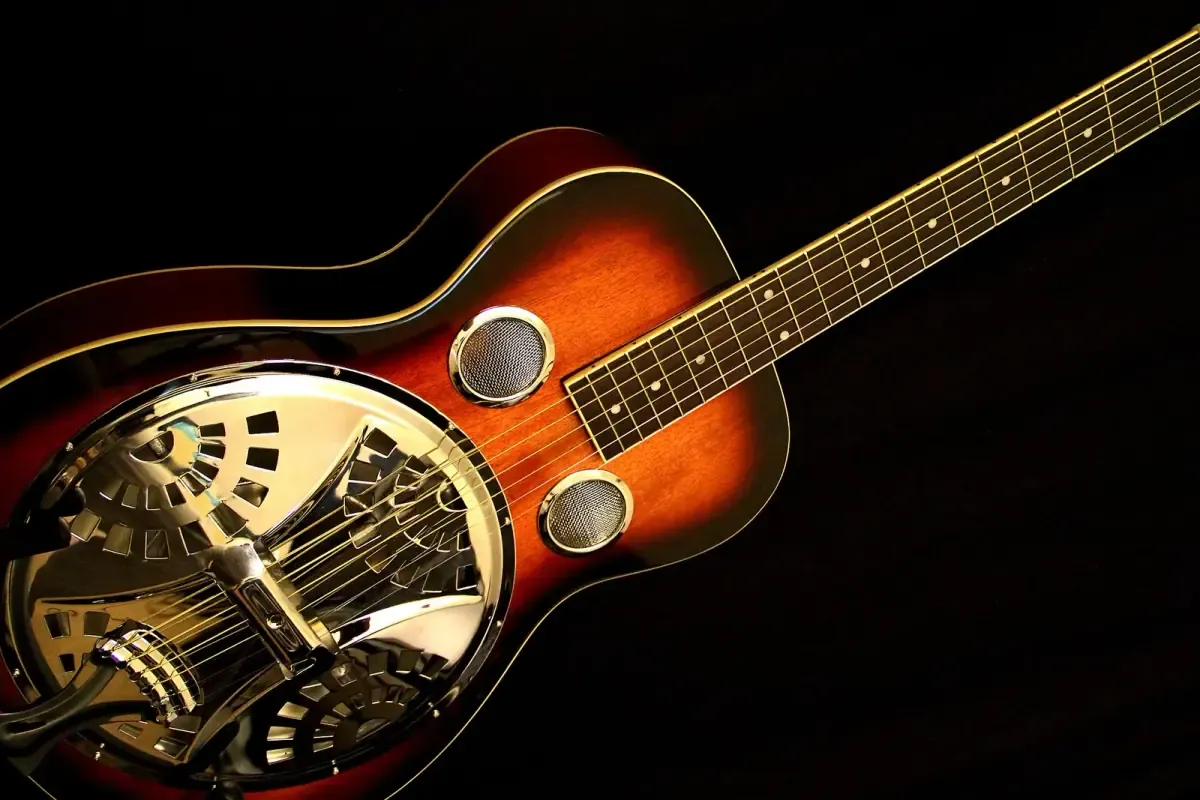
A dobro is a resonator guitar. Instead of relying only on a wooden top, it passes the string vibration to an aluminum cone under a metal cover plate, which works like an acoustic loudspeaker. The result is more volume, a metallic attack and a long sustain. The name comes from the Dopyera brothers, who started the brand in the late 1920s. Dobro is now a trademark owned by Gibson, and instruments of the same kind from other makers are more accurately called resonator guitars, even if most people say dobro for all of them.
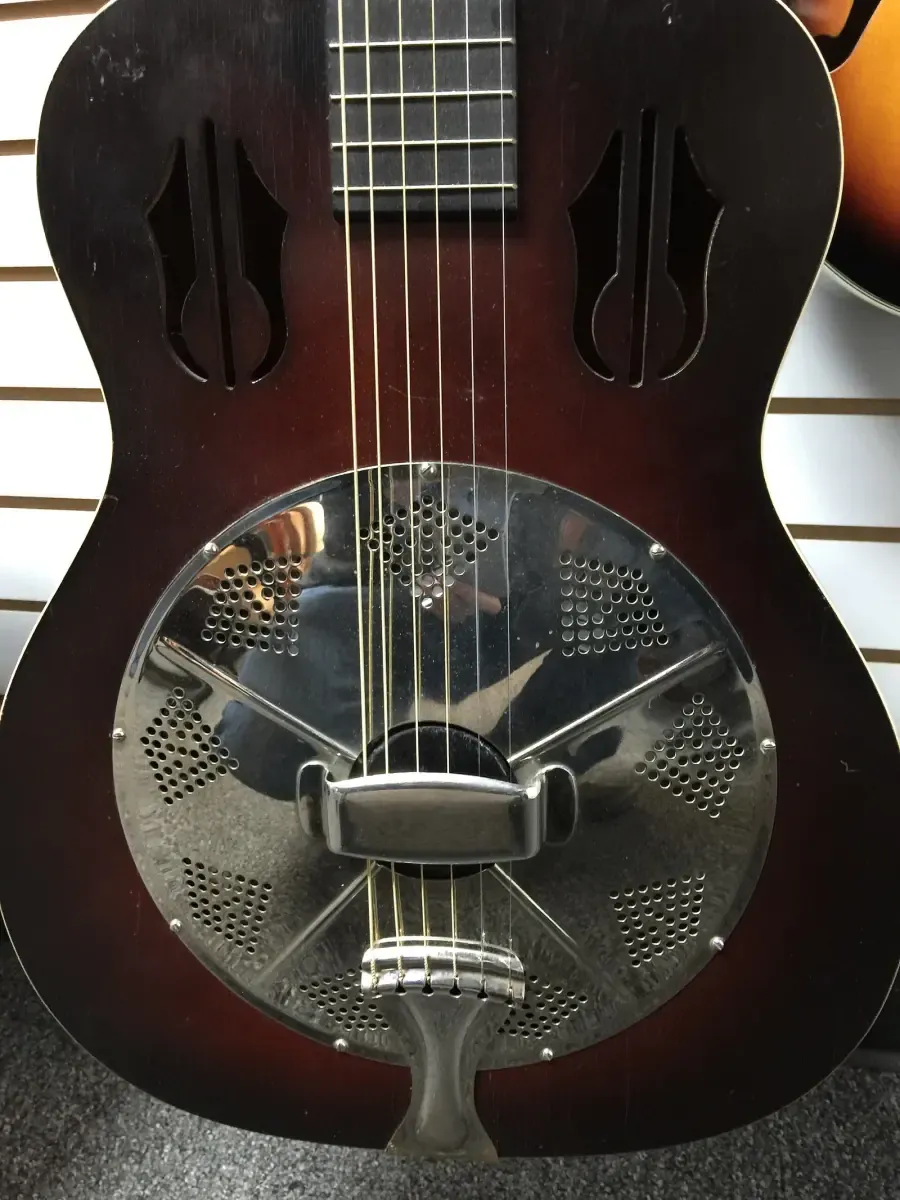
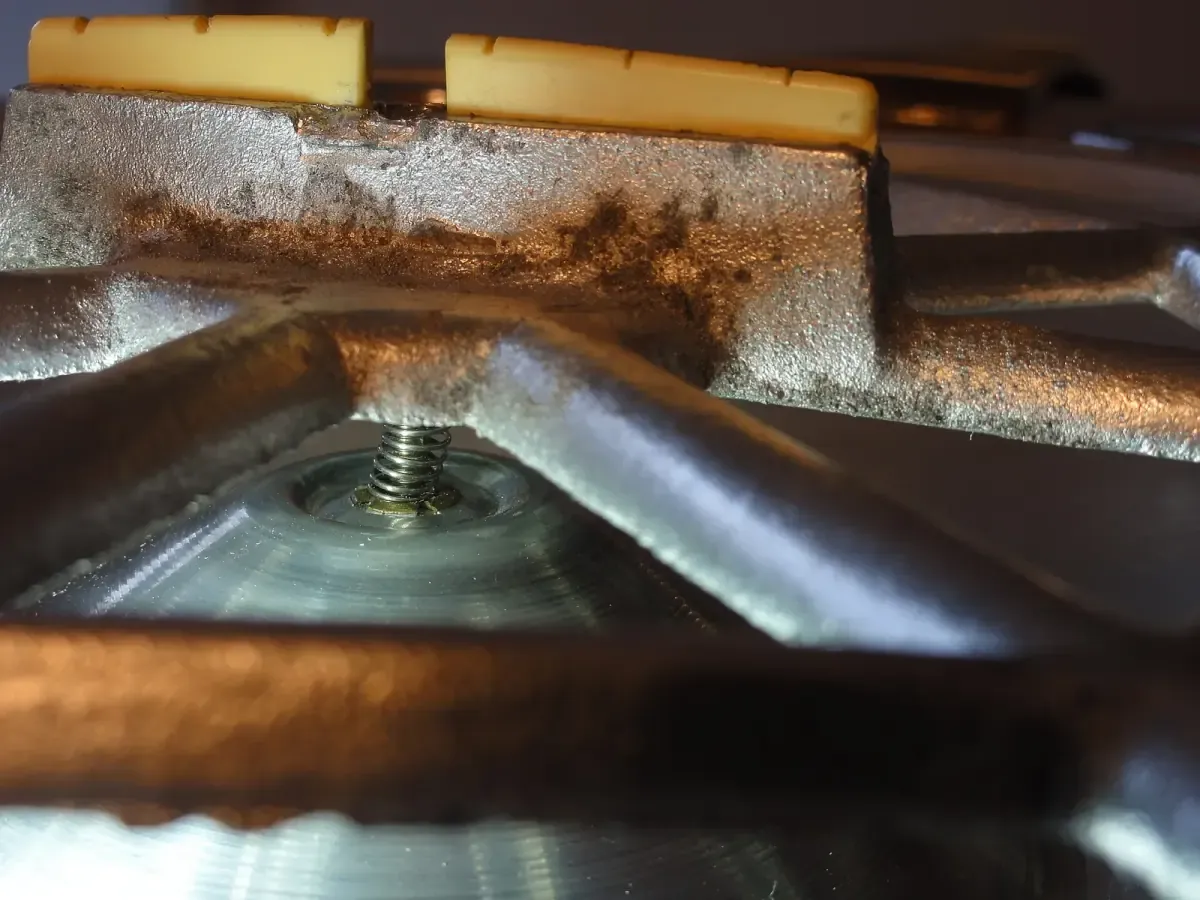
There are two main designs. The spider type, the Dobro design, has an inverted cone under a bridge with spider-like legs: a clear voice and even sustain, the reference for bluegrass played flat. The biscuit type, the National design, has a small biscuit bridge at the center of a single cone: a more percussive attack and a grittier tone, at home in roots blues with a bottleneck.
Once the strings are in tune, the bar decides the rest.
- Keep the bar directly over the fret wire. Not between frets like a finger. Behind the fret, the note comes out flat.
- Keep it straight across the strings, unless you mean to slant it. A crooked bar puts each string at a slightly different pitch.
- Block with the picking hand. Damp strings with thumb, index and middle to cut off notes you are done with, or they ring into the next chord.
- Use harmonics as landmarks. The harmonics at the fifth, seventh and twelfth frets work for intros and fills, and as a reference point for where the bar should sit.
For reference points, listen to Jerry Douglas for a clean, modern bluegrass dobro, and Mike Auldridge, who brought the dobro to the front of bluegrass in the 1970s. On the blues and roots side, listen to Taj Mahal, and to Rory Gallagher on a metal-bodied resonator. If you also play flat on an electric, the lap steel tuner opens on C6, the classic lap steel tuning.
Frequently asked questions
How do you tune a dobro?
Is dobro tuning the same as open G?
Can I tune a regular acoustic guitar to dobro tuning?
What is the difference between a dobro and a resonator guitar?
Why does the tuner not catch my low string when I start?

Who made this
Guitar Social Club is the work of Yohann Abbou, a guitar teacher in Paris. He teaches adults, which shapes everything here: people with jobs, limited practice time and a clear idea of the songs they want to play. The tools come out of his lessons, which is why none of them asks you to sign up before it works, and why this one shows you cents rather than a green light. The rest of our free guitar tools work the same way.
More about Yohann on his page, and about why Guitar Social Club exists.