This page is about the project rather than the person. It says why Guitar Social Club was built, what it is trying to fix in the way adults learn the guitar, and what joining it actually means. The tools on this site are the part of it you can use in English today.
- A method, not a library
- 35 years of teaching behind it
- Built for adults
- Tools free, no account
Learning the guitar a different way
Guitar Social Club did not come out of an abstract idea. It came out of a plain observation, made over 35 years of teaching: plenty of adults want to play, make progress for a while, then slow down, start doubting themselves, and end up lost.
Not because they lack musical feeling. Not because they were not made for music. But because the frame they are learning in is rarely clear enough, alive enough, or human enough to hold them for longer than a few months.
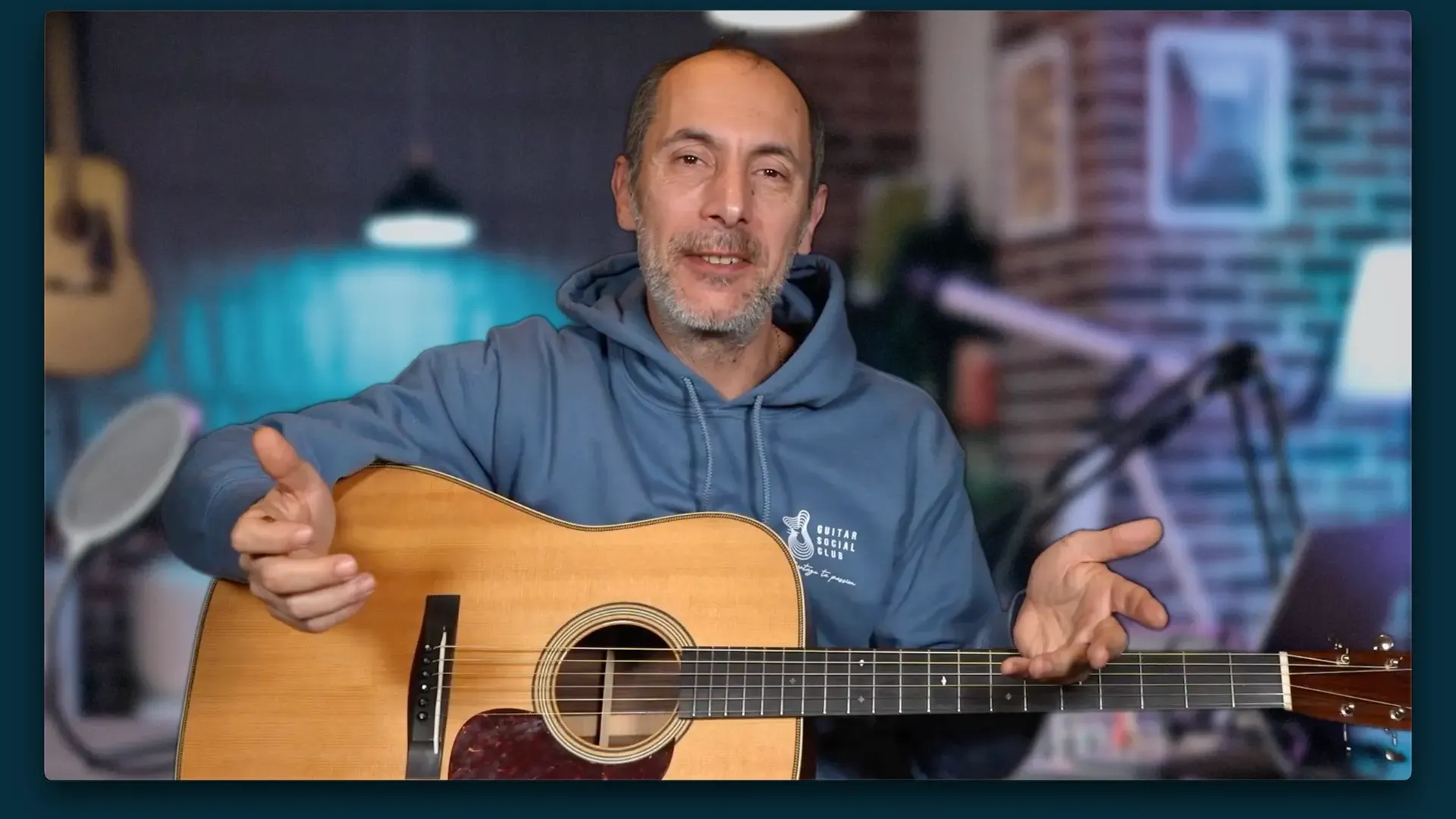
The problem is not the students. Most of the time it is the frame they are learning in.
What Guitar Social Club is trying to fix
A lot of guitar players pile up material, switch methods, work with no clear direction, and end up mistaking activity for progress. The hours go in, the playing stays where it was, and the conclusion they draw is about themselves rather than about the method.
Guitar Social Club was designed to put order, pleasure and real continuity back into that. Three things get in the way, and each one has an answer.
Too much content
The aim is less noise and more landmarks. A hundred tutorials on the same chord do not make the chord any clearer.
Not enough direction
Good material only helps if it arrives at the right moment. Out of order, the best lesson in the world lands on someone who cannot use it yet.
Too little contact with the real thing
Playing, sound, rhythm and motivation have to stay concrete. What you hear is part of what makes you want to pick the guitar up again.
A system built as an extension of the real thing
Guitar Social Club was not designed as one more generic app. It sets out to extend what a good teacher does in the room: set a frame, keep you from scattering, keep motivation alive, and fit the progression to the level you are actually at rather than the one a program assumed.
The technology, the artificial intelligence, the tools and the paths are only there to serve that logic. They are not there to replace music, or the teacher, or the ear. They are there to make learning readable, alive and practicable on an ordinary weekday evening.
That is also why the free tools behave the way they do. They give you a reading rather than a verdict, they run in your browser, and they ask for nothing before they work. There are 33 of them on the French site and a growing number in English, and they came out of lessons, not out of a product plan.
What you are actually joining
Guitar Social Club is not an app. It is a whole system, and it has one door: joining starts with becoming a member of the Club, for free. The rest is added afterwards, piece by piece, as you need it. Nothing obliges you to take the next piece, and nothing works better for having taken all of them at once.
The Club: your own space
Open the moment you have an account, and never closed again: your apps and tools, your profile, your documents, the thread of your practice from one day to the next. 22 of its 24 apps and tools open with the free account, with no card. The Club is in French today.
The Guitar Social Club app: the path
If you want to be guided, the app puts songs, videos and steps in an order that holds up, following your level and your taste. More than 4,500 teaching videos and 194 guided songs sit behind it. You add it the day you need it, not before. The app is in French today.
The content and the specialized apps
A single song, a book, Match & Play, Partition Studio or Jam Studio: each piece is added to the same account, for one precise need. All of them are in French today.
Behind all of it there is real teaching, a point of view and years of field experience. Guitar Social Club starts from the way you actually play, and from the practice you can actually keep up, rather than from a theoretical syllabus. That is the whole difference, and it is the reason the level comes before the program.
Go further
If you want the story behind this view of teaching, the person who built it has a page of his own, with where every figure on this site comes from. If you would rather place yourself first, the eight levels are described step by step on the home page, and the frequently asked questions cover what adults ask before they start.
And if you simply want to play something tonight, the tools are open. No account, no email, no trial that ends.
Frequently asked questions
Is Guitar Social Club an app?
What is Guitar Social Club trying to fix?
Why start from the player rather than from a program?
Which parts of Guitar Social Club can I use in English today?

Who made this
Guitar Social Club is the work of Yohann Abbou, a guitar teacher in Paris who has been teaching for 35 years. Everything on this page comes from that: the method was not designed at a whiteboard, it was assembled lesson by lesson, with adults who had jobs, limited practice time and a clear idea of the songs they wanted to play. The tools came out of the same lessons.
More about Yohann on his page, and about why Guitar Social Club exists.