Every tool on this site was built by one person, for his own students, before it was ever put online. This page says who that is, what the eight levels are, and where each figure on the site comes from.
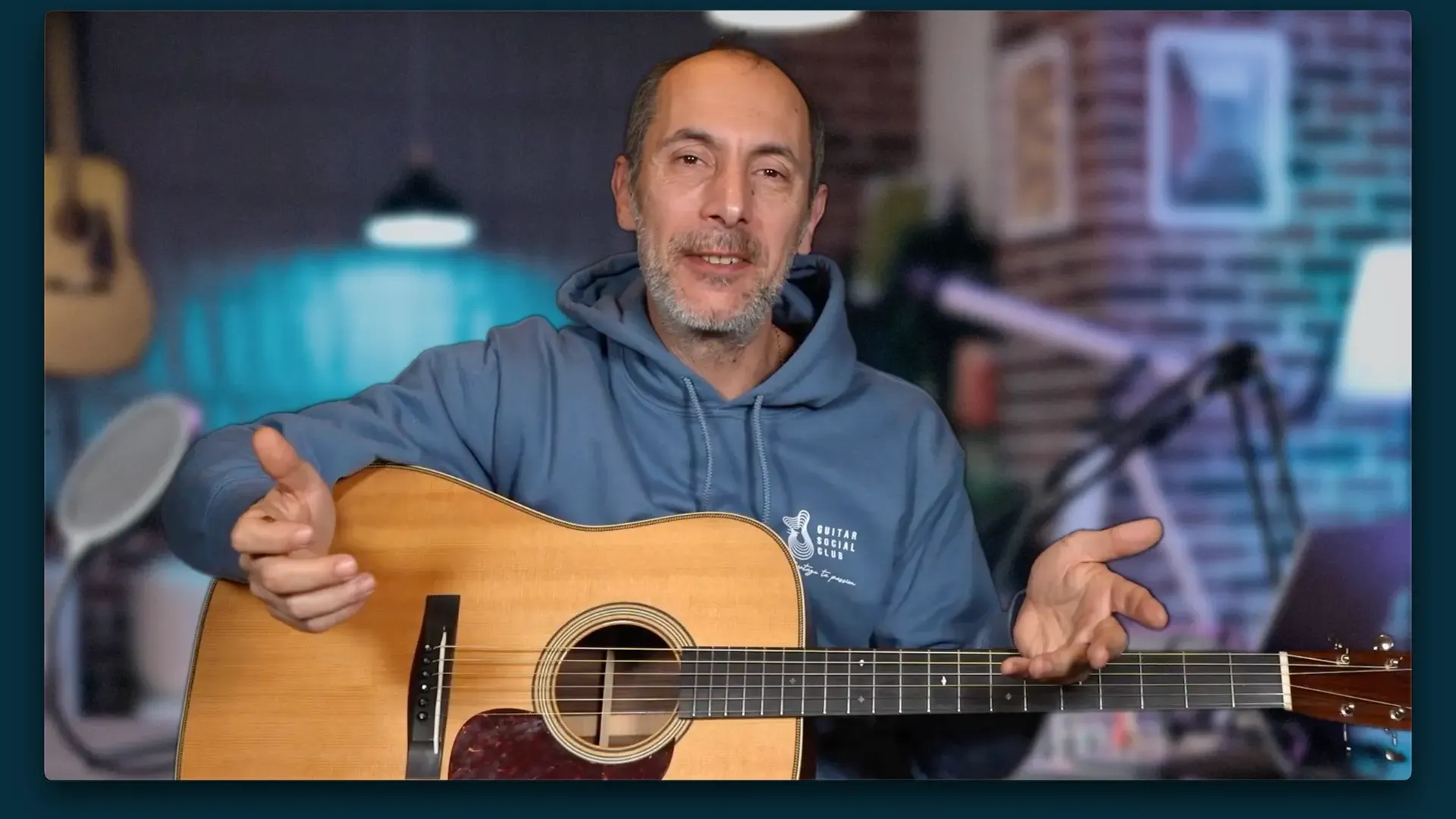
A guitar teacher in Paris, for thirty five years
Yohann Abbou is a guitarist and a guitar teacher in Paris. He started teaching as a teenager, studied musicology, and spent years giving lessons to pay for days that were otherwise entirely taken up by practice. He has also worked as a composer, an arranger, a producer and a sound engineer, on several hundred studio sessions and more than fifty albums.
What matters here is who he teaches. His students are adults: people with jobs, with an hour of practice a week when the week is kind, and with a short list of songs they actually want to play. That one fact shapes everything on this site. An adult learner does not need more material. They need to know what to work on next.
Over those years the same picture came back, whatever the student: not a lack of talent, not a lack of love for music, but a lack of direction. They had collected tutorials, tried three methods, and no longer knew in what order to move, what to work on, or how to tell whether they were getting better.
It is not for the student to fit the method. It is for the method to fit the student.
That sentence came out of one particular experience, teaching an adult student with a mental disability. A path built entirely around what he could do made real progress possible, where a standard course had made none. It is the idea the rest of the work rests on.
The eight levels, L1 to L8
The lessons run on a scale of eight steps, L1 to L8. The point of a scale is honesty. Without one, easy is an adjective, and a beginner ends up with a part that was never going to work yet. With one, easy becomes a level, and a song can be called easy for the player in front of you rather than easy in general.
A level is set by the hardest thing a song actually asks of your hands, not by how many chords it has. That is why a two chord song can land at L5 and a nine chord song at L3. What decides is the right hand first, then the key. Each step names what it adds to the one before it: the eighth note at L2, the first barre chords at L3, the beat divided in three at L4, sixteenth notes at L5, and so on up to clave and rhythms that group three events inside four beats at L8.
The eight levels are listed on the home page, and the easy songs for beginners are the L1 and L2 end of the same scale. If you want the scale applied to time rather than to songs, how long it takes to learn guitar walks through it milestone by milestone.
What is behind the numbers
A site that asks for nothing still has to be worth believing. Here is every figure this site puts forward, and where each one comes from. The research papers are public: the ISMIR 2025 publication and the paper on HAL are both in English.
| What it counts | The figure | Where it comes from |
|---|---|---|
| App Store rating | 4.8 out of 5 | What people who use the Guitar Social Club app left on the App Store, across 14 ratings. The app is in French. |
| Video lessons | More than 4,500 | Technique videos, repertoire videos, theory and the exercises added along the way, counted across the whole catalog. They are in French. |
| Songs in the catalog | 194 | Songs arranged, filmed and placed on the eight level scale. The easy songs page draws its list from this catalog, and leaves out anything nobody has placed yet. |
| Research | With the CNRS | Research on artificial intelligence applied to music teaching, carried out in connection with the CNRS, with published papers. |
| Teaching | 35 years | Teaching guitar, from the first private lessons given as a teenager to the adult students these tools were built for. |
Why the tools are free and need no account
These tools were not built as a product. They were built in the middle of lessons, because a student needed a tuner that showed how far off a string was rather than a green light, or a chord diagram printed the right size, or a metronome that could drop part of its clicks at random, to find out whose pulse was holding the bar together. Once a tool existed, putting it online cost nothing more.
So none of them asks you to create an account first. A tuner that wants your email before it listens to your guitar is not a tuner, it is a sign-up form with a microphone. Everything runs in your browser: the tuner and the chord detector work on sound that never leaves your device, the generators draw their preview as you change a setting, and nothing is uploaded anywhere. There are no ads either.
It is also why the tools show you a reading rather than a verdict. A number you can see tells you which way a string is pulling and by how much. A green light only tells you that someone else decided you were close enough.
What is still in French
The tools are in English. The Club, the guided app and the books are in French, and so is the rest of the writing. If you would want any of them in English, say so on the English home page and you will hear about it when it is ready, not before.