Guitar Social Club
Free online guitar tools, made by a guitar teacher
Everything here runs in your browser. Nothing to install, no account to create, no ads.
These tools were built by a guitar teacher in Paris for his own adult students, then put online as they were.
Tuning
Eight tuners and one guide, all listening through your microphone
They are the same engine, each opened on a different tuning, and they all show you a reading in cents rather than a green light. A number you can see tells you which way a string is pulling, and by how much.
Online guitar tuner
A chromatic tuner that listens through your microphone and shows how far off you are, in cents.
Twelve tuning presets, from standard to DADGAD, plus bass and ukulele. Free, in your browser, no account.
Bass tuner
The same tuner, opened on bass, with presets for four strings (E A D G) and five (B E A D G).
It widens its analysis window for the low strings, where a bass needs more time to be read. Electric or acoustic.
Ukulele tuner
The same tuner, opened on G C E A, the tuning of soprano, concert and tenor ukuleles.
Low G and baritone D G B E sit in the preset menu. Chromatic, so it names any note you give it.
Open D tuner
Opens on Open D, D A D F# A D, where the six open strings already sound a D major chord.
Three strings come down and none goes up. The page covers one finger chords across the neck, and slide basics.
Drop D tuner
Opens on Drop D, D A D G B E. Only the thickest string moves, a whole step from E down to D.
The bottom three strings become a power chord with nothing held down. Double Drop D and Drop C are explained too.
Drop C tuner
Opens on Drop C, C G C F A D, a whole step below Drop D on every string. The low C needs heavier strings, and the page says which.
The tuner widens its analysis for that low C, which a standard window reads late. Drop C sharp is covered through the chromatic reading.
Open G tuner
Opens on Open G, D G D G B D, where the open strings sound a G major chord and one finger across the neck gives the next chord.
Three strings come down, nothing goes up. The page covers one finger chords, slide basics, and whether to keep or drop the sixth string.
Half step down tuner (Eb)
Opens on Eb Ab Db Gb Bb Eb, standard tuning with every string lowered by one semitone.
Your shapes and your tabs all still work, one fret lower. The page says why so many records are played there.
How to tune a guitar
The written guide to standard tuning, E A D G B E: with an online tuner, with a clip-on, or by ear with the 5th fret method.
It also covers what changes between an acoustic and an electric, why a guitar drifts out of tune, and where alternate tunings fit.
Tempo and rhythm
Find the tempo of a record, hold one yourself, then put a pattern on it
Those are three different jobs, so they have three pages. The metronome goes past a plain click: subdivisions between the beats, an accent on any beat of the bar, mute modes that drop a share of the clicks at random, and bar by bar programs that chain tempo, time signature and subdivision on their own, which is how a tempo ramp becomes a few lines of text.
Tap tempo
Tap along with a song, on the button or the space bar, and read its tempo in beats per minute.
It averages your last taps instead of timing a single gap, and converts the BPM into milliseconds for a delay.
Online metronome
A metronome built for practice: subdivisions between the beats, an accent on any beat, and a visual mode that works with the sound off.
Tempo from 20 to 400 BPM, tap tempo built in, and mute modes that take the click away to see whether the pulse is yours.
Guitar strumming patterns
Eight patterns written out in downs and ups on an eighth note grid, from four plain down strokes to swing, easiest first.
One method makes any of them readable: the arm never stops moving, and a pattern is only the strokes you let touch the strings.
Chords
Chords and fretboard
Some of these run in the page and some are written pages you read, but they all come back to the same question: which notes sit under your fingers, and what chord they add up to.
Each card says what its page does, and also what it does not do, because that is usually the faster way to find the right one.
Interactive fretboard
Every note from the nut to the twelfth fret, and tapping a fret plays it. Show the names or hide them, as sharps or as flats.
Change the tuning, light up a chord or a scale across the whole neck, then turn a quiz on and answer on the board.
Guitar chord chart
The 24 shapes that cover most of the pop, rock and folk repertoire, each one drawn with its fingering, its muted strings and its barres.
Every diagram is on the page. Below them sits the generator that laid them out, so you can change the size, the colors or the list and print it.
Chord finder
Give it a shape, as a string code or by clicking the grid, and it draws that chord as a clean diagram. There is no library to browse here.
Barres, finger numbers, colors, a left handed mode, and any window on the neck. Download the result as a PNG or an SVG.
What chord is this?
Give it an audio file, a direct audio link or the sound of a browser tab, and it names the chord that is sounding. There is no microphone mode.
It timestamps every change, so you come away with a chord chart rather than a guess. Nothing is uploaded, and nothing leaves your browser.
Basic guitar chords
The open chords a beginner learns first, E, A, D, G, C, E minor, A minor and D minor, written out string by string and finger by finger.
Each shape comes with the fault it usually produces, the change it leads into, and the place it takes in the order you learn them.
Capo chart
Which chord your shape actually sounds at each capo fret, because once the capo is on, the shape you play and the chord you hear stop sharing a name.
It reads the other way too: pick the key you need, find the fret that gets you there, and see the shapes that come with it.
The F chord
The chord that stops most beginners, in the order to learn it: the three finger shape, the half barre, then the full barre at the first fret.
Why it is hard, four fixes that make the barre ring, and the C to F change written out. The easy xx3210 shape is named for what it is, an Fmaj7.
Barre chords
Two movable shapes, E and A, major and minor, and with them every chord on the neck. A chart gives the fret of each one by note.
Pressure, thumb and angle, the three things that make a barre ring, plus the honest easier versions of B minor while the shape settles.
Power chords
Root and fifth, two or three fingers, one shape that slides anywhere. A chart gives every power chord by note on the sixth and fifth strings.
Palm muting, the right hand, and Drop D, where the whole shape becomes one finger laid flat.
Chord progressions
A generator that builds a progression in any key and plays it back with piano, bass and drums, then exports it as MIDI.
Below it, a chart of the progressions behind most songs in all twelve keys, the minor keys, and the 12 bar blues written out.
Tablature
Write and print
Reading somebody else's tablature, writing your own, and the blank sheets for the times a printed page beats a screen. The two generators redraw their preview as you change a setting, and both end on a printer or in a PDF.
How to read guitar tabs
The six lines and the numbers first, then every symbol after that: hammer-ons, pull-offs, slides, bends, muted notes and palm muting.
Each one comes with a short written example you can play as you read. The page also says what a tab leaves out, starting with the rhythm.
Guitar tab maker
Click a string, type a fret number, and the staff above the tab fills in on its own. A Play button tells you whether what you wrote is what you meant.
Pick a duration, notate the usual techniques, then print the page or export MusicXML, PNG, SVG or JSON.
Blank tab paper
Printable tablature sheets, drawn to the paper you actually want: how many strings, how many systems on a page, portrait or landscape.
The preview redraws as you change a setting, so you see the sheet before you use the paper. Send it to a printer or save it as a PDF.
Blank chord chart
A page of empty chord diagrams, waiting for the shapes you are working on this week.
Set how many fit on a sheet, how big they are and how much room sits under each one, then print it or save a PDF.
Songs
Easy songs to start with
Most lists call a song easy and stop there, which is how a beginner ends up with a part that was never going to work yet. This one gives every song a level instead, L1 or L2 on the scale used in lessons, and says what the arrangement actually asks of your hands.
The list is drawn from our catalog, and a song nobody has placed on the scale is left off rather than given a level it has not earned.
The scale
How the 8 levels work
A level is set by the hardest thing a song actually asks of you, not by how many chords it has. That is why a two chord song can land at L5 and a nine chord song at L3. Each level below names what it adds to the one before it.
L1
Open chords, steady strumming
A complete beginner holds the first open chords and keeps one strumming figure going.
L2
The eighth note arrives
The strumming hand starts moving between the beats, not only on them.
L3
First barre chords
Shapes stop being open and start traveling up the neck under one finger.
L4
The beat divides in three
Shuffles, 6/8, and everything that swings rather than marches.
L5
Sixteenth notes
Four events per beat, where a hand that rushes the last one has nowhere to hide.
L6
Arpeggios, pick and fingers
Strings are picked one at a time, and the pick starts sharing the work with the fingers.
L7
Fingerstyle
Bass, melody and accompaniment carried at once, by the same hand.
L8
Across the beat
Rhythms that sit between the beats rather than on them, and stay there.
How long does it take to learn guitar?
The honest answer, level by level: first chords that ring, a first song end to end, a first barre chord, playing with other people.
Wide ranges rather than a promise, what actually changes them, and a practice routine that fits a working week.
The teacher
Who's behind this
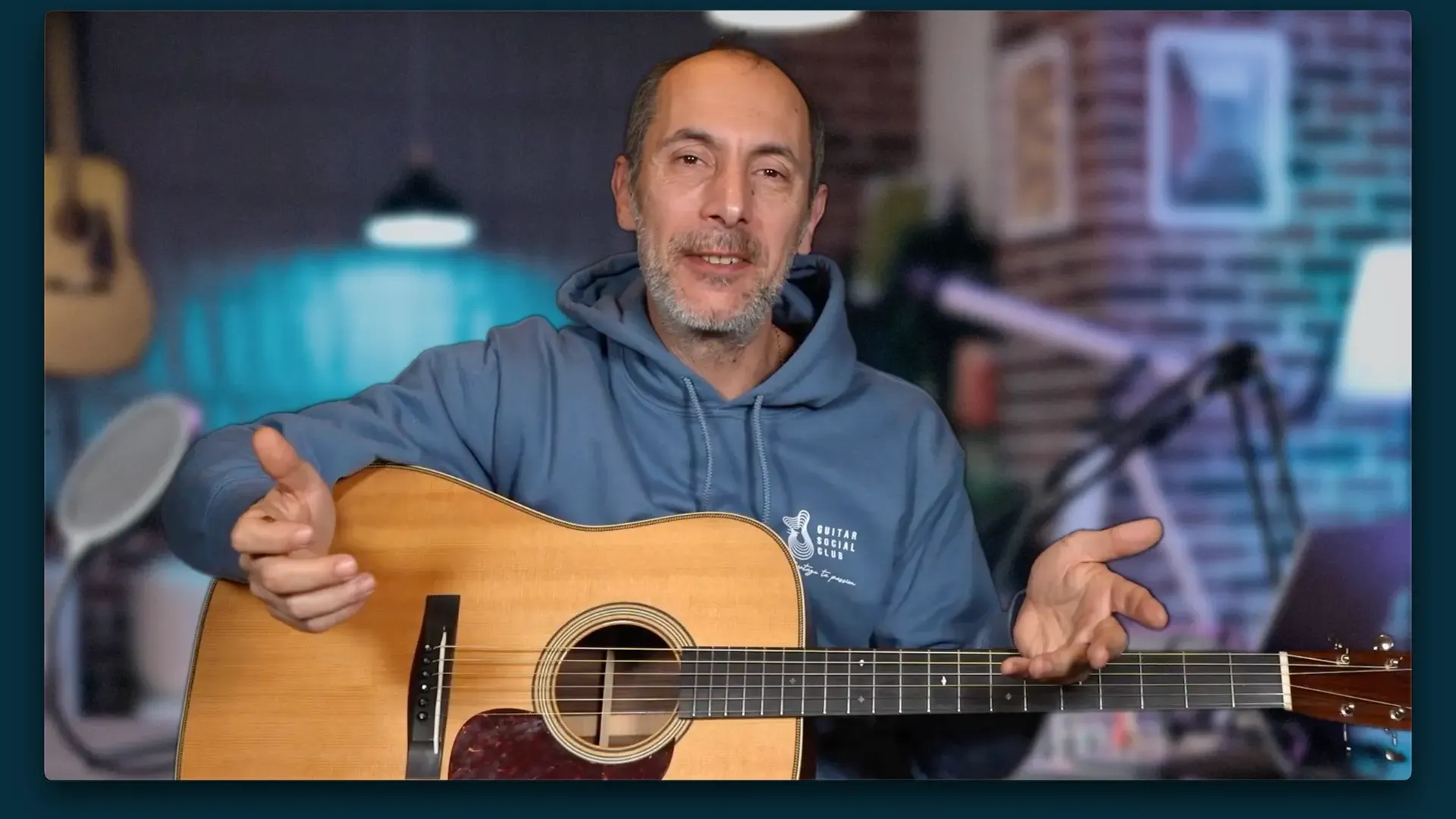
Guitar Social Club is the work of Yohann Abbou, a guitar teacher in Paris.
He teaches adults, and that shapes everything here: people with jobs, an hour of practice a week if the week is kind, and a short list of songs they actually want to play.
His teaching runs on a scale of eight levels, L1 to L8. The point of a scale is honesty. It lets a song be called easy only when it really is easy for the player in front of you, instead of easy in general.
These tools come out of his lessons, which is why none of them asks you to sign up before it works.
It is also why they show you a reading rather than a verdict. A number you can see tells you more about your playing than a green light.
What is still in French
Not in English yet
The Club, the guided app and the songbooks exist in French. Tell us if you would want them in English, and we will write to you when they are ready, not before.
The tools on this page are all in English. What is still in French is everything around them: the Club, the guided app, the books and the blog.
Looking for the French site? Guitar Social Club in French has the Club, the apps, the books and the full blog.