This is a free online guitar tuner, already set to Open A. The strings become E A E A C# E, so the open strings sound an A major chord. Three strings move, and all three go up a whole step. Press Start, tap the button of the string you are tuning, play it, and tighten until the reading sits at 0 cents. Open G, Open D and standard are in the menu above the tuner. No account, no download. It sits alongside the rest of our free guitar tools.
What Open A tuning is
An open tuning is one where the open strings already form a chord. Open A is built on A major and reads E A E A C# E, from the thickest string to the thinnest. Strum all six and you hear a bright, ringing A chord without fretting a note.
It is Open G moved up a whole step. The intervals between the strings are identical, so every chord, riff and slide position you know in Open G works here unchanged and sounds two frets higher.
| String | Standard | Open A | Move | Target, at A 440 |
|---|---|---|---|---|
| Sixth, the thickest | E | E | stays | E2, 82.41 Hz |
| Fifth | A | A | stays | A2, 110.00 Hz |
| Fourth | D | E | up one whole step | E3, 164.81 Hz |
| Third | G | A | up one whole step | A3, 220.00 Hz |
| Second | B | C# | up one whole step | C#4, 277.18 Hz |
| First, the thinnest | E | E | stays | E4, 329.63 Hz |
Reference tones, A4 = 440 Hz
One button per string in Open A, from the low E up to the high E. Play the string on the guitar and bring it to the same pitch.
Each tone is synthesized by your browser at the exact frequency, with A4 at 440 Hz as the reference, so it stands in for a tuning fork. No audio file is downloaded.
Count the notes: three Es, two As and one C#. A is the root, C# the major third, E the fifth. The lowest string is an E, the fifth of the chord rather than its root, so strumming all six gives you A major with E in the bass, written A/E. The root sits on the fifth string. The tuner names the second string C#, never Db: this preset writes sharps.
The reference pitch menu offers A at 432, 440 and 442 Hz, and opens on 440, which is what the frequencies above assume. Change it and all six targets move together.
Open A across the neck: every note on 12 frets
E A E A C# E from the thickest string to the thinnest. The As, C#s and Es are highlighted: they are the three notes of the open A major chord, wherever they fall on the neck.
Open A raises the tension: the honest version
Open G gets to its chord by loosening three strings. Open A gets to the same shape a whole step higher, and the only way there is up: the fourth, third and second strings each rise a whole step. The guitar ends up holding more total pull than it was set up for.
On the same string at the same scale length, tension rises with the square of the pitch. A whole step up means about 26 percent more tension on each of those three strings. A sound guitar takes that in its stride, and many players keep one in Open A, but it is worth knowing before you start.
- The second string is the one to watch. It is thin and it goes up a full step, so bring it up gradually. A string tightened past its target is the one that snaps.
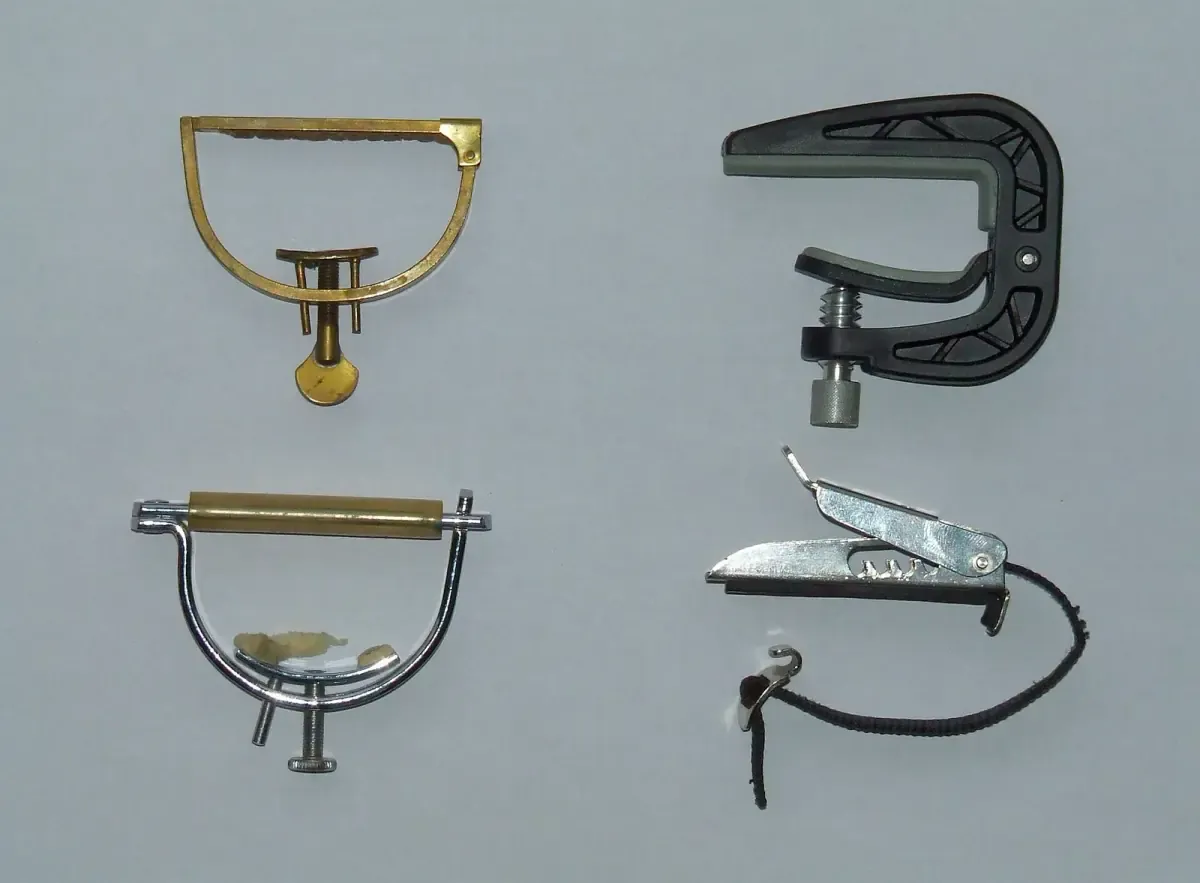
- On an old or lightly built acoustic, or a guitar whose neck or bridge already worries you, take the capo route below.
- Recheck the setup if you stay. More pull bows the neck a little more. If the action creeps up after a few days in Open A, that is why.
How to tune to Open A from standard
Start from an accurate standard tuning. Then raise the three strings that move, one at a time, and let the tuner guide each one up.
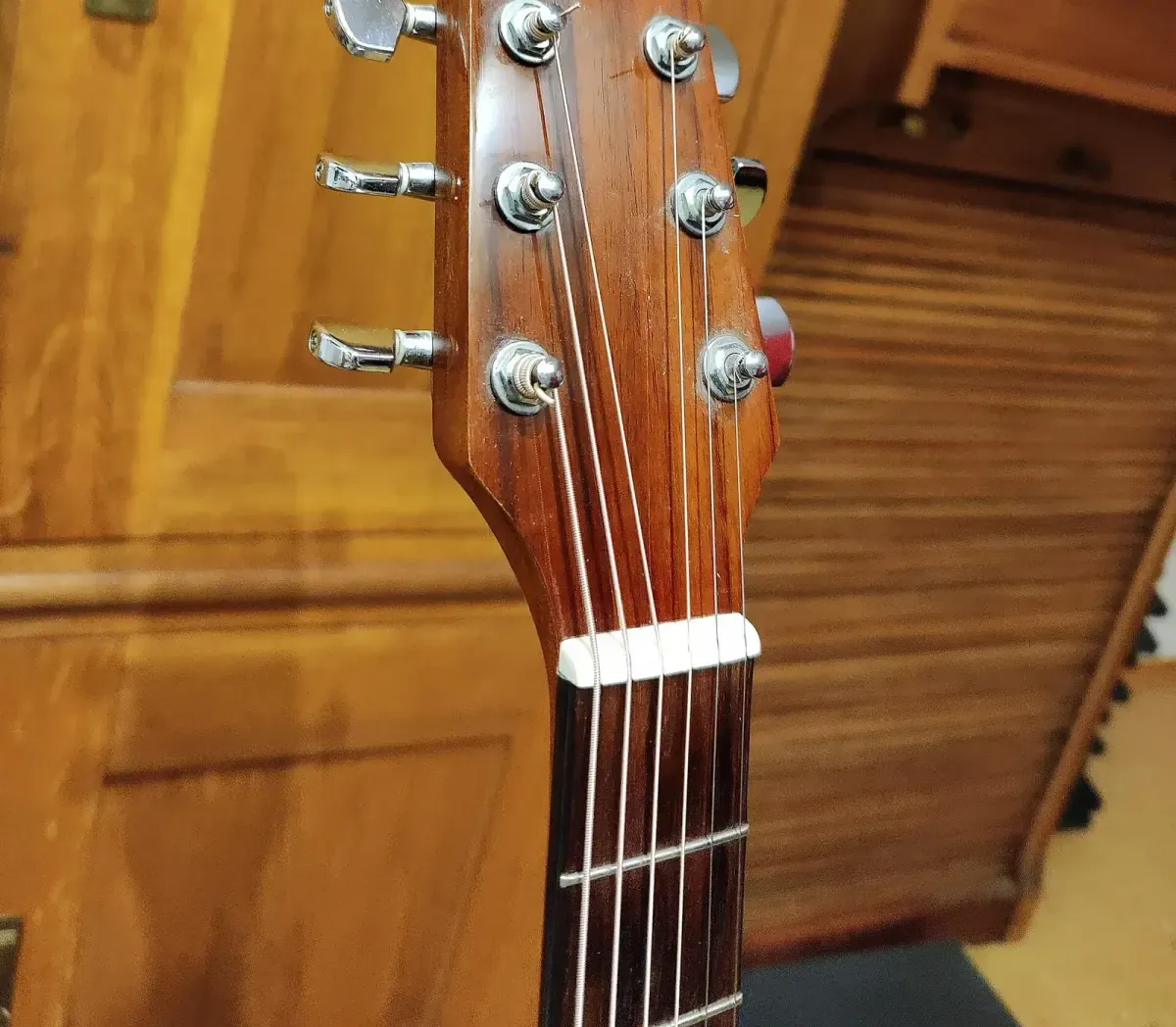
- Press Start and allow the microphone. The tuner is already on Open A.
- Tap the button for the fourth string, E3. You hear its note, and the tuner now aims at that string. This step matters: in automatic mode the tuner only locks onto a string within a little less than a whole step, and every string you are about to raise starts a full step low.
- Play the string and tighten slowly. The message tells you whether to tighten or loosen. Stop at 0 cents.
- Do the same for the third string, A3, and then the second, C#4. Take the second string up in small turns.
- Go round all six strings a second time. Three strings gaining tension pull the neck forward a little, and the others drift while you work.
There is an ear check for each step, the same as in Open G. The gaps between strings are 5, 7, 5, 4 and 3 frets, reading upwards. The fifth fret of the sixth string gives the open fifth, the seventh fret of the fifth gives the open fourth, the fifth fret of the fourth gives the open third, the fourth fret of the third gives the open second, and the third fret of the second gives the open first.
Chords in Open A: one finger across the neck
Lay one finger flat across the five thinnest strings at any fret and you get another major chord, in tune, with the root on the fifth string. The chord moves up one half step per fret. Include the sixth string and the chord stays major, with its fifth in the bass.
- Open strings, nothing held down: A major.
- Barre the second fret: B major.
- Barre the fifth fret: D major.
- Barre the seventh fret: E major.
- Barre the twelfth fret: A major again, an octave up.
A at the open strings, D at the fifth fret and E at the seventh: the three chords of a blues or a rock song in A, all under one finger.
Minor chords need one adjustment. The third of the chord sits on the second string, so to make a barre minor you fret that string one fret below the barre. Barre the fifth fret for D major, put the second string at the fourth fret, and you have D minor. In the open position there is no fret below the open strings, so A minor is the one chord you cannot reach this way.
The same string gives you the suspended fourth. Fret the second string one fret above the barre and the third becomes a fourth: in the open position, the first fret of the second string turns C# into D, and A becomes Asus4. Let it fall back to the barre and the suspension resolves.
These diagrams are drawn for Open A, not for standard tuning. Read the open strings as E A E A C# E: the same shapes in standard would give different chords.
Slide guitar in Open A
A slide is a straight bar, so it only plays what a straight line across the strings gives you. In Open A that line is a major chord at every fret, and the two highest strings, C# and E, carry the melody while the low ones drone underneath.
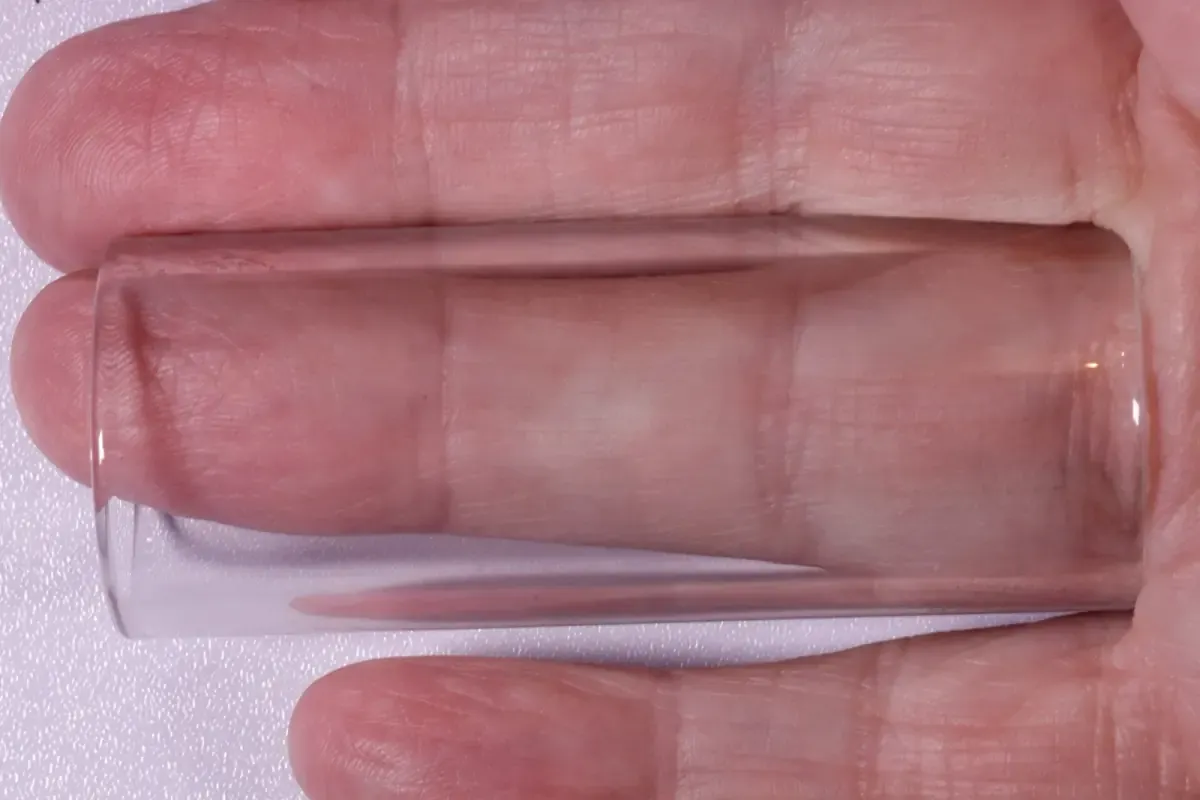
- Sit the slide over the fret, not behind it. Directly above the metal. Behind the fret, the note comes out flat.
- Rest, do not press. Press and you get a rattle against the frets and a note pushed sharp.
- Mute behind the slide. Let the fingers trailing behind it touch the strings lightly, or everything between the slide and the nut rings along.
- Tune carefully first. With a slide there is no finger pressure to nudge a flat string into line. Get each string to 0 cents, then strum the open strings and listen for one that wobbles against the rest.
Open A vs Open G
Same tuning, two pitches. Each string in Open A sits exactly two half steps above its Open G counterpart, which is why a capo at the second fret turns one into the other.
| String | Open G | Open A |
|---|---|---|
| Sixth | D | E |
| Fifth | G | A |
| Fourth | D | E |
| Third | G | A |
| Second | B | C# |
| First | D | E |
How to choose. Take Open A when you want the brighter, tighter version and the full length of the neck, and your guitar is comfortable with the extra tension. Take Open G when you want a looser feel under the hand, or when you switch keys a lot: a capo moves Open G to A, and to other keys, without retuning anything.
Open A has a cousin in the same position: Open E is to Open D what Open A is to Open G, a whole step higher with three strings going up. For every other preset, go to the online guitar tuner.
Frequently asked questions
Which strings do I change for Open A?
Is Open A the same as Open G with a capo?
Is Open A bad for my guitar?
Why does the tuner not recognize my string when I start?
How do I get back to standard tuning?

Who made this
Guitar Social Club is the work of Yohann Abbou, a guitar teacher in Paris. He teaches adults, which shapes everything here: people with jobs, limited practice time and a clear idea of the songs they want to play. The tools come out of his lessons, which is why none of them asks you to sign up before it works, and why this one shows you cents rather than a green light. The rest of our free guitar tools work the same way.
More about Yohann on his page, and about why Guitar Social Club exists.