This is a free online Irish bouzouki tuner that listens through your microphone. It opens on G D A D, the tuning most Irish bouzouki players use. Press Start, play one string of a pair with the other muted, let the note settle, then aim for 0 cents. Then do the same for its twin. If you play in G D A E, A D A D or the Greek C F A D, the same preset reads them: the section below explains why. No account, no download. It sits alongside the rest of our free guitar tools.
Irish bouzouki tuning: G D A D
An Irish bouzouki is a long-necked instrument with eight strings in four pairs, called courses, played with a pick. In G D A D, from the lowest course to the highest, the two strings of each course are usually tuned to the same pitch and played together, so you have eight strings to tune and four target notes. That is why the tuner shows four.
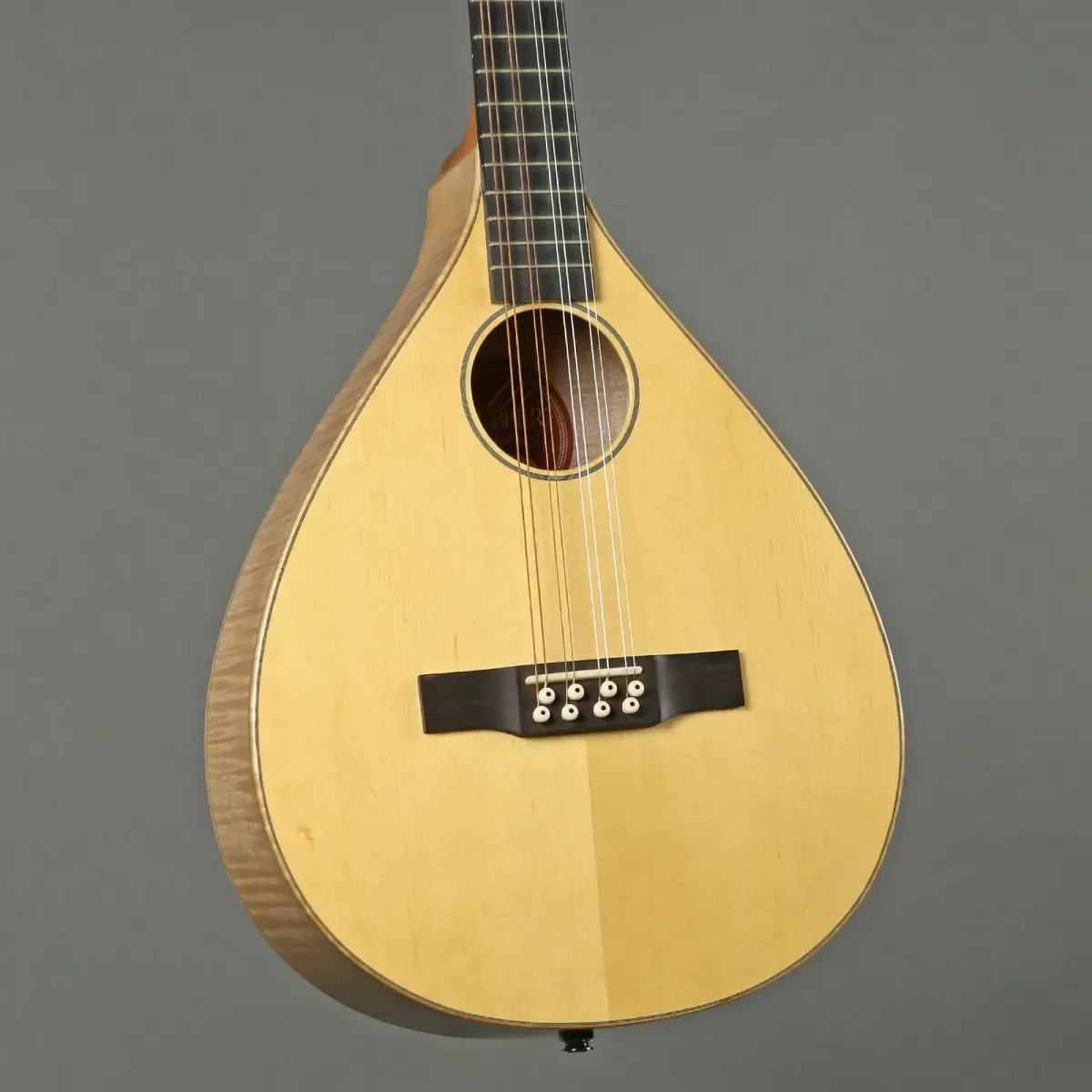
G D A D is neither major nor minor. There is no third in it, only roots and fifths, which is exactly what makes it so useful for accompanying Irish tunes: you can let the open strings ring as a drone under a modal melody without deciding its color for it.
| Course | Note | Target, at A 440 | To remember |
|---|---|---|---|
| Fourth, the lowest | G2 | 98.00 Hz | An octave below the open G string of a guitar |
| Third | D3 | 146.83 Hz | Same pitch as the open D string of a guitar |
| Second | A3 | 220.00 Hz | An octave above the open A string of a guitar |
| First, the highest | D4 | 293.66 Hz | An octave above the third course, which gives the drone |
Reference tones, A4 = 440 Hz
One button per course, from the low G to the high D. Play one string of the pair and bring it to the same pitch, then its twin.
Each tone is synthesized by your browser at the exact frequency, with A4 at 440 Hz as the reference, so it stands in for a tuning fork. No audio file is downloaded.
The reference pitch menu, next to the tuning menu, offers A at 432, 440 and 442 Hz. It opens on 440, which is what the frequencies above assume. Change it only if you are tuning to another instrument or a recording that sits elsewhere.
How to tune an Irish bouzouki, pair by pair
The method is the same for all four courses: one string at a time, with its twin silenced, then the pair together as a check.
- Press Start and allow the microphone. Nothing is recorded or uploaded: the signal is analyzed in your browser and discarded.
- Lay a fingertip lightly on one string of the G course to mute it, and pick the other. It should read G. Two strings sounding at slightly different pitches give the tuner a blurred note, which is why you mute one.
- Wait for the reading to settle, then look at the cents. Flat means too low, so tighten. Sharp means too high, so loosen. Turn the tuner peg in small steps.
- Swap: mute the string you just tuned, pick its twin, and bring it to the same 0 cents.
- Play the pair together. A slow wobble in the sound, a beating, means the two strings are still slightly apart. Nudge one until it disappears.
- Repeat for D, A and the top D. Finish with a second pass over all four courses: eight strings pulling on the neck shift each other a little.
If a string has gone far out of tune, open Settings and tick Open string sound. One button per course appears. Tap one and you hear its reference pitch, and the tuner then measures against that course even when the string is several half steps away.
If your low courses are strung in octaves rather than unison, tune each string to its own octave. An octave string on the G course is G3, at 196.00 Hz, and the tuner simply names it. An octave string on the D course is D4, the same pitch as the top course, and the tuner measures it against that course, which is the right target. Some players do this for a brighter sound. Most keep their courses in unison.
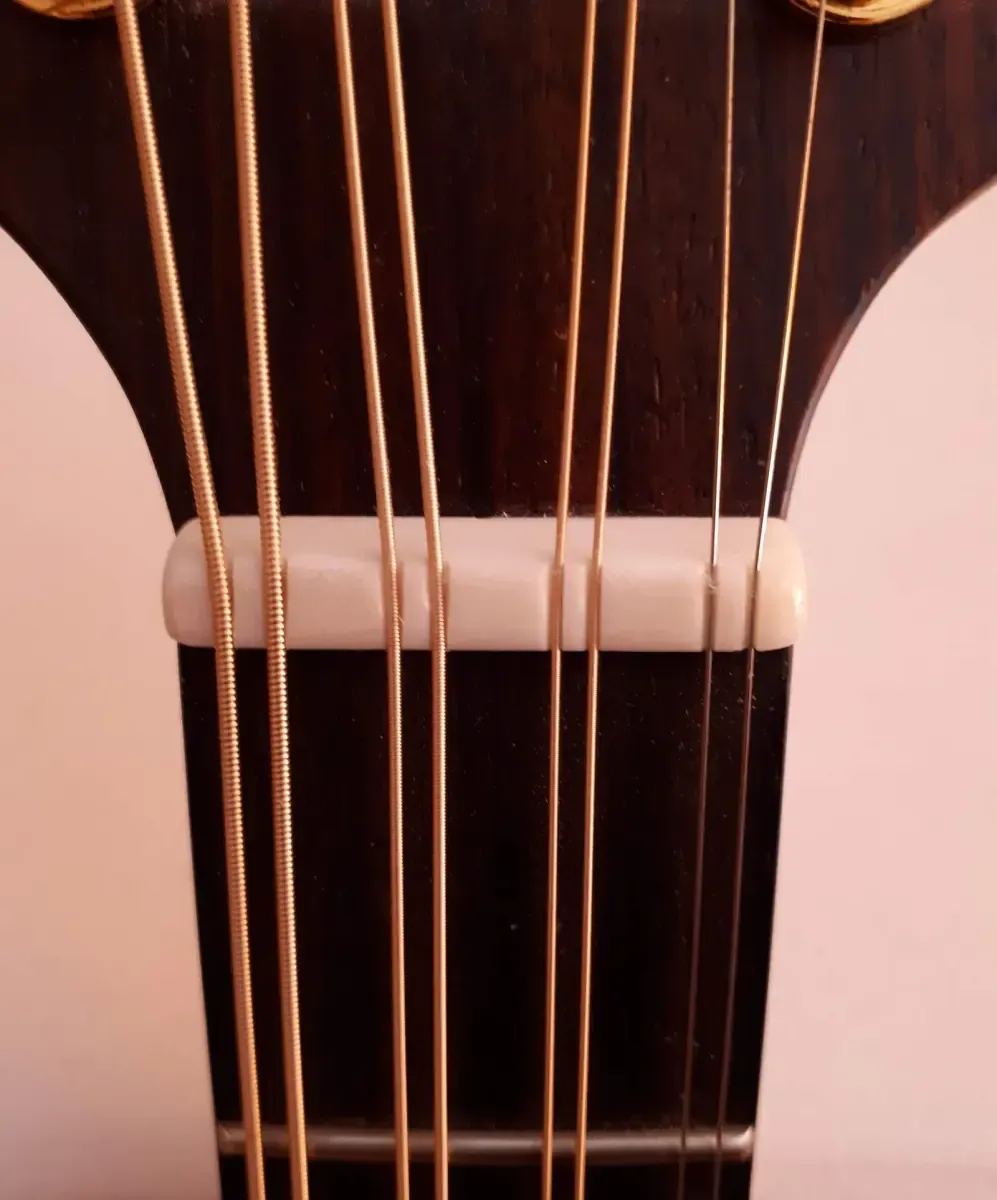
The ear check, for when you have no tuner at hand. The G course at the seventh fret matches the open D. The D course at the seventh fret matches the open A. The A course at the fifth fret matches the open top D, and the two D courses should blend as one octave with no beating.
Irish bouzouki fretboard in G D A D: every note
The four courses over 12 frets. D and A, the root and fifth of the open drone, are highlighted: you can see how much of the neck already sits inside the open tuning.
First Irish bouzouki chords in G D A D
Once the bouzouki is in tune, these shapes are a good starting point for a session. The numbers are frets, G course first, 0 for an open course and x for a course you do not play. Each finger holds down both strings of a course.
| Chord | Frets, G D A D | Notes you get |
|---|---|---|
| G | 0 0 2 0 | G D B D |
| D | x 4 0 0 | F# A D |
| D5, no third | x 0 0 0 | D A D |
| Em | 0 2 2 2 | G E B E |
| Am | 2 2 3 2 | A E C E |
| C | 5 5 3 2 | C G C E |
| Bm | x 4 2 0 | F# B D |
| A5, no third | 2 2 0 x | A E A |
The two chords without a third, D5 and A5, do a lot of work in Irish accompaniment. They say neither major nor minor, so they sit under a modal tune without clashing with it. If a chord sounds wrong while the fingering is right, check the pairs before you blame your left hand: one string slightly off inside a course makes every chord that uses it sound sour.
Work your right hand slowly against the online metronome before you take a reel up to speed. Guitarists who play Irish music in DADGAD will recognize the idea: open strings that ring, and a drone that holds the tune together.
G D A E, A D A D and the Greek C F A D
Only G D A D has its own preset, and it reads the other common bouzouki tunings too, because the reading is chromatic: the tuner names the nearest note to whatever you play and shows how far off it is in cents. One detail is worth knowing about how it decides what you are aiming for.
When a string is less than a whole step from one of the strings of the loaded preset, the tuner assumes you are aiming for that string, measures the cents against it, and names it in its message. Each tuning below has been checked against the Irish bouzouki preset: every note is either one of its strings or at least a whole step from all of them. Once your string is on its note, the reading is measured to that note.
| Tuning | Notes, low to high | Hz, at A 440 | Preset to load |
|---|---|---|---|
| G D A D, Irish | G2 D3 A3 D4 | 98.00, 146.83, 220.00, 293.66 | Irish bouzouki, the preset this page opens on |
| G D A E, melodic | G2 D3 A3 E4 | 98.00, 146.83, 220.00, 329.63 | Irish bouzouki |
| A D A D, open D | A2 D3 A3 D4 | 110.00, 146.83, 220.00, 293.66 | Irish bouzouki |
| C F A D, Greek | C3 F3 A3 D4 | 130.81, 174.61, 220.00, 293.66 | Irish bouzouki |
- G D A E. The melodic option, with the same notes as the Irish tenor banjo and the octave mandolin, and the mandolin's G D A E one octave down. Only the top course changes: the E is a whole step above the preset's D. On the way up from D, the message names D; keep turning and it switches to E just before you get there. Mandolin and fiddle fingerings carry over, on a longer neck that asks for wider stretches.
- A D A D. An open D tuning for players who want even more drone. Only the low course changes, up a whole step from G to A. On the way, the message names G until you are close to A.
- C F A D. The tuning of the four course Greek bouzouki, the tetrachordo, which Manolis Chiotis made the modern Greek standard. A and D are preset strings. C sits a whole step below the preset's D, and F a minor third above it, so both are read as they are. Tune the C up from below: if you overshoot toward D, the message starts naming D, so go back below C and come up again.
Changing tuning changes the tension on each course, and string sets are sold for a given tuning: a top string meant for D is not built for the pull of an E. If you settle on G D A E or C F A D, fit a set made for it.
From Greece to Ireland
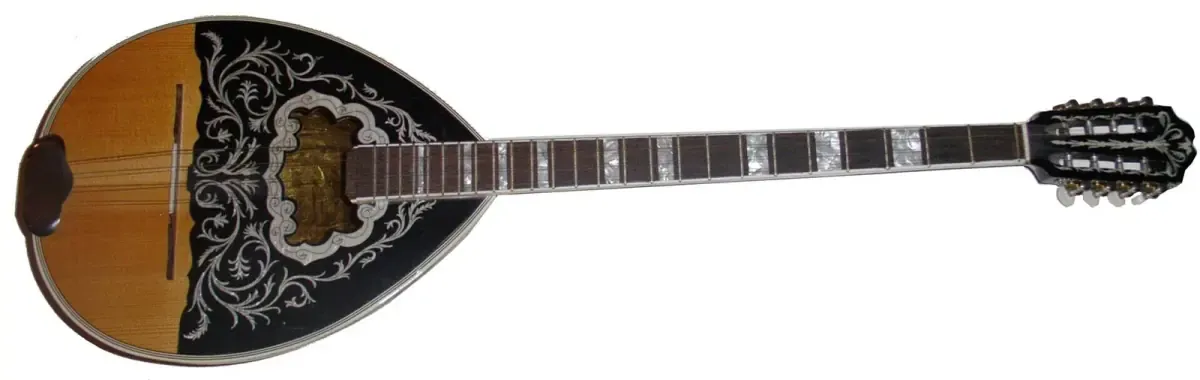
The bouzouki comes from Greece, but the Irish version took its own shape from the 1960s on, in the hands of players such as Johnny Moynihan, Andy Irvine and Dónal Lunny. It moved away from the Greek instrument in body, in tuning and above all in role. Where the Greek bouzouki carries fast melodies, the Irish one mostly accompanies: drones, open chords, a steady pick, and room left for the tune.
If you come from the mandolin or the tenor banjo, G D A E will feel like home. If you come from the guitar, the online guitar tuner opens on standard tuning, and the method is the same on four pairs as on six strings.
Frequently asked questions
What is the standard Irish bouzouki tuning?
GDAD or GDAE: which should I use?
Are the low courses tuned in octaves or unison?
What is the difference between an Irish and a Greek bouzouki?
Can I tune a bouzouki with a guitar tuner?

Who made this
Guitar Social Club is the work of Yohann Abbou, a guitar teacher in Paris. He teaches adults, which shapes everything here: people with jobs, limited practice time and a clear idea of the music they want to play. The tools come out of his lessons, which is why none of them asks you to sign up before it works, and why this one shows you cents rather than a green light. The rest of our free guitar tools work the same way.
More about Yohann on his page, and about why Guitar Social Club exists.