This is a free online oud tuner that listens through your microphone. It opens on Arabic oud tuning, C G A D G C. Press Start, play one string with its twin muted, let the note ring, then aim for 0 cents. The low C is a slow wave, so the tuner listens a little longer before it answers. No account, no download. It sits alongside the rest of our free guitar tools.
Arabic oud tuning: C G A D G C
The most common oud has eleven strings in six courses: five pairs and a single low string. In Arabic tuning they read C G A D G C, from the lowest course to the highest. The two strings of a pair are tuned to the same pitch and played together, so there are eleven strings to tune and only six target notes. That is why the tuner shows six.
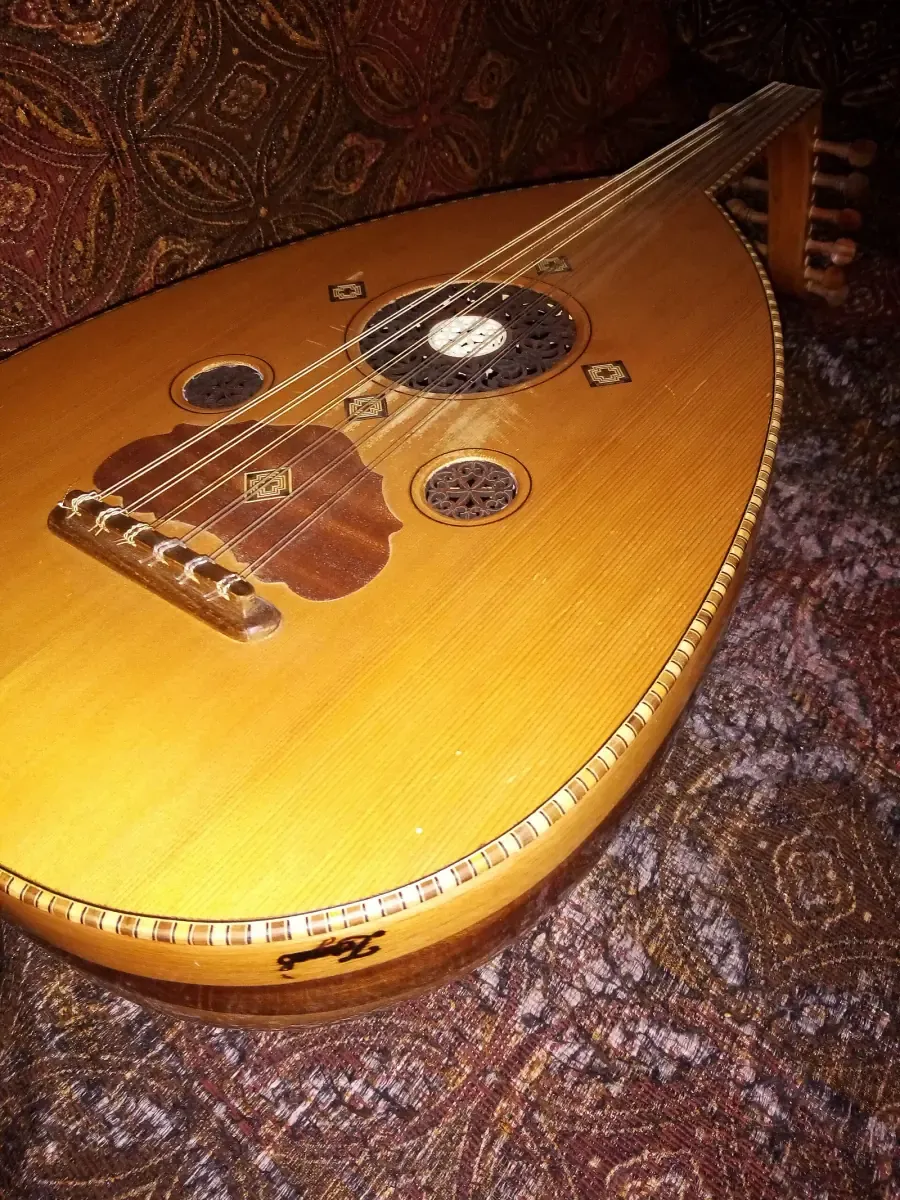
Above the low C, the upper courses climb mostly in fourths, A to D, D to G, G to C, and the two Gs and the two Cs give you octaves to check against each other. If you come from guitar, three of these courses will feel familiar: A, D and the upper G are the exact pitches of the A, D and G strings of a guitar. The low C is the one that is new. It sits below the guitar's low E.
| Course | Note | Target, at A 440 | To remember |
|---|---|---|---|
| Lowest, often a single string | C2 | 65.41 Hz | Lower than anything a guitar in standard tuning plays |
| Second | G2 | 98.00 Hz | A fifth above the low C |
| Third | A2 | 110.00 Hz | Same pitch as the open A string of a guitar |
| Fourth | D3 | 146.83 Hz | Same pitch as the open D string of a guitar |
| Fifth | G3 | 196.00 Hz | Same pitch as the open G string of a guitar, an octave above the second course |
| Sixth, the highest | C4 | 261.63 Hz | Middle C, two octaves above the lowest string |
Reference tones, A4 = 440 Hz
One button per course, from the low C to the high C. Play one string of the course and bring it to the same pitch, then its twin.
Each tone is synthesized by your browser at the exact frequency, with A4 at 440 Hz as the reference, so it stands in for a tuning fork. No audio file is downloaded.
The reference pitch menu, next to the tuning menu, offers A at 432, 440 and 442 Hz. It opens on 440, which is what the frequencies above assume. Change it only if you are tuning to another instrument or a recording that sits elsewhere.
How to tune an oud, course by course
Start with the low string, then work up through the pairs: one string at a time with its twin silenced, then the pair together as a check.

- Press Start and allow the microphone. Nothing is recorded or uploaded: the signal is analyzed in your browser and discarded.
- Play the low C and let it ring. The oud preset gives this note a longer analysis window than standard guitar tuning gets, the same one the Drop C preset uses for its low C, so the reading takes a moment to settle. A single, unhurried pluck works better than repeated picking.
- Look at the cents. Flat means too low, so tighten. Sharp means too high, so loosen. Move the peg in small steps and let the note settle between moves.
- Move to the G pair. Lay a fingertip lightly on one string to mute it, pluck the other, and bring it to 0 cents. Then swap: mute the string you just tuned and bring its twin to the same target.
- Play the pair together. A slow wobble in the sound, a beating, means the two strings are still slightly apart. Nudge one until the sound turns smooth. Your ear catches differences here that the needle barely shows.
- Do the same for A, D, the upper G and the top C. Then play a few minutes and go round all six courses again: the strings settle under tension, new ones especially.
If a string has gone far out of tune, open Settings and tick Open string sound. One button per course appears. Tap one and you hear its reference pitch, and the tuner then measures against that course even when the string is several half steps away.
The ear check, for when you have no tuner at hand. The oud has no frets, so you check with open courses. The two G courses are an octave apart and should blend without beating. So should the two Cs, two octaves apart. Then listen to the fourths, A to D, D to G and G to C: a fourth in tune sounds open and still, one that is off seems to move.
Other oud tunings: Turkish style and G D A E
Only the Arabic tuning has its own preset, and it handles the others too, because the reading is chromatic: the tuner names the nearest note to whatever you play and shows how far off it is in cents. One detail is worth knowing about how it decides what you are aiming for.
When a string is less than a whole step from one of the strings of the loaded preset, the tuner assumes you are aiming for that string, measures the cents against it, and names it in its message. Each tuning below has been checked against the oud preset: every note is either an oud preset string or at least a whole step from all of them. Once your string is on its note, the reading is measured to that note.
| Tuning | Notes, low to high | Hz, at A 440 | Preset to load |
|---|---|---|---|
| Arabic | C2 G2 A2 D3 G3 C4 | 65.41, 98.00, 110.00, 146.83, 196.00, 261.63 | Oud, the preset this page opens on |
| Turkish style, D G D G C F | D2 G2 D3 G3 C4 F4 | 73.42, 98.00, 146.83, 196.00, 261.63, 349.23 | Oud |
| Crossover, G D A E | G2 D3 A3 E4 | 98.00, 146.83, 220.00, 329.63 | Oud, or Irish bouzouki |
- Turkish style, D G D G C F. A variant often used for Turkish music, with a brighter sound. G, D, the upper G and C are oud preset strings. The low D is a whole step above the preset's low C, and the top F is far from everything, so both are read as they are. Tune the low string up to D from C: on the way, the message names C. Keep turning, and it switches to D just before you arrive.
- Crossover, G D A E. Not a traditional oud tuning, but a practical one if you come from the violin, the mandolin or the Irish tenor banjo. G and D are oud preset strings, and A and E sit a whole step or more from the rest. If your oud has more than four courses, set the remaining ones to suit the music, as extra bass or doublings, and tune them by note name. The Irish bouzouki preset reads G D A E cleanly too, with three of the four notes as its own strings.
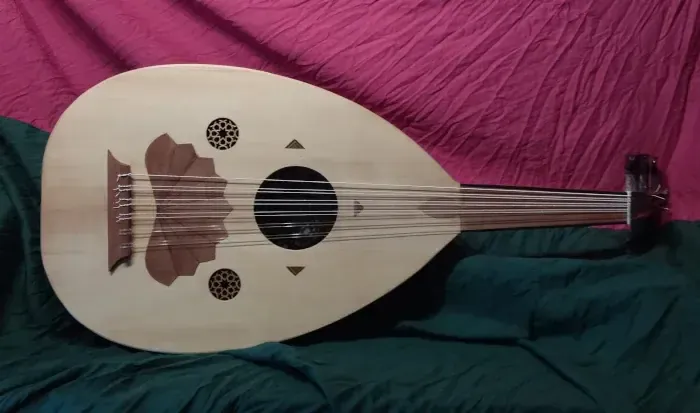
To hear what these tunings are for: in the Arabic tradition, players such as Munir Bashir, Farid al-Atrash and Naseer Shamma; in the Turkish one, Yurdal Tokcan, Necati Çelik and Cinuçen Tanrıkorur.
Why tuning matters more on a fretless instrument
On a guitar, the frets put every note in roughly the right place once the open strings are right. An oud has no frets. The open courses are the only fixed pitches on the instrument, and every other note is placed by ear and by finger, measured against them. If an open course is a little flat, everything you play around it inherits the error, and your ear has no fret to lean on.
That is why oud players check their tuning several times in a session, not just at the start. It is also why the drones matter: the low C and G give the ear a fixed floor, and modal music, built around a central note and its pull, depends on that floor being steady.
To check that the tuning holds while you play, not only while you tune, play a slow phrase against the online metronome for a few minutes, then play each open course again.
Frequently asked questions
What are the notes of an oud in Arabic tuning?
How do I tune an 11 string oud?
Can I tune an oud with a guitar tuner?
What is the Turkish oud tuning?
My oud is in tune but my melodies sound off. Why?

Who made this
Guitar Social Club is the work of Yohann Abbou, a guitar teacher in Paris. He teaches adults, which shapes everything here: people with jobs, limited practice time and a clear idea of the music they want to play. The tools come out of his lessons, which is why none of them asks you to sign up before it works, and why this one shows you cents rather than a green light. The rest of our free guitar tools work the same way.
More about Yohann on his page, and about why Guitar Social Club exists.