This is a free online tuner for your classical guitar. It listens through your microphone and opens on standard tuning, E A D G B E, which is what a nylon string guitar uses too. Press Start, pluck one string, let it ring, and aim for 0 cents. If you play with an ensemble that tunes higher, switch the reference pitch to A 442 Hz. No account, no download. It sits alongside the rest of our free guitar tools.
Classical guitar tuning: notes and frequencies
A classical guitar is tuned E A D G B E, from the sixth string, the thickest, to the first. It is the same standard tuning as a steel string acoustic or an electric guitar, so every chord chart and every method book you already own applies. What nylon changes is everything around the notes: how the strings stretch, how they are fixed to the bridge, and how long they take to hold their pitch.
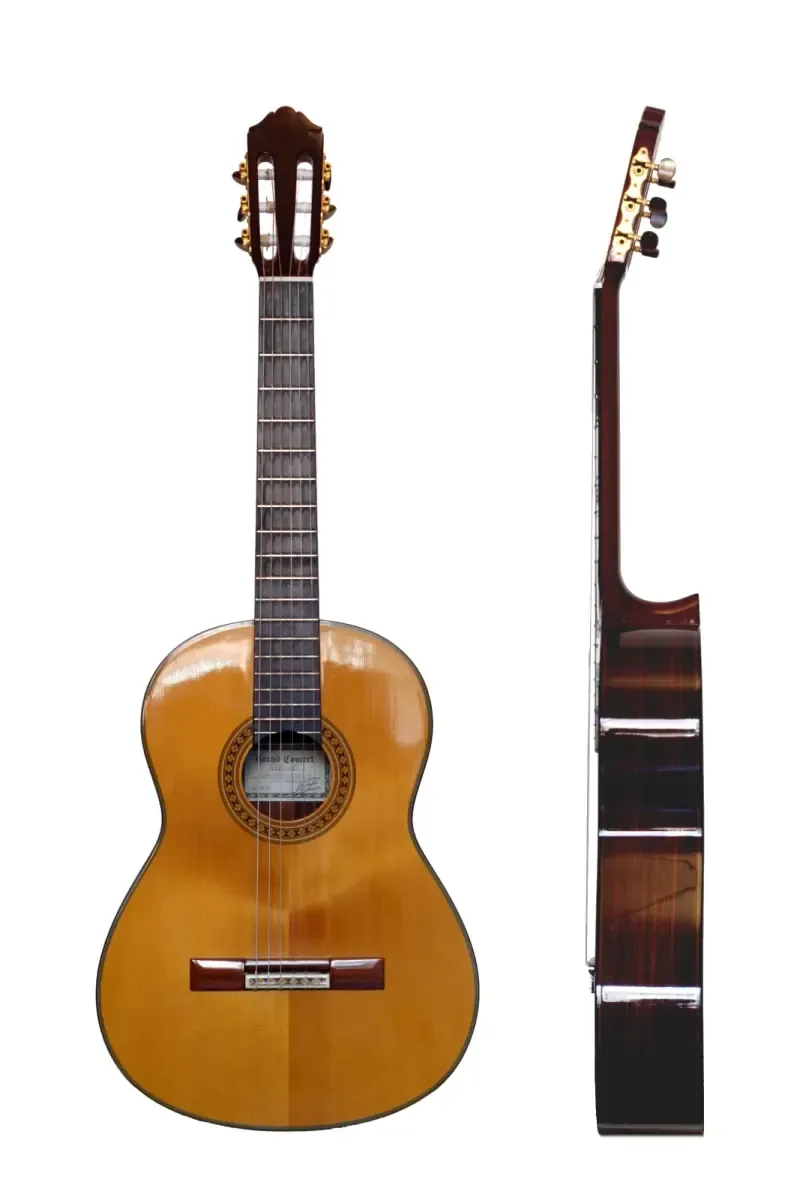
The table gives the target of each open string at the two reference pitches a classical player actually meets. You do not need to memorize any of it, because the tuner recalculates every target the moment you change the reference pitch. It is there so you know what the display is aiming for.
| String | Note | At A 440 Hz | At A 442 Hz |
|---|---|---|---|
| Sixth, the thickest | E2 | 82.41 Hz | 82.78 Hz |
| Fifth | A2 | 110.00 Hz | 110.50 Hz |
| Fourth | D3 | 146.83 Hz | 147.50 Hz |
| Third | G3 | 196.00 Hz | 196.89 Hz |
| Second | B3 | 246.94 Hz | 248.06 Hz |
| First, the thinnest | E4 | 329.63 Hz | 331.13 Hz |
Reference tones, A4 = 440 Hz
One button per string, from the low E to the high E. Pluck the string on the guitar and bring it to the same pitch.
Each tone is synthesized by your browser at the exact frequency, with A4 at 440 Hz as the reference, so it stands in for a tuning fork. No audio file is downloaded.
Reference tones, A4 = 442 Hz
The same six strings, about 8 cents higher, for when your ensemble tunes to 442.
Synthesized by your browser at the exact frequency, with A4 at 442 Hz as the reference.
A 440 or A 442: which reference to choose
The reference pitch is the A the whole tuning is built from. The menu next to the tuning selector offers three: 440, 442 and 432 Hz. It opens on 440, and once you change it, the tuner remembers your choice on this device, which saves resetting it before every rehearsal.
- Playing alone, taking lessons, playing along with recordings: 440 Hz. It is the reference almost everything you hear is tuned to.
- Playing in an orchestra, a guitar ensemble or a chamber group: ask. Many ensembles tune a little higher, often to 442 Hz. Whoever sets the pitch, the conductor, the first violin or the teacher, will tell you.
- Playing with a piano: tune to the piano, whatever it is. A piano cannot follow you. If its A reads 442 on this tuner, set the reference to 442 and tune the whole guitar there.
- 432 Hz: only if the recording or the group you are playing with is tuned there. It is not a more natural pitch, just a lower one. The 432 Hz vs 440 Hz page explains why.
The gap between 440 and 442 is about 8 cents, a twelfth of a semitone. Played alone, nobody hears it. Played against an instrument at the other reference, every note beats, and the guitar sounds slightly sour without anyone being able to say why. That is why it is worth asking before the first rehearsal rather than after it.
How to tune a classical guitar, step by step
A classical guitar is loud enough for any phone or laptop microphone, so the setup is simple. The one thing to adjust is your patience: nylon takes a moment to settle under each turn of the peg.
- Press Start and allow the microphone. Set the reference pitch first, 440 or 442, so you do not tune the whole guitar twice.
- Pluck the sixth string with the flesh of your thumb, over the soundhole, at a normal volume. A very hard attack starts the note sharp, and the tuner shows you that, not the real pitch of the string.
- Let the note ring. The display refreshes about once a second, so a string you damp immediately never gets a steady reading.
- Too low, tighten. Too high, loosen past the pitch and come back up to it. Nylon slips back a little after each turn, and approaching from below leaves the string pulling the right way against the tuning roller.
- Work from the sixth string to the first, then go round a second time. The display treats anything within 5 cents as in tune, and aim for 0 if the guitar will play with other instruments.
- Finish with a chord you know well, E minor or G. If it sounds sour while every string reads 0 on its own, read the section on intonation below.
To hear a target before you tune to it, open Settings under the tuner and tick Open string sound. The six strings appear as buttons, and pressing one plays its pitch for a moment at the reference you selected. It also locks the tuner onto that string, which helps when a fresh string is so far off that it reads as a different note.
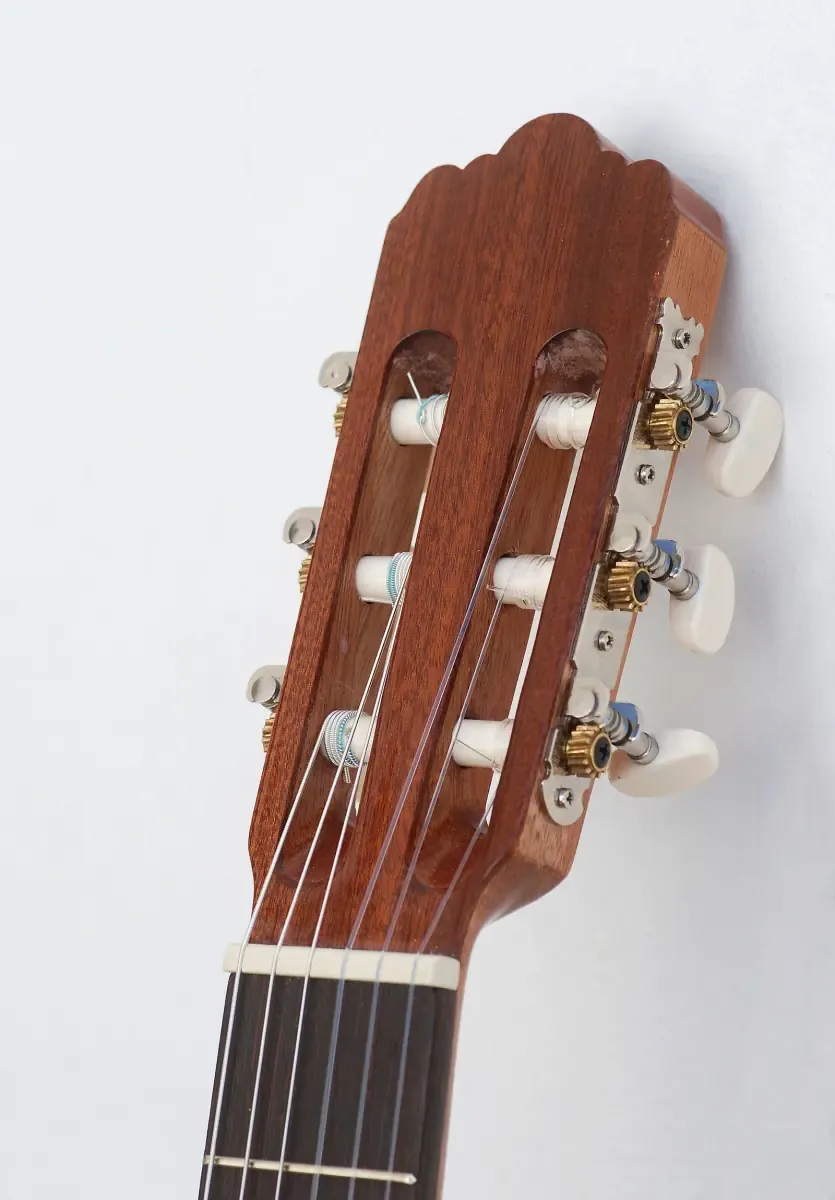
Why nylon strings keep going flat
A classical guitar that drifts flat is rarely a broken guitar. Nylon stretches far more than steel, and most of what looks like a tuning problem is the strings still finding their length.
- New strings stretch for days. A fresh set needs retuning several times in the first session and a little more each time you pick the guitar up for the following days. After tuning a new string to pitch, pull it gently away from the fingerboard along its length, retune, and repeat two or three times. Pull with care, not with your whole arm.
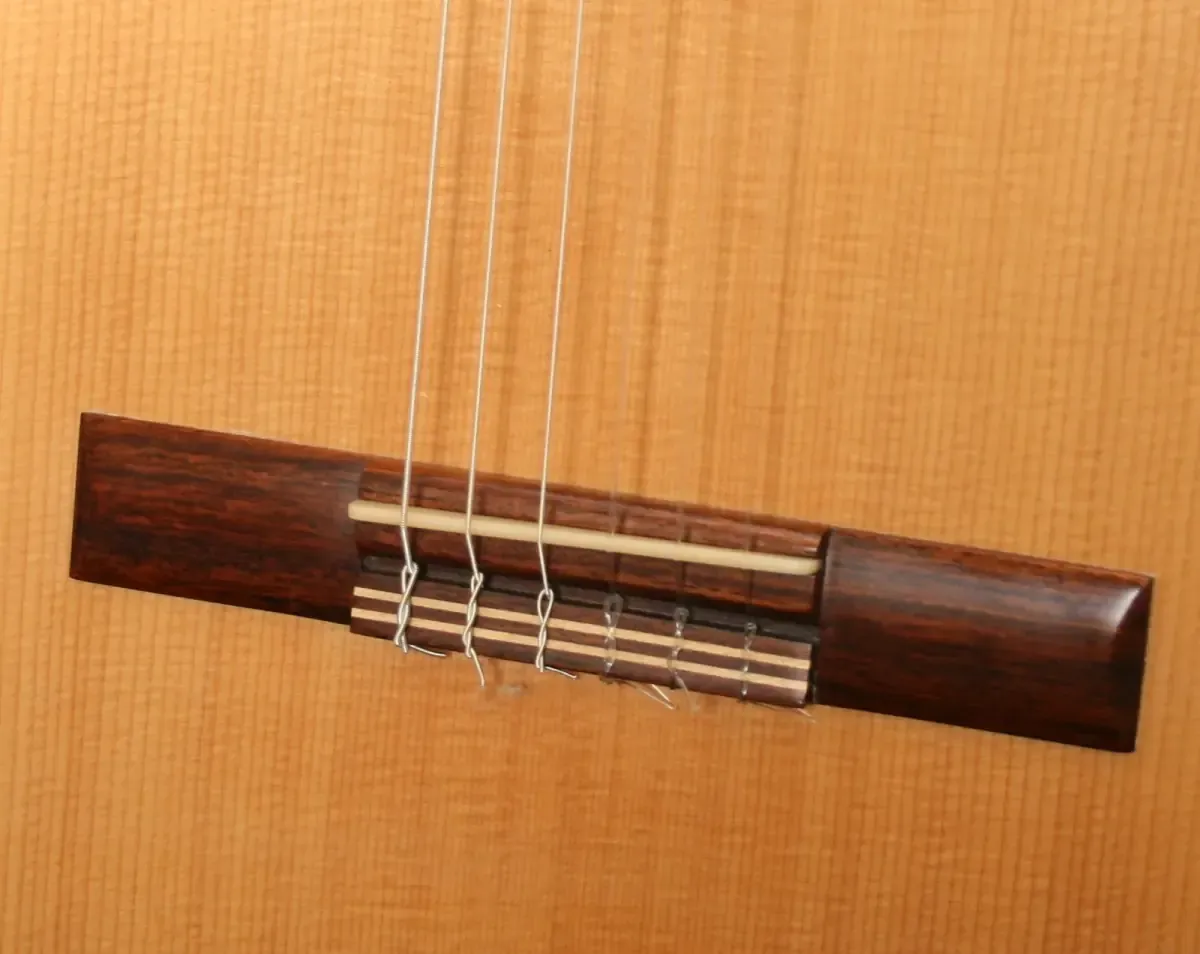
- The tie at the bridge can slip. Classical strings are not held by a ball end in a pin but tied around the tie block. Plain nylon trebles are slippery, so they hold better with an extra wrap or two before the end is tucked. A string that keeps falling flat by the same amount is often a tie still tightening.
- The winding on the roller matters too. On a slotted headstock, wind the string neatly onto the roller, turns side by side, with the first one trapping the free end. Loose turns tighten under tension, and every one of them lowers the pitch.
- Temperature and humidity move everything. A guitar brought in from the cold, or left in the sun, goes out of tune as the wood and the nylon adjust. Let it reach room temperature before you tune.
- A capo pulls the strings sharp. Tune without it, fit it just behind the fret with the least pressure that stops the buzz, then check the tuning again with the capo on.
Check the intonation with the twelfth fret harmonic
Once the open strings are in tune, one more check tells you whether the guitar will play in tune further up the neck. Touch a string lightly directly above the twelfth fret, without pressing, and pluck it: you get a clear, bell-like harmonic an octave above the open string. Then press the same string down at the twelfth fret and pluck it normally.
Both notes should read the same on the tuner, at nearly the same number of cents. The reading is chromatic, so the tuner names whatever you play, the harmonic included: on the sixth string you will see E for both. A fretted note a few cents sharp of its harmonic is common and normal. A fretted note clearly sharp on several strings means the action is high or the nut and saddle need attention.
On a steel string guitar you might fix that at the saddle yourself. On most classical guitars the saddle is a plain strip of bone or plastic sitting in a slot, with no adjustment, so the fix belongs to a luthier. Tuning is your job before every practice. Intonation is a setup job, done once and checked when something changes.
Harmonics also let you tune by ear, string against string, with no tuner at all. The whole method is on how to tune a guitar.
Classical guitar and steel string tuners: the difference
There is none in the notes, and that is the point. Any guitar tuner worth using will tune a classical guitar, as long as it reads the low E cleanly and lets you choose the reference pitch. What differs is the routine around it: more passes while the strings are new, a gentler attack, and the 442 question that steel string players rarely face.
If you also play a steel string or an electric, the general online guitar tuner page covers the alternate tunings, the microphone troubleshooting and the acoustic versus electric setup. For a twelve string, the 12 string guitar tuner deals with the octave pairs. And if you are wondering which note sits where once the guitar is in tune, the guitar string notes page starts from the open strings.
Classical guitar fretboard in E A D G B E: every note
Standard tuning over 12 frets, the same on nylon as on steel. Every E is highlighted, starting with the two outer open strings, which ring E two octaves apart.
Frequently asked questions
What are the notes of a classical guitar?
Should I tune my classical guitar to 440 or 442 Hz?
How long do new nylon strings take to settle?
Can I put steel strings on a classical guitar?
My open strings are in tune but chords higher up sound off. Why?

Who made this
Guitar Social Club is the work of Yohann Abbou, a guitar teacher in Paris. He teaches adults, which shapes everything here: people with jobs, limited practice time and a clear idea of the songs they want to play. The tools come out of his lessons, which is why none of them asks you to sign up before it works, and why this one shows you cents rather than a green light. The rest of our free guitar tools work the same way.
More about Yohann on his page, and about why Guitar Social Club exists.