This is a free online banjo tuner that listens through your microphone. It opens on the 5 string banjo in open G, g D G B D, the tuning most bluegrass and old-time players start from. Press Start, play one open string, let the note settle, then aim for 0 cents. If your banjo has four or six strings, or you play in double C, the sections below tell you which preset to pick. No account, no download. It sits alongside the rest of our free guitar tools.
Open G banjo tuning: g D G B D
A 5 string banjo in open G reads g D G B D, starting from the fifth string. That fifth string is the odd one: it is shorter than the others, starts at the fifth fret, has its own tuning peg on the side of the neck, and it is the highest note on the instrument. That is why it is written with a small g. You rarely fret it. It rings as a drone on top of whatever you play on the four long strings.
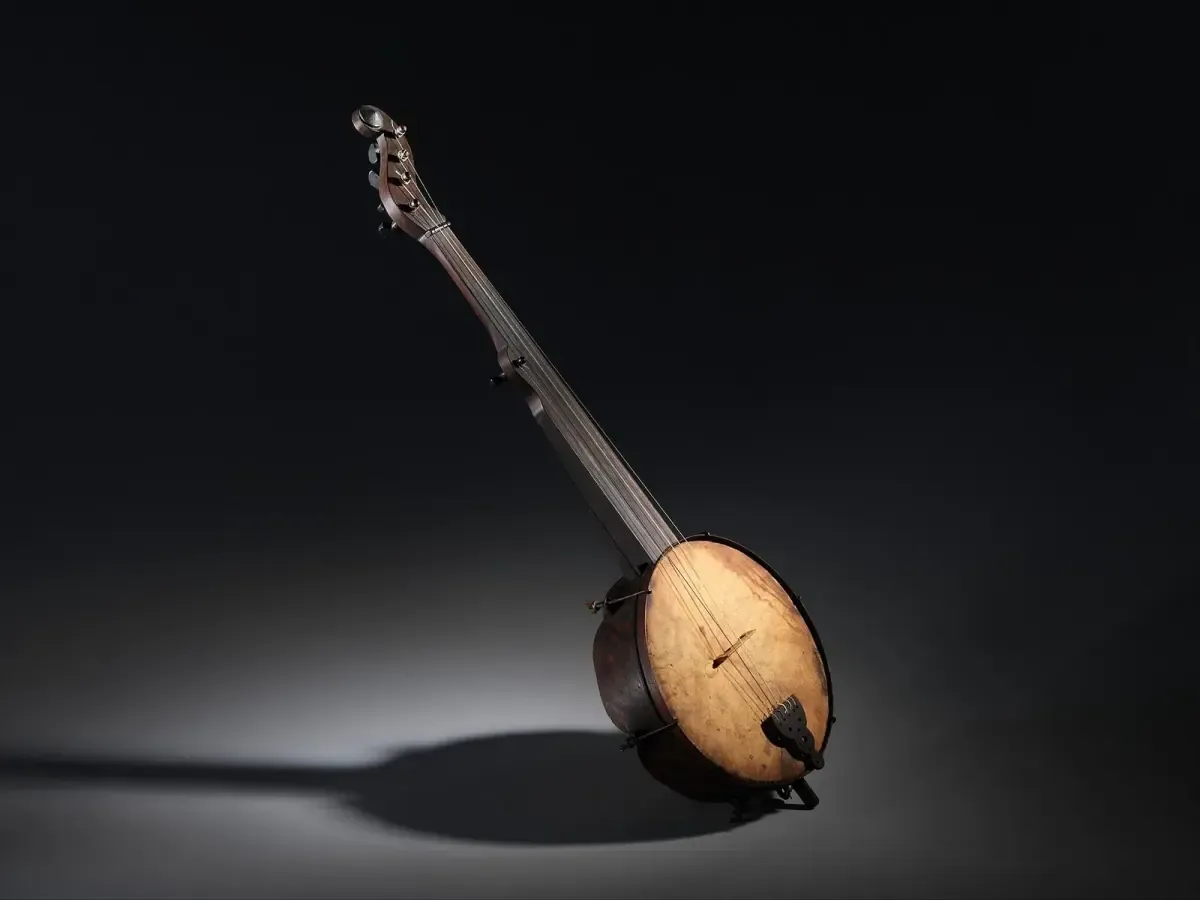
Strum the five open strings and you hear a G major chord. That is the whole point of the tuning: the right hand can roll through open strings and always land on notes of the key, and the left hand only has to change what is needed. If you already play guitar, the four long strings will feel familiar. They are the same pitches as the top four strings of a guitar in open G, and they differ from standard guitar tuning by one string only: the first string is a D where the guitar has an E.
| String | Note | Target, at A 440 | What it does |
|---|---|---|---|
| Fifth, the short one | G4 | 392.00 Hz | The high drone, tuned from the peg on the side of the neck |
| Fourth | D3 | 146.83 Hz | The lowest note on the banjo |
| Third | G3 | 196.00 Hz | The root of the open G chord |
| Second | B3 | 246.94 Hz | The major third, which makes the chord major |
| First | D4 | 293.66 Hz | The fifth, an octave above the fourth string |
Reference tones, A4 = 440 Hz
One button per string, short fifth string first, in the order the tuner lists them. Play the string on the banjo and bring it to the same pitch.
Each tone is synthesized by your browser at the exact frequency, with A4 at 440 Hz as the reference, so it stands in for a tuning fork. No audio file is downloaded.
The reference pitch menu, next to the tuning menu, offers A at 432, 440 and 442 Hz. It opens on 440, which is what the frequencies above assume. Change it only if you are tuning to another instrument or a recording that sits elsewhere.
How to tune a banjo, string by string
Tune the four long strings first, then the short fifth string. The order matters on a banjo more than on a guitar, because the bridge is not glued down and the head under it gives a little: every string you bring up changes the pressure on the others.
- Press Start and allow the microphone. Nothing is recorded or uploaded: the signal is analyzed in your browser and discarded.
- Play the fourth string, D. Rest your other fingers lightly across the strings you are not tuning: a banjo rings a long time, and the drone of the fifth string is exactly what you do not want reaching the microphone here.
- Wait for the reading to settle, then look at the cents. Flat means too low, so tighten. Sharp means too high, so loosen. Pick with your normal attack: a hard pluck pushes the note sharp for a moment.
- Do the same for the third string, G, the second, B, and the first, D.
- Now the fifth string, the high g, with the peg on the side of the neck. Small turns: it is a thin string and the pitch moves fast.
- Go round all five a second time. The first pass is never the last word on an instrument with a floating bridge.
If you would rather pick the string yourself than let the tuner guess, open Settings and tick Open string sound. One button per string appears. Tap one and you hear its reference pitch, and the tuner then measures against that string, even when it is several half steps away, which helps with a string that has gone badly slack.
The ear check, for when you have no tuner at hand. Fret the fourth string at the fifth fret and it matches the open third. The third string at the fourth fret matches the open second. The second string at the third fret matches the open first. And the first string at the fifth fret gives a G, the same pitch as the open fifth string.
First chords in open G
Once the banjo is in tune, these shapes cover a good part of the bluegrass and old-time repertoire in G. The numbers are the frets on the four long strings, fourth string first, 0 for an open string. The fifth string stays open and keeps its high g ringing over every chord.
| Chord | Frets, 4th to 1st | Notes you get |
|---|---|---|
| G | 0 0 0 0 | D G B D |
| C | 2 0 1 2 | E G C E |
| D | 0 2 3 4 | D A D F# |
| D7 | 0 2 1 0 | D A C D |
| Em | 2 0 0 2 | E G B E |
| Am | 2 2 1 2 | E A C E |
G, C and D are enough for a first song. If a chord sounds wrong while the fingering is right, check the tuning before you blame your left hand: on a banjo, a single string slightly off shows up in every chord.
Tenor, plectrum, double C and 6 string banjos
Only the 5 string open G has its own preset. The other banjos are tuned just as accurately, because the reading is chromatic: the tuner names the nearest note to whatever you play and shows how far off it is in cents. What changes is which preset you load, and that choice matters for one reason.
When a string is less than a whole step from one of the strings of the loaded preset, the tuner assumes you are aiming for that string, measures the cents against it, and names it in its message. That is what you want on the right instrument, and it gets in the way on another one. So each tuning below comes with the preset whose strings either match its notes or sit at least a whole step away from them. Once your string is on its note, the reading is measured to that note.
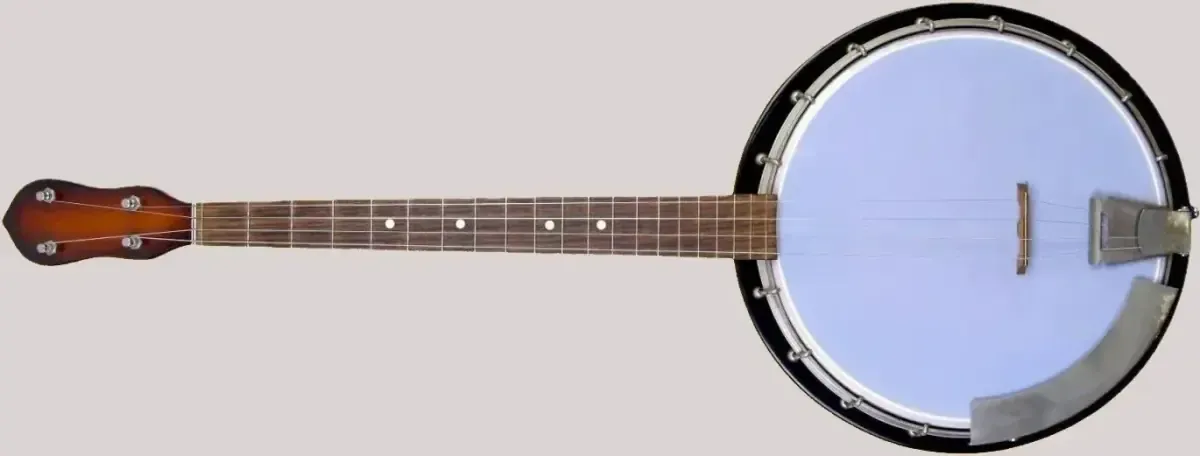
| Banjo | Notes, low to high | Hz, at A 440 | Preset to load |
|---|---|---|---|
| 4 string tenor, jazz and folk | C3 G3 D4 A4 | 130.81, 196.00, 293.66, 440.00 | Mandolin G D A E |
| 4 string tenor, Irish | G2 D3 A3 E4 | 98.00, 146.83, 220.00, 329.63 | Mandolin G D A E |
| 4 string plectrum | C3 G3 B3 D4 | 130.81, 196.00, 246.94, 293.66 | 5 string banjo, open G |
| 5 string, double C | G4, then C3 G3 C4 D4 | 392.00, then 130.81, 196.00, 261.63, 293.66 | Open C, in the Guitar group |
| 6 string banjo | E2 A2 D3 G3 B3 E4 | 82.41, 110.00, 146.83, 196.00, 246.94, 329.63 | Standard E A D G B E |
- Tenor, C G D A. Three of its four notes, G, D and A, are mandolin strings, so the mandolin preset reads them as such. The low C sits far from all of them and is simply named.
- Irish tenor, G D A E. These are the mandolin's four notes an octave lower, which is why the same preset works: no string is close enough to be mistaken for another, and the tuner names what you play.
- Plectrum, C G B D. Three strings are shared with open G. Load the 5 string banjo preset and bring the fourth string up to C from below. If you overshoot toward D, the message starts naming D: go back below C and come up again.
- Double C, g C G C D. A common tuning for old-time clawhammer playing: from open G, the fourth string drops to C and the second rises to C. Do not do it with the banjo preset loaded, because the second string's C sits only a half step from the preset's B and would be measured against it. Load Open C from the Guitar group instead: it contains the C, the G and the higher C, and leaves the g and the D on top to plain chromatic reading. The open C tuner page opens straight on it.
- 6 string banjo. It is tuned exactly like a guitar, E A D G B E, so use the guitar Standard preset, or go to the online guitar tuner, which opens on it.
Why a banjo drifts out of tune
A banjo is a drum with a neck, and that explains most of it. The strings press a loose bridge onto a stretched head, so anything that moves the head or the bridge moves the pitch.
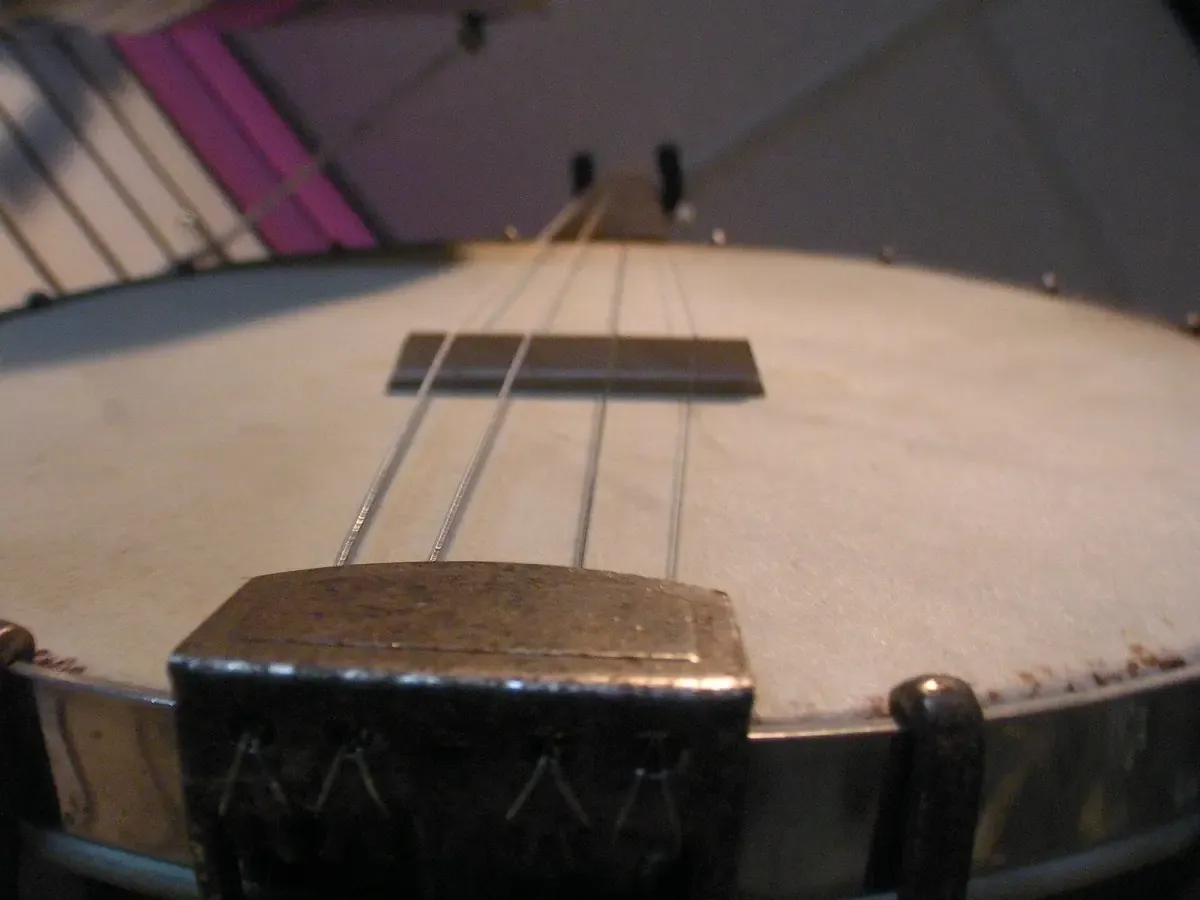
- The bridge has shifted. It is held in place by string pressure alone. If the open strings are in tune but chords up the neck sound sour, compare the twelfth fret harmonic with the fretted note on the first and fourth strings. If they disagree, the bridge has moved.
- New strings are still stretching. Tune, play for a few minutes, tune again. Pulling each string gently away from the fingerboard and retuning a few times speeds it up.
- Temperature and humidity. The head reacts to the room. A banjo brought in from the cold will drift for a while. Let it come to room temperature before you tune it for real.
- A capo. Banjo players use one a lot, and it pulls the strings slightly sharp. Check the tuning with the capo on. If you capo the four long strings, the fifth string needs to go up by the same amount, either by retuning it or with a fifth string capo.
To check that the tuning holds while you play, not just while you tune, pick a roll against the online metronome for a couple of minutes, then play each open string again.
Frequently asked questions
What are the notes of a 5 string banjo in open G?
Can I use a guitar tuner on a banjo?
How do I tune a tenor banjo?
Is banjo open G the same as guitar open G?
Why does my banjo keep going out of tune?

Who made this
Guitar Social Club is the work of Yohann Abbou, a guitar teacher in Paris. He teaches adults, which shapes everything here: people with jobs, limited practice time and a clear idea of the songs they want to play. The tools come out of his lessons, which is why none of them asks you to sign up before it works, and why this one shows you cents rather than a green light. The rest of our free guitar tools work the same way.
More about Yohann on his page, and about why Guitar Social Club exists.