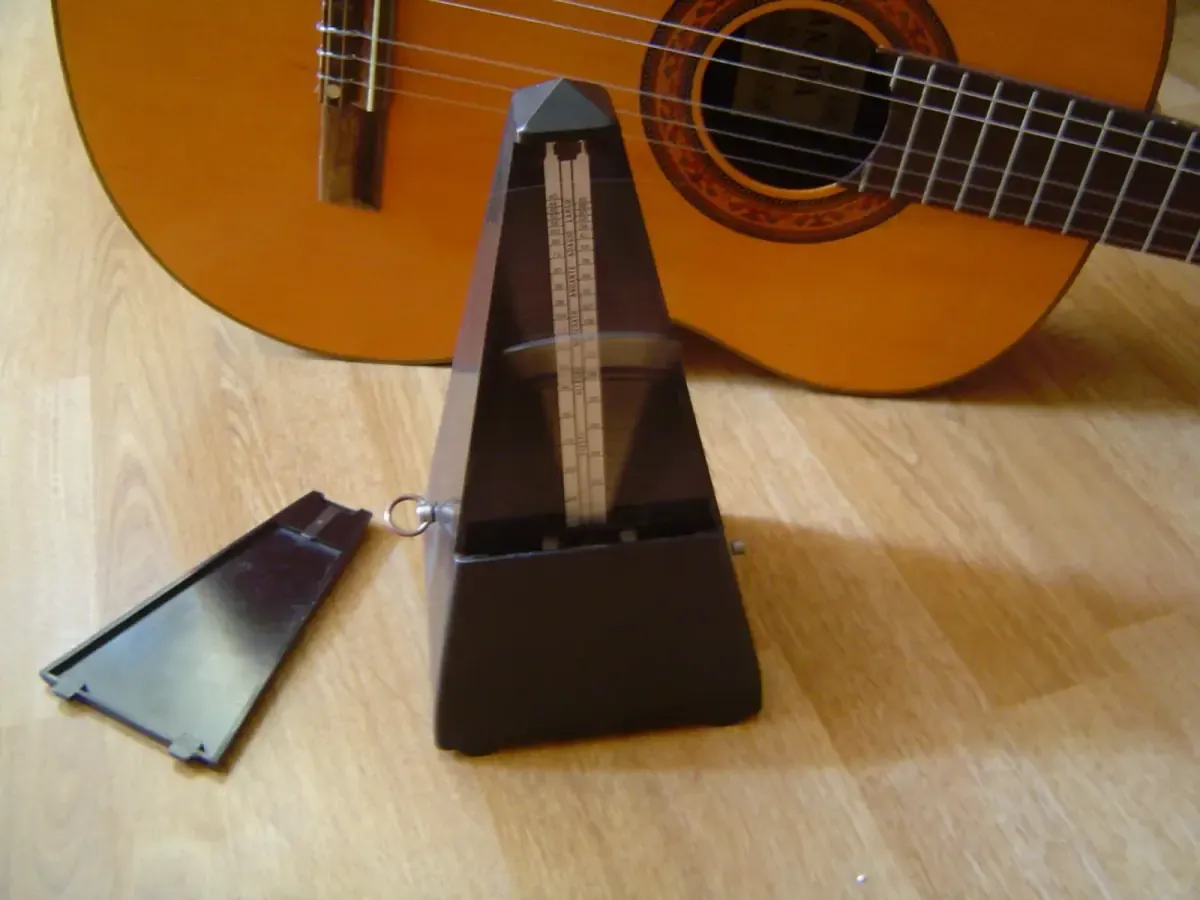
Practicing with a metronome comes down to a short method. Start at a tempo slow enough to play cleanly, often around 60 BPM. Move the click to beats 2 and 4 once the part holds. Raise the tempo a few BPM at a time, never ten. Take some of the clicks away to find out whether the timing is yours. And record yourself, because what you hear while playing is not what comes out. The metronome below is already set to 60 BPM in 4/4, so you can start with step one right now.
The metronome is a mirror, not a judge
A lot of people avoid the metronome because it makes them feel bad. Every time they drift, the click seems to say they got it wrong. That is the wrong way to read it. The click does not grade you, it gives you information: you came in early, you slowed down at the chord change, you held it for two bars and then rushed. Each of those is something you can fix, and none of them is visible without a fixed reference.
So the goal of the method below is not to play perfectly with the click. It is to find out what your timing actually does, one piece at a time, and improve the weakest piece first.
The method, step by step
1. Find your clean tempo
Pick one short passage: two chords, a strumming pattern, a riff, a single hard bar. Press Play at 60 BPM and play it. Your clean tempo is the speed at which you can play it three times in a row with no tension, a clear sound, and every stroke landing with the click. Once by luck does not count. If the third pass is worse than the first, lower the tempo.
There is no universal starting number. Many beginners settle somewhere around 50 to 70 BPM for quarter and eighth note strumming, and lower for sixteenth notes. Some hard chord changes need 45 at first. Lowering the tempo is not a step backward. It is a measurement.
2. Lock in at that tempo, one layer at a time
Do not try to fix the chords, the strum and the timing in the same pass. Build it up:
- Tap your foot on the click and count out loud, 1, 2, 3, 4, then 1 and 2 and 3 and 4 and. If the foot wobbles here, the problem is not the guitar.
- Mute the strings with your fretting hand and strum eighth notes, down and up. Listen for evenness: are the up strokes early, are the down strokes louder, does the arm stop?
- Play one chord with the same eighth notes. Then add the chord change, and make sure it lands on beat one rather than just after it.
3. Put the click on 2 and 4
In most rock, pop, blues, soul and funk, the snare drum lands on beats 2 and 4. That is the backbeat, and it is where a band's groove sits. Practicing with the click there trains you to feel it, and it leaves beats 1 and 3 for you to place on your own. There are two ways to do it with the metronome on this page.
With the accents
Under the beat dots there is one accent switch per beat, and beat 1 is checked when you arrive. Uncheck 1, check 2 and 4. Those two beats now play louder, with an extra layer on top of the click. Beats 1 and 3 still sound, more quietly, so this is the gentle version: you hear the backbeat stand out without losing the other beats.
With half the tempo
For a click on 2 and 4 only, set the metronome to half your tempo and the signature to 2/4, then uncheck the accent on beat 1 so both clicks sound the same. To practice at 80 BPM, set 40. Now hear each click as beat 2 or beat 4, and count 1 and 3 in the silence between them.
The half tempo version feels strange for the first minute. Count out loud, starting on the click with "two", and it settles.
4. Climb in small steps
Once the passage holds at your clean tempo, raise it by four to six BPM and check the same three things again: relaxed, clean, on time. 60, 66, 72, 78, 84 is a sensible ladder. A jump from 60 to 90 skips the zone where your hands actually adapt.
You can set each step by hand with the plus and minus buttons, or let the metronome climb for you. Choose Program in the play mode menu, paste these lines, and press Apply:
bars:8 tempo:60
bars:8 tempo:64
bars:8 tempo:68
bars:8 tempo:72
bars:8 tempo:76
Each line is one block: eight bars at 60, eight at 64, and so on. The metronome counts the bars and moves to the next block on its own, then stays on the last one. Change the numbers to suit your passage. For a shorter warm up that keeps rising without a plan, the Steps play mode raises the tempo by a step you choose every few seconds, up or down, until you press Stop.
5. Take some clicks away
Playing with the click and keeping time are two different skills. To test the second one, choose Random mute in the play mode menu and set a percentage. That share of the clicks drops out at random, and the clicks that remain land exactly where they always would. When one comes back and you are ahead of it or behind it, you have found the drift.
Start low, around 20 or 25 percent, where you barely notice the gaps. Go toward half once you stop drifting. The Visual mode button is another version of the same test: it turns the sound off and leaves the beat dots flashing, so your ear has nothing to ride on.
6. Record yourself
While you play, part of your attention is on your hands, and you hear a steadier version of yourself than the real one. A recording does not have that problem. Put your phone near the guitar, keep the click audible, and record one take of the passage. Listen back once for the click, once for the guitar. The usual findings are rushing into a chord change, a late chord after it, and up strokes that arrive early.
When to move up, and when to go back
Move up when three things stay stable at the current tempo: the hands stay relaxed, every stroke lands where it should, and the sound is still musical. If any one of the three disappears, stay where you are.
Two signs tell you a step was too big. The first is tension, anywhere from the forearm to the jaw. The second is subtler: your strokes start arriving just after the click, following it rather than playing with it. Drop back to the last tempo that held, play four clean bars there, and climb again with a smaller step.
And come down on purpose sometimes. Once a passage works at a new tempo, play it again a little slower. If it falls apart at the slower speed, it was running on momentum rather than control.
A 12 minute metronome routine
Short and focused beats long and vague. This routine fits before you play songs, and it touches every step of the method once.
| Minutes | Focus | What to do |
|---|---|---|
| 0 to 2 | Pulse only, no guitar | Metronome at 60. Tap your foot on the click and count 1, 2, 3, 4 out loud, then 1 and 2 and 3 and 4 and. |
| 2 to 4 | Muted strings | Lay your fretting hand across the strings and strum eighth notes, down and up. Listen for evenness, not volume. |
| 4 to 6 | One chord | Same eighth notes on one open chord. Keep the arm moving and the tempo where it was. |
| 6 to 8 | The hard change | Two chords, one bar each, at your clean tempo. The change must land on beat one, not after it. |
| 8 to 10 | Click on 2 and 4 | Accents on 2 and 4, or half tempo in 2/4. Play the same two bars and feel the backbeat. |
| 10 to 12 | Test and record | Random mute around 25 percent, then one recorded take on your phone. Write down today's tempo. |
Common mistakes
- Starting at the song's tempo. The record's BPM is where you are going, not where you start. If you are not sure what that number means, what BPM is in music explains it with a click you can hear.
- Moving up after one good take. One clean pass is luck. Three in a row is a tempo.
- Fixing everything at once. Chords, strumming and timing are three problems. Isolate the one that breaks first.
- Never practicing without the click. Mute modes and recordings are what turn the click's timing into yours.
- Confusing stiff with steady. Being on time does not mean every stroke sounds the same. Once the tempo holds, add accents and dynamics back in.
When the click starts to feel dry, put the same part over a groove on the online drum machine. For the rhythm work that happens inside each beat, see how to improve your guitar rhythm, and when you are ready for other feels, the swing metronome and the 6/8 metronome pick up from here.
Frequently asked questions
What tempo should I start at with a metronome?
How much should I increase the tempo each time?
Why put the click on 2 and 4?
Should I practice with a metronome every day?
I can play with the click, but I drift without it. Why?
Does the metronome get easier at slow tempos?

Who made this
Guitar Social Club is the work of Yohann Abbou, a guitar teacher in Paris. He teaches adults, which shapes everything here: people with jobs, limited practice time and a clear idea of the songs they want to play. Ten minutes a day with a metronome is what most of them can give, so this method is built to make those ten minutes count, and the metronome on this page has every setting it asks for. The rest of our free guitar tools work the same way, with no account and nothing to install.
More about Yohann on his page, and about why Guitar Social Club exists.