Rhythm on guitar is not a gift you either have or lack. When it goes wrong, it goes wrong in one of three ways, and each one has a cause you can see and a fix you can practice. So this page starts with a diagnosis: do you speed up, do you slow down, or does your strumming hand stop? Then come the four habits that fix all three: a hand that never stops, a count said out loud, subdivisions you can feel, and a click you learn to do without. A metronome is built into the page, already set to a slow tempo, so you can practice each step as you read it.
First, find out what actually goes wrong
Before any exercise, record yourself. Thirty seconds on your phone, strumming one chord over the metronome below at 60 BPM, then listen back without the guitar in your hands. You are listening for where your strokes land against the click, and almost every rhythm problem falls into one of these three.
You rush
Your strokes gradually arrive ahead of the click, and by the fourth bar you are a little in front of it. Rushing comes from the gaps: the space after a strum feels empty, so you shorten it. It gets worse on the bars you know well and when you are nervous. The fix is to give the gaps something to do, which is the moving hand described below.
You drag
Your strokes fall behind, usually at the same spot every time: a chord change, a barre, a shape you are less sure of. The time does not slow down evenly, it stalls at the hard moment and then catches up. That is not a rhythm problem in the strumming hand. It is the fretting hand holding the whole bar hostage, and the fix is to choose a tempo at which the change fits, then raise it in small steps.
Your strumming hand stops
You move when there is a stroke to play and freeze when there is not. On the recording it sounds uneven in a way that is hard to name: each gap is a slightly different length. This is the most common of the three, and the one that causes the other two. If you only fix one thing, fix this.
Keep the strumming hand moving
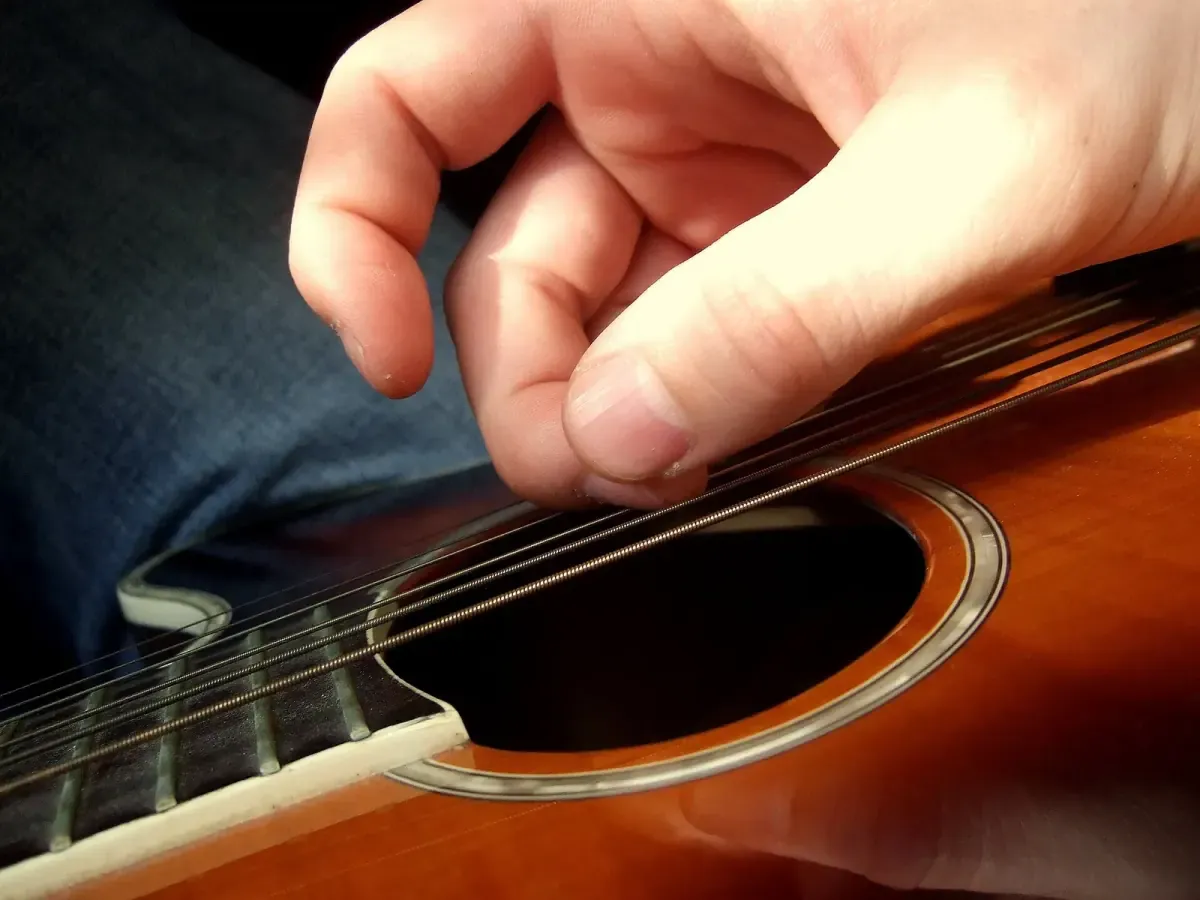
The metronome above is clicking eighth notes, two per beat, and that is the speed your strumming arm should swing at: down on each beat, up on each and, for as long as the song lasts. A strumming pattern does not change that movement. It only decides which swings touch the strings. The others go past in the air, and they are what keeps the time even.
This is why a hand that stops cannot keep time. Every time it stops, it has to start again, and it never restarts at exactly the same moment. A hand that keeps swinging does not have to guess where the next beat is: it is already on its way there.
Three exercises, in this order
- Muted strings, every swing. Lay your fretting hand flat across the strings so nothing rings, and strum down and up with the eighth note click for one minute. You hear only the rhythm, so any unevenness is obvious.
- Play two beats, miss two beats. Strum on beats 1 and 2, then keep the arm swinging just above the strings on beats 3 and 4. The silent swings must take exactly as long as the played ones.
- Play a bar, miss a bar. Same idea over a whole bar. Coming back in exactly on the next beat 1, together with the click, is the whole test.
Once this feels natural, the guitar strumming patterns page writes eight patterns on the same down and up grid, easiest first. Every one of them is this movement with some swings left out.
Count out loud, and feel the pulse in your body
Counting out loud feels childish and it works better than anything else on this page. Say one and two and three and four and, at the speed of your arm, while you play. If you cannot say the count while you strum, you are not keeping time, you are repeating a movement and hoping it comes out even. The voice ties the hand to the bar.
The pulse also has to live somewhere other than your hands. Before you pick up the guitar, spend a minute on it with your body alone:
- Walk around the room at a steady pace and count one, two, three, four with your steps.
- Snap your fingers on every beat and pat your leg on 2 and 4, for sixty seconds, without speeding up.
- Breathe in for four beats and out for four beats. Steady matters more than slow.
Then tap your foot on the beats while you play. A foot that keeps going when the hands get busy is the most reliable sign that the pulse is yours rather than the metronome's.
Subdivisions: what happens between the beats
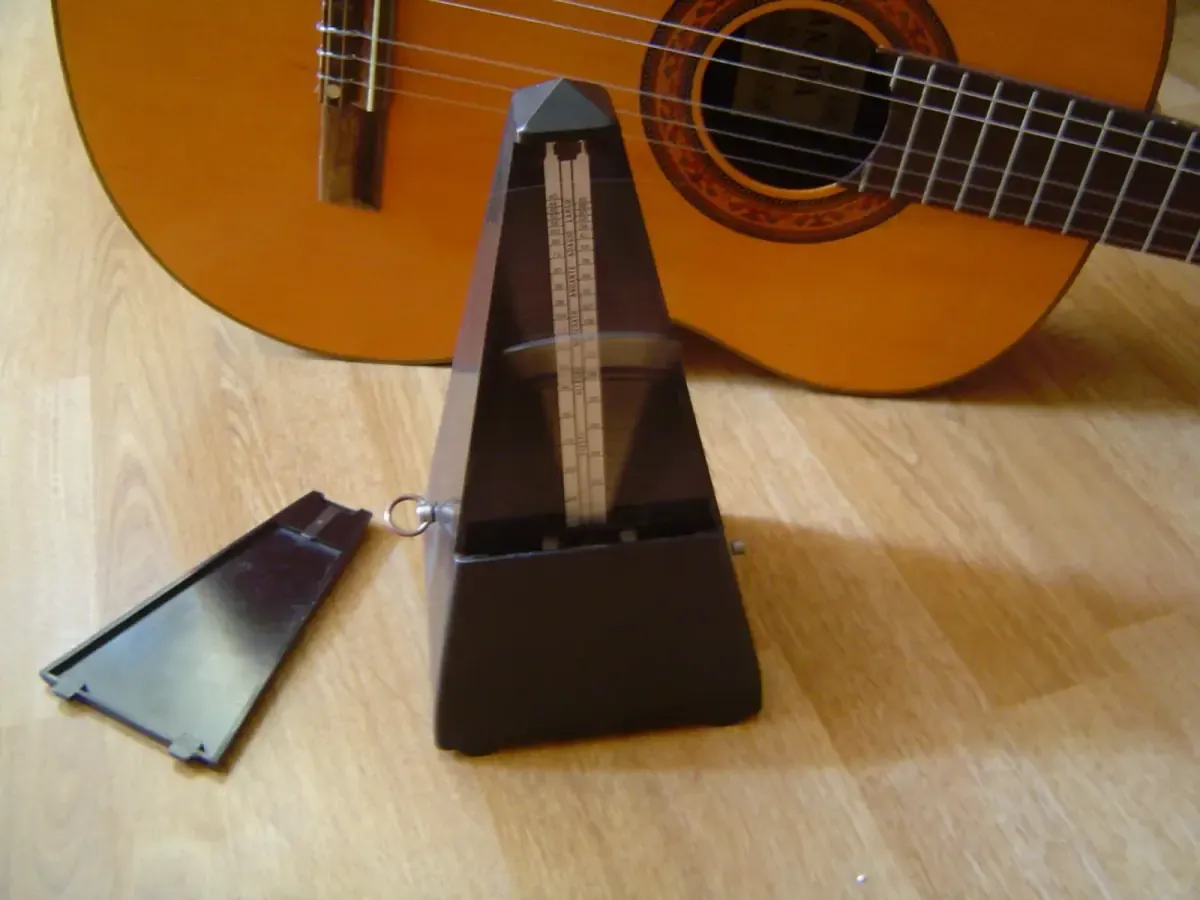
Most timing problems are not on the beat, they are between beats. A subdivision is how you split each beat, and saying it out loud is what makes the space between two clicks feel measured instead of empty. There are three to know.
Eighth notes: two per beat
1 & 2 & 3 & 4 &
The speed of the strumming arm, and the setting the metronome above starts on. In its Rhythm figures menu, this is Eighth note.
Sixteenth notes: four per beat
1 e & a 2 e & a 3 e & a 4 e & a
Said one e and a. This is where funk lives, and where an arm swinging in eighth notes simply moves twice as fast. In the menu, Sixteenth note.
Triplets: three per beat
1 trip let 2 trip let 3 trip let 4 trip let
Three even pulses per beat, the ground under blues, shuffles and slow 12/8 ballads. In the menu, Triplet. The menu also has a Swing shuffle setting, which clicks the long and short pair you get when you lean a triplet: the first two thirds of the beat, then the last third.
Switch without changing tempo
The exercise that makes subdivisions stick: keep the tempo fixed and change only the split. Two bars of eighth notes, two bars of triplets, two of sixteenths, then back down. The beat must not move at all while the notes inside it change. The metronome can drive this for you: set Play mode to Subdivision pyramid and it steps through quarter notes, eighth notes, triplets and sixteenth notes, then back down, at a fixed tempo.
If you would rather read rhythms than count them, the rhythm generator writes four random bars on a staff at the level you choose. Clap them, then strum them on one chord.
Check yourself: accents, silence, recording
Once the hand moves and the count is out loud, the job is to find out whether the pulse is yours. Three checks, each harder than the one before.
Accents on 2 and 4
Under the metronome's controls, Custom accents has one box per beat, and beat 1 is checked when it opens. Uncheck 1 and check 2 and 4: the click now leans on the backbeat, where a snare drum would be. Playing against that lean, rather than on the first beat of every bar, makes you feel the bar as a whole instead of a string of separate beats.

Take part of the click away
Set Play mode to Random mute and raise the silence slider to 20 or 30 percent. The metronome now drops that share of its clicks at random, so you never know which ones will be missing. Keep playing through the holes. When the click comes back, you are either together with it or not, and there is nothing to argue with. If you keep losing it, lower the percentage before you lower the tempo.
Record and listen back
Thirty seconds, once per session, and listen for a single thing: does the time hold? Not the sound, not the chords, not the pattern. One question per recording is what makes them useful.

A ten minute rhythm routine
Short and every day beats long and once a week. This is the order that works for most adult students, all of it on the metronome above. One goal per block, and the tempo goes up by five BPM only on a day when the whole routine held.
| Time | What you do | Metronome |
|---|---|---|
| 0:00 to 1:00 | Pulse in the body, no guitar: tap your foot, count 1 2 3 4 out loud | 60 BPM, Quarter note |
| 1:00 to 3:00 | Strumming hand on muted strings, down and up without a pause, counting 1 & 2 & 3 & 4 & | 60 BPM, Eighth note |
| 3:00 to 5:00 | Same movement, half the swings in the air: play two bars, miss two bars, keep the arm going | 60 BPM, Eighth note |
| 5:00 to 7:00 | Two chords, changing on beat 1, simple pattern | 60 to 70 BPM, accents on 2 and 4 |
| 7:00 to 9:00 | The same two chords with part of the click removed | Random mute, 20 to 30 percent |
| 9:00 to 10:00 | Record thirty seconds and listen back for one thing only: does it hold? | Click on, tempo of the day |
For the chord changes in the middle of the routine, two open chords you know well are enough, C and A minor for example. If the change breaks the time, the answer is never to push: go back to a simpler pattern, or slow down until the change fits inside the bar. Getting rhythm and chord changes to agree is the real work, and it is the subject of knowing chords but not being able to play songs.
When the routine holds, take it somewhere musical: the online drum machine plays rock, funk and reggae grooves at any tempo, and a groove is far less forgiving than a click. For the metronome itself, from choosing a tempo to working without it, see how to practice with a metronome.
Frequently asked questions
Can you learn rhythm if you think you have none?
How long does it take to improve your rhythm on guitar?
Should I always practice with a metronome?
Why do I speed up when I play guitar?
What tempo should I start rhythm exercises at?

Who made this
Guitar Social Club is the work of Yohann Abbou, a guitar teacher in Paris. He teaches adults, which shapes everything here: people with jobs, limited practice time and a clear idea of the songs they want to play. The three rhythm problems on this page are the three he hears most often in lessons, and the routine is the one he gives students when time is short. The rest of our free guitar tools work the same way.
More about Yohann on his page, and about why Guitar Social Club exists.