BPM stands for beats per minute. It is the number of beats, the steady pulse you tap your foot to, that fit into one minute of music. That is all a tempo marking of 60 or 120 means: at 60 BPM there is one beat every second, at 120 BPM there are two. The metronome right below this paragraph is already set to 60 BPM. Press Play and look at a clock: the clicks and the second hand move together.
The beat comes first, the number second
Before BPM can mean anything, there has to be a beat to count. The beat, also called the pulse, is the regular throb under the music: what you nod your head to, what a crowd claps on, what a drummer's bass drum and snare keep marking. It is felt before it is measured. Most people find it without any training, which is why a room full of strangers can clap together.
BPM is simply that pulse put into numbers. Count the beats for one full minute and you have the tempo. Nobody does it that way, but it is a good way to remember what the number is: a count, not a style and not a difficulty.
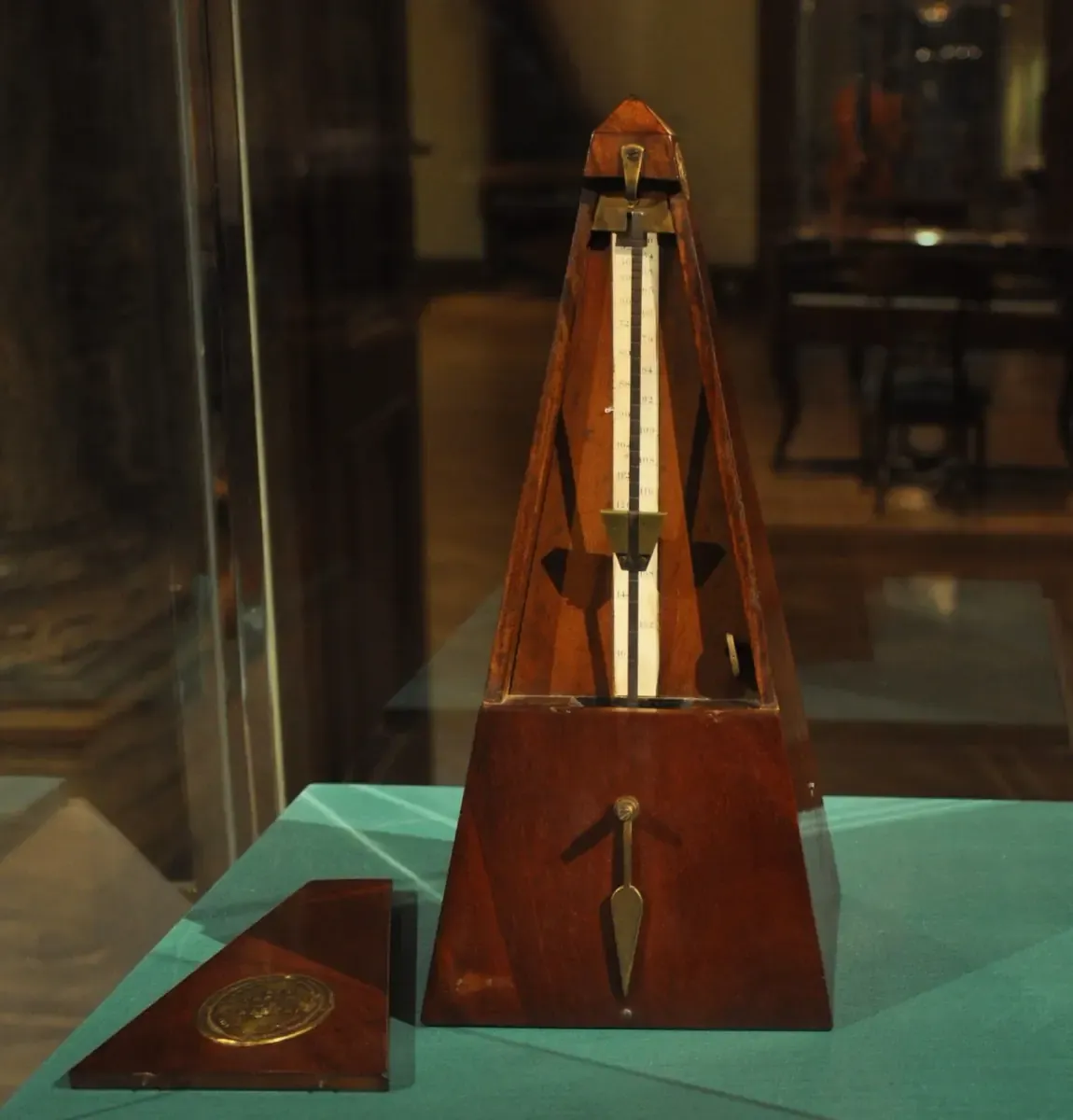
Tempo, beat and rhythm are three different things
These three words get mixed up constantly, and the confusion costs guitarists real practice time.
- The beat is the regular pulse itself, the thing you count as 1, 2, 3, 4.
- The tempo is how fast that pulse goes, and BPM is the unit it is measured in.
- The rhythm is what you actually play on top of the beat: which strums land, which are left out, how long each note lasts.
Two guitarists can play at the same tempo, on the same beat, and still play completely different rhythms. One strums once per beat, the other strums down and up twice per beat with a gap in the middle. The BPM has not moved. That is why being at the right tempo and playing the right rhythm are two separate skills, and why guitar strumming patterns are written against the beat rather than against a number.
What a BPM number feels like
The arithmetic is simple: divide 60 by the BPM and you get the length of one beat in seconds, or divide 60,000 by it for milliseconds. 60 BPM is one second per beat. 120 BPM is half a second. 90 BPM sits in between, at two thirds of a second.
| Tempo | Beats per second | One beat lasts |
|---|---|---|
| 60 BPM | 1 | 1 second (1000 ms) |
| 80 BPM | 1.33 | 750 ms |
| 90 BPM | 1.5 | 667 ms |
| 100 BPM | 1.67 | 600 ms |
| 120 BPM | 2 | 500 ms |
| 140 BPM | 2.33 | 429 ms |
Those numbers matter on a guitar because of what you fit inside each beat. Strum eighth notes, down and up, and you play two strokes per beat: at 60 BPM that is two strokes a second, at 120 BPM it is four. Switch to sixteenth notes and you double it again. A tempo that feels relaxed for quarter notes can be very demanding once the subdivision gets finer, which is why the BPM alone never tells you how hard a part is.
Italian tempo markings and their BPM
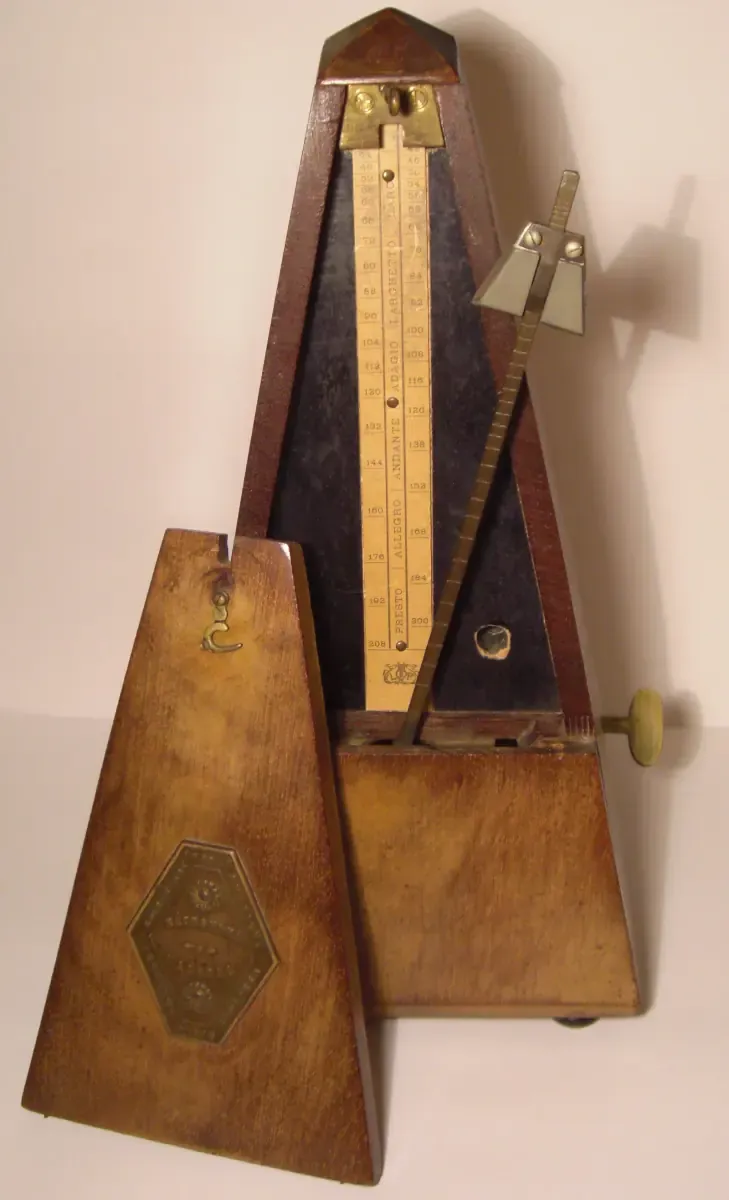
Classical scores often give the tempo as a word instead of a number, and the words are Italian because that is where the convention started. Here are the usual zones. Read them as conventions, not as fixed values: the ranges below are common approximations, different books and metronome makers print slightly different ones, and the edges overlap because each word describes a character as much as a speed.
| Marking | Approximate BPM | Character |
|---|---|---|
| Grave | 25 to 45 BPM | Very slow, solemn |
| Largo | 40 to 60 BPM | Broad and spacious |
| Adagio | 66 to 76 BPM | Slow, expressive |
| Andante | 76 to 108 BPM | Walking pace |
| Moderato | 108 to 120 BPM | Moderate |
| Allegro | 120 to 168 BPM | Fast, cheerful |
| Vivace | 168 to 176 BPM | Lively |
| Presto | 168 to 200 BPM | Very fast |
| Prestissimo | 200 BPM and up | As fast as it goes |
You will meet these words far less in guitar tabs and pop songbooks, which usually print a plain number, often written as a note symbol followed by an equals sign and the BPM. When a score does use a word, it is telling you about the mood as much as the speed. Andante, walking pace, is the one most often played too fast, because most people walk slower than they think.
How to find the BPM of a song
The quickest way is to tap along with it. Play the song, tap a key or a button on every beat, and a tap tempo tool turns the gaps between your taps into a BPM. Our tap tempo page is built for exactly that, and the metronome above has a Tap Tempo button of its own that averages your last few taps and sets its tempo to the result.
- Listen for a few bars before you tap. Find the pulse you would clap to, usually where the kick drum and the snare fall.
- Tap the beat, not the rhythm. Drum fills, off-beat guitar chops and syncopated vocals pull the average around.
- Give it eight to twelve taps. One gap tells you very little; an average over several settles quickly.
- Check the result against the song: start the metronome at that tempo and play the track alongside it. If the two drift apart within a bar or two, tap again.
Double time and half time
The most common surprise is getting a number that is twice or half what you expected. A ballad can honestly be tapped at 70 BPM or at 140 BPM, depending on whether you tap the slow pulse or every subdivision. Neither is wrong. For practice, pick the reading you can count comfortably as 1, 2, 3, 4, and stay with it.
BPM and the time signature
BPM tells you how fast the beats go. The time signature tells you how the beats are grouped. In 4/4, the most common signature in popular music, the beats come in groups of four and each one is a quarter note, so 100 BPM means one hundred quarter notes per minute, or twenty-five full bars. In 3/4, the beats come in threes, which is the feel of a waltz. The tempo can stay the same while the grouping changes, and that changes how the music feels far more than you might expect.
Compound meters: which note is the beat?
Signatures like 6/8 and 12/8 are where BPM gets ambiguous. A bar of 6/8 holds six eighth notes, but it is usually felt as two big beats of three eighths each. A tempo for 6/8 can therefore be quoted for the eighth note or for that bigger dotted quarter beat, and the two numbers are three times apart: 60 dotted quarters per minute is 180 eighth notes per minute.
Know which one your metronome counts. The one on this page, set to 6/8, clicks six times per bar, one click per eighth note. So to play a 6/8 song felt at 60 BPM, you set it to 180, and the accent on beat one marks the start of each bar. The 6/8 metronome page goes further into counting it, and odd time signatures covers the meters that do not divide evenly at all.
The song's BPM is not your practice BPM
Once you know a song's tempo, the temptation is to set the metronome to it and start playing. That is the tempo you are working toward, not the one you start from. Start where you can play the part cleanly, relaxed, three times in a row, which is often well under the record, then climb in steps of a few BPM. A number written down each day also gives you something most practice lacks: proof that you are moving.
The full method, with the metronome settings for each step, is in how to practice with a metronome. If the tempo holds but the groove feels stiff, how to improve your guitar rhythm deals with what happens inside the beat.
Frequently asked questions
What does BPM stand for?
Is a higher BPM always faster?
What BPM is a normal song?
How do I find the BPM of a song?
What BPM should I practice at?

Who made this
Guitar Social Club is the work of Yohann Abbou, a guitar teacher in Paris. He teaches adults, which shapes everything here: people with jobs, limited practice time and a clear idea of the songs they want to play. Most of them say they have no sense of rhythm when what they are missing is a word for the beat and a number for the tempo, which is why this page puts both next to a click you can hear. The rest of our free guitar tools work the same way, with no account and nothing to install.
More about Yohann on his page, and about why Guitar Social Club exists.