Bossa nova sounds soft, elegant and simple. Then you pick up the guitar and nothing lines up: the bass wants one thing, the chords want another, and the pulse seems to float. That is normal. The bossa nova rhythm is not hard because it is fast. It is hard because it asks for a calm, steady pulse with chords placed slightly around it. This page builds it in order: the pulse, the thumb on its own, the fingers on the beat, then the fingers off the beat, with the chord shapes written out and a metronome built in.
Two parts in one hand
Bossa nova comes from Brazil. It is related to samba, in a more intimate, quieter form. On the guitar, that comes down to a picking hand doing two jobs at once:
- The thumb plays the bass, on the low strings, steady as a clock. It is the ground.
- The fingers play the chord, index, middle and ring on three higher strings, plucked together. They are the movement.
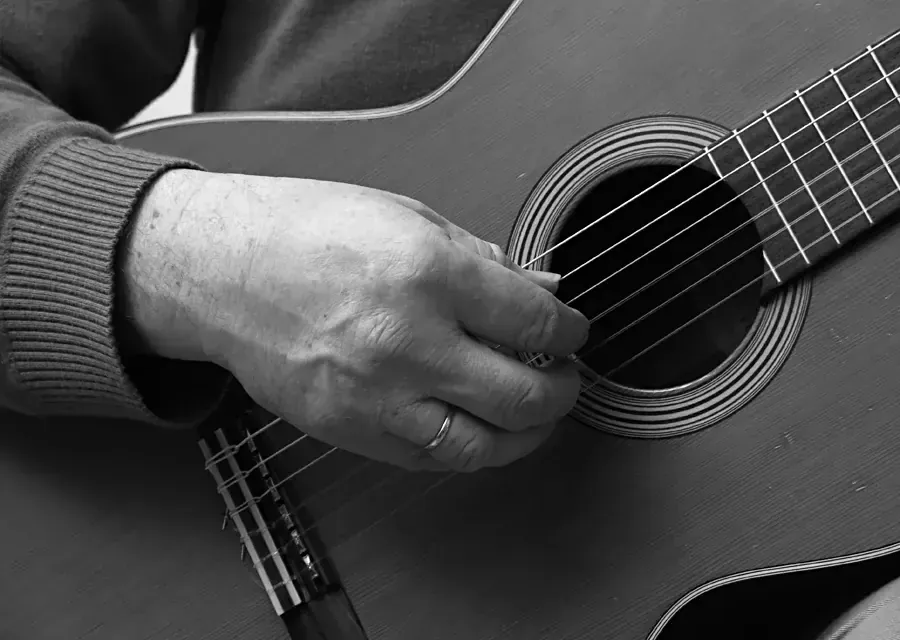
So this is not strumming. It is a small arrangement inside one hand: bass, chord, silence, answer. That is why it is played with the fingers rather than a pick, and why the order of practice matters so much. Play the whole thing at once and the pulse disappears. Take it apart and put it back together one layer at a time, and it comes.
If plucking with the thumb and fingers is new to you, picking hand technique covers which finger goes where before you ask it to keep a rhythm.
The chords: m7, 7 and maj7
The working progression on this page is four chords, one per bar, in the key of C. It is a common jazz and bossa movement, and all four shapes are open, with no full barre.
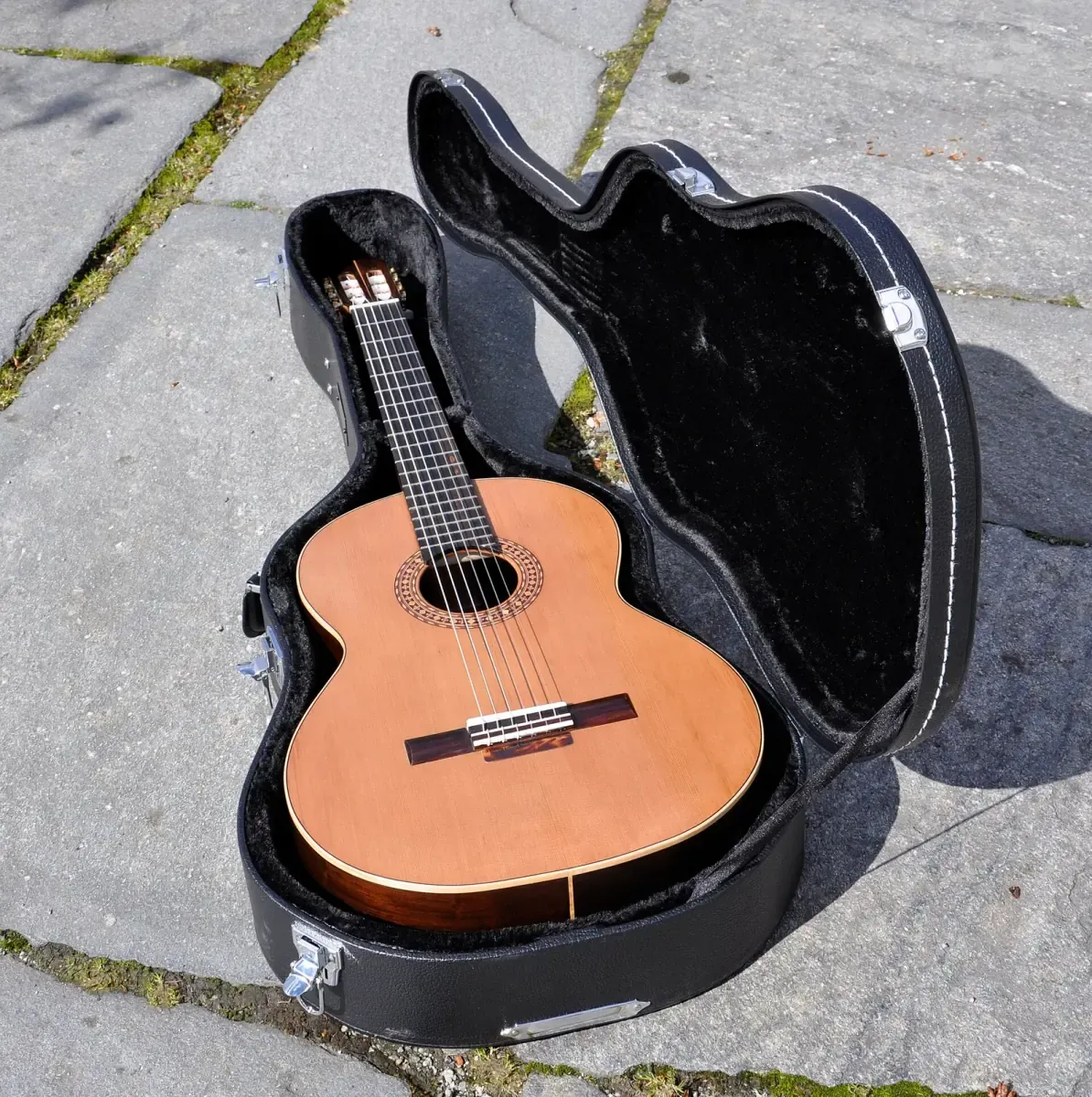
| Am7 | Dm7 | G7 | Cmaj7 |
Codes read from the thickest string to the thinnest: x means the string is not played, 0 means it rings open. On Dm7 the index finger lies across the two thinnest strings at the first fret. If the seventh chords slow you down, play Am, Dm, G and C instead. The color can wait. The rhythm cannot.
Who plays what
The thumb plays the root of the chord on beat 1. On beat 3 it can play the root again, or alternate to the fifth, which gives the bass line its gentle back and forth. Start with the root on both beats and add the alternation once the pattern holds.
| Chord | Thumb on 1 | Thumb on 3 | Fingers |
|---|---|---|---|
| Am7 | A, 5th string open | E, 6th string open | 4th, 3rd, 2nd strings: E G C |
| Dm7 | D, 4th string open | A, 5th string open | 3rd, 2nd, 1st strings: A C F |
| G7 | G, 6th string, 3rd fret | D, 4th string open | 3rd, 2nd, 1st strings: G B F |
| Cmaj7 | C, 5th string, 3rd fret | G, 6th string, 3rd fret | 4th, 3rd, 2nd strings: E G B |
Two of those beat 3 notes, the low E under Am7 and the A under Dm7, are open strings the diagrams mark with an x, because they are left out when the chord is strummed. Here only the thumb touches them, and both belong to the chord. On Cmaj7, alternating to the G means moving the ring finger from the 5th string to the 6th, same fret, and back. If that hop breaks the time, keep the C on both beats.
Adding a 9 chord
Ninth chords are the other sound you hear constantly in bossa. The easiest one to start with is a dominant 9 with its root on the 5th string. At the fifth fret it is D9, and it leads naturally to G major 7, which gives a second short grid:
| Am7 | D9 | Gmaj7 | Gmaj7 |
D9 here is D, F sharp, C and E: a D7 with the ninth added and the fifth left out, which is exactly what makes it light. On D9 the two outer strings stay silent, on Gmaj7 the 5th and 1st strings do: let the fretting fingers touch them lightly to keep them quiet. The thumb plays the D on the 5th string for D9 and the G on the 6th string for Gmaj7.
The pulse before the pattern
Before you play anything, feel the movement. The metronome below is set to 70 BPM in 4/4, clicking eighth notes, so you hear every beat and every and between them. Tap your foot on the beats and count out loud: one and two and three and four and. Bossa is not out of time. It only seems to float because the chords do not always land where a beginner's ear expects them. The beat itself never moves.
The bossa nova pattern, in four steps
Each grid below is one bar of eighth notes. X means the note is played, a dot means nothing sounds. The thumb never changes: beat 1 and beat 3, all the way through. Only the fingers move.
1. The thumb alone
| Hand | 1 | & | 2 | & | 3 | & | 4 | & |
|---|---|---|---|---|---|---|---|---|
| Thumb | X | . | . | . | X | . | . | . |
Am7, the A string on 1 and 3, nothing else, for two minutes. Then the four chords of the grid, still with the thumb only. You are not looking for a nice sound yet. You are looking for a bass that does not speed up. If the thumb cannot hold alone, the full pattern cannot hold at all.
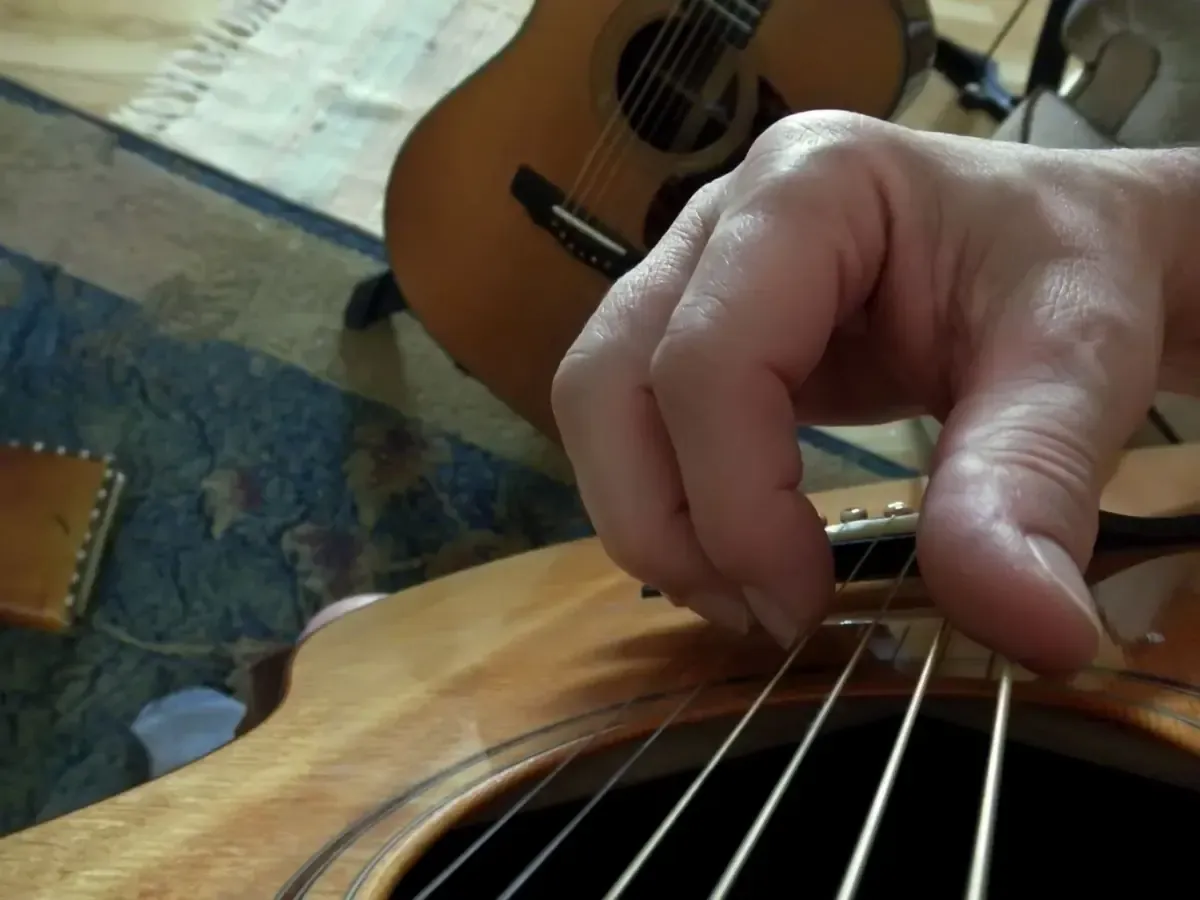
2. Fingers on the beat
| Hand | 1 | & | 2 | & | 3 | & | 4 | & |
|---|---|---|---|---|---|---|---|---|
| Thumb | X | . | . | . | X | . | . | . |
| Fingers | . | . | X | . | . | . | X | . |
Bass on 1, chord on 2, bass on 3, chord on 4. It sounds too simple, and that is the point: you are teaching the hand that the thumb and the fingers have two separate jobs. A simple chord that lands on time beats a rich chord that arrives late.
3. Fingers off the beat
| Hand | 1 | & | 2 | & | 3 | & | 4 | & |
|---|---|---|---|---|---|---|---|---|
| Thumb | X | . | . | . | X | . | . | . |
| Fingers | . | . | . | X | . | . | . | X |
The chord moves half a beat later, to the and of 2 and the and of 4, exactly on the second click of each of those beats. This is where the feel changes: the bass holds the pulse, the chord dances around it. Your body will try to drag the chords back onto the beat. Let the count win, say the ands out loud, and work on muted strings first if you need to, then on Am7 alone, then on two chords, then on all four.
4. Over two bars
| Hand | 1 | & | 2 | & | 3 | & | 4 | & | 1 | & | 2 | & | 3 | & | 4 | & |
|---|---|---|---|---|---|---|---|---|---|---|---|---|---|---|---|---|
| Thumb | X | . | . | . | X | . | . | . | X | . | . | . | X | . | . | . |
| Fingers | X | . | . | X | . | . | X | . | . | . | X | . | . | X | . | . |
The longer pattern spreads the chords over two bars: 1, the and of 2, and 4 in the first bar, then 2 and the and of 3 in the second. On the very first beat, thumb and fingers play together, a pinch. Everywhere else the chords fall between the bass notes, and none of them lines up the same way in both bars, which is what gives the rhythm its long, rolling shape. Take it slowly: this is the step that usually needs a few days rather than a few minutes.
Common mistakes
- Playing too fast. Bossa played too fast turns nervous. 60 or 70 BPM is a perfectly good place to work.
- Filling every space. A chord on every eighth note is not bossa. The silences give it air. Fewer notes, better placed, sound more like the style.
- Forgetting the bass. If the thumb wobbles, the whole thing floats away, however nice the chords are.
- Forcing the syncopation. An off beat chord that is pushed sounds like a mistake. One that is felt sounds like breathing. The difference is the pulse inside you.
- Plucking too hard. If you need to hit hard to feel the rhythm, the pulse is not clear enough yet. Play softly: if the rhythm holds quietly, you really control it.
A twelve minute bossa routine
All of it on the metronome above, at 70 BPM, with the grid Am7, Dm7, G7, Cmaj7 or the plain Am, Dm, G, C.
| When | What you do |
|---|---|
| Minutes 1 and 2 | Pulse only. Tap your foot, count 1 & 2 & 3 & 4 &. No guitar. |
| Minutes 3 and 4 | Thumb only, on 1 and 3, through the four chords. |
| Minutes 5 and 6 | Add the fingers on 2 and 4. |
| Minutes 7 to 9 | Move the fingers to the & of 2 and the & of 4. Slowly. |
| Minutes 10 and 11 | The full grid: Am7, Dm7, G7, Cmaj7, or the plain triads. |
| Minute 12 | Record one take and listen for the bass only. |
When you listen back, ask three questions and nothing else. Does the bass stay even? Do the chords arrive early or late? Does the rhythm breathe? Once the pattern holds, test the pulse without help: in the metronome, set Play mode to Random mute and let it drop 20 percent of its clicks at random. If you are still together with it when it comes back, the pulse is yours.
When the pattern feels comfortable, play it over a real groove: the backing track generator has a Bossa nova style, with soft kick, syncopated rim and a root and fifth bass under the chords you type. And if your timing in general needs work, how to improve your rhythm on guitar starts with finding out whether you rush, drag or stop.
Frequently asked questions
What is the basic bossa nova rhythm on guitar?
Is bossa nova hard to play on guitar?
Should I play bossa nova with a pick or with my fingers?
What tempo should I practice bossa nova at?
Which chords should I start bossa nova with?

Who made this
Guitar Social Club is the work of Yohann Abbou, a guitar teacher in Paris. He teaches adults, which shapes everything here: people with jobs, limited practice time and a clear idea of the songs they want to play. The order on this page, thumb first, then the fingers, then the syncopation, is the order he uses in lessons, because it is the one that keeps the pulse alive. The rest of our free guitar tools work the same way.
More about Yohann on his page, and about why Guitar Social Club exists.