Your picking or strumming hand determines the timing, attack and groove of a guitar part. Even when your fretting hand plays the right chords, a tense or uneven picking hand makes the song sound unclear. The French Guitar Social Club lesson this guide is based on begins with one principle: identify what the hand is disrupting before adding another exercise.
This guide covers a relaxed wrist, pick versus fingers, alternate strokes, palm muting, dynamics and a four-week routine. For a steady reference, use our free online metronome. If you already know the pattern but cannot tell what is wrong with your playing, see Guitar Match & Play.
Quick answer: what should your picking hand do?
| Your goal | Hand movement | Useful next step |
|---|---|---|
| Steady rhythm | Loose wrist, small range of motion | Metronome |
| Pop and rock strumming | Continuous down/up movement with controlled accents | Strumming patterns |
| Arpeggios | Thumb and fingers playing separate strings | Tab maker |
| Palm muting | Edge of the hand close to the bridge | Tap tempo |
First, diagnose what your picking hand changes
Lists of picking styles are useful, but improvement begins when you can hear what is wrong: timing, pick depth, accents, note length or energy. Work on the cause rather than repeating the whole song.
| What you hear | What is happening | Where to begin |
|---|---|---|
| The tempo drifts | Attack timing is inconsistent | Work with a metronome, then accent beats 2 and 4 |
| The pick catches | The attack is too deep | Use less pick and relax the wrist |
| The sound is flat | All strokes carry the same weight | Contrast accented and brushed strokes |
| The exercise never sounds musical | The movement is detached from the song | Use a short chord chart at a practical tempo |
Why the picking hand matters
The picking hand controls when a string sounds, how hard it is struck and how long it rings. That is why the same chord can sound heavy, delicate, dry, danceable or awkward depending on the motion. Compare the strumming of Wonderwall with the delicate picking of Blackbird: the fretted notes are only part of the musical result.
Left-handed guitarists who strum with their left hand should apply the same exercises to that hand; nothing else in the method changes.
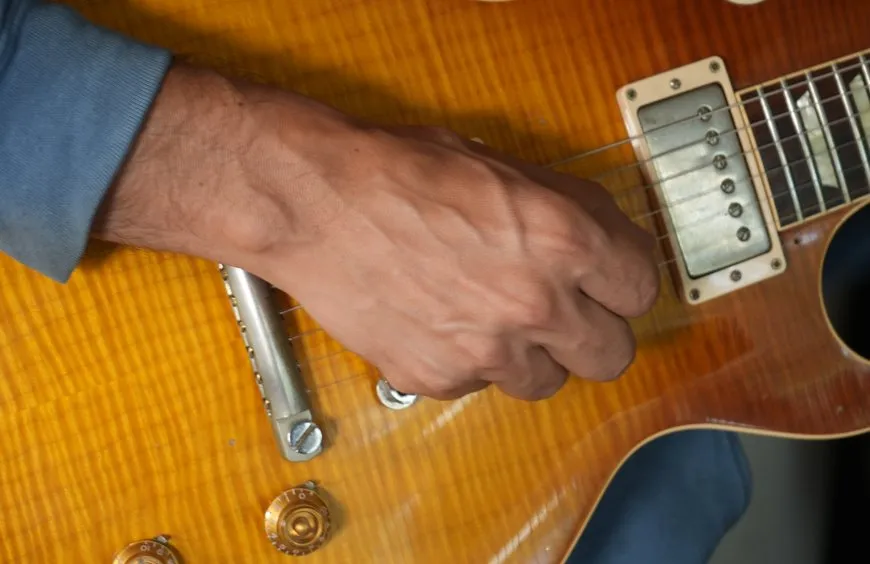
Keep the wrist springy
The key is a supple wrist. Avoid driving every strum with a large elbow movement. A shorter stroke brings more control and endurance with less unnecessary tension. The forearm supports the gesture, but the quick rebound should remain comfortable around the wrist.

Where tension really comes from: wrist, forearm and shoulder
- Your forearm burns after two minutes: your elbow may be doing too much of the work. Halve the movement and see whether the elbow stays comparatively quiet.
- Your wrist is stiff and the tone is messy: your pick grip may be too tight. Hold it securely, but not as though it could never move between your fingers.
- Your shoulder rises as you play: the guitar may be too low or too far away. Reposition the instrument and rest the arm again.
- Your hand stops during every chord change: the two hands have not yet become independent. Keep the strumming motion moving, even silently, while the fretting hand changes position.
Try thirty seconds of alternating strokes over muted strings, then stop. Notice what suddenly relaxes. That often reveals where you were using unnecessary force.
Dynamics: one hand, loud and soft
Steady does not mean mechanical. If every strum is equally loud, even a correct rhythm can sound flat. Two simple exercises create contrast:
- Accents: play eighth-note down/up strokes while emphasizing beats 2 and 4. Brush the strings lightly on the other strokes.
- Verse and chorus: play a quiet verse and a much louder chorus without changing the tempo or pattern.
The extra sound should come from a freer arm movement, not a tighter hand. Record yourself: if the quiet and loud sections sound the same, increase the contrast gradually.
Four main picking-hand techniques
| Technique | Use it for | Common mistake |
|---|---|---|
| Pick | Pop, rock, funk, riffs and crisp strumming | Digging too deeply between the strings |
| Fingers | Arpeggios, folk, bossa nova and subtle dynamics | Pulling the strings outward rather than plucking them |
| Hybrid picking | Country, rock, double-stops and faster arpeggios | Uneven volume between the pick and fingers |
| Palm muting | Rock, metal, dry grooves and alternating bass | Placing the hand too far from the bridge and choking the sound |
Common errors to avoid
- Driving the movement from the elbow until the forearm becomes tired.
- Locking the wrist and increasing the range to compensate.
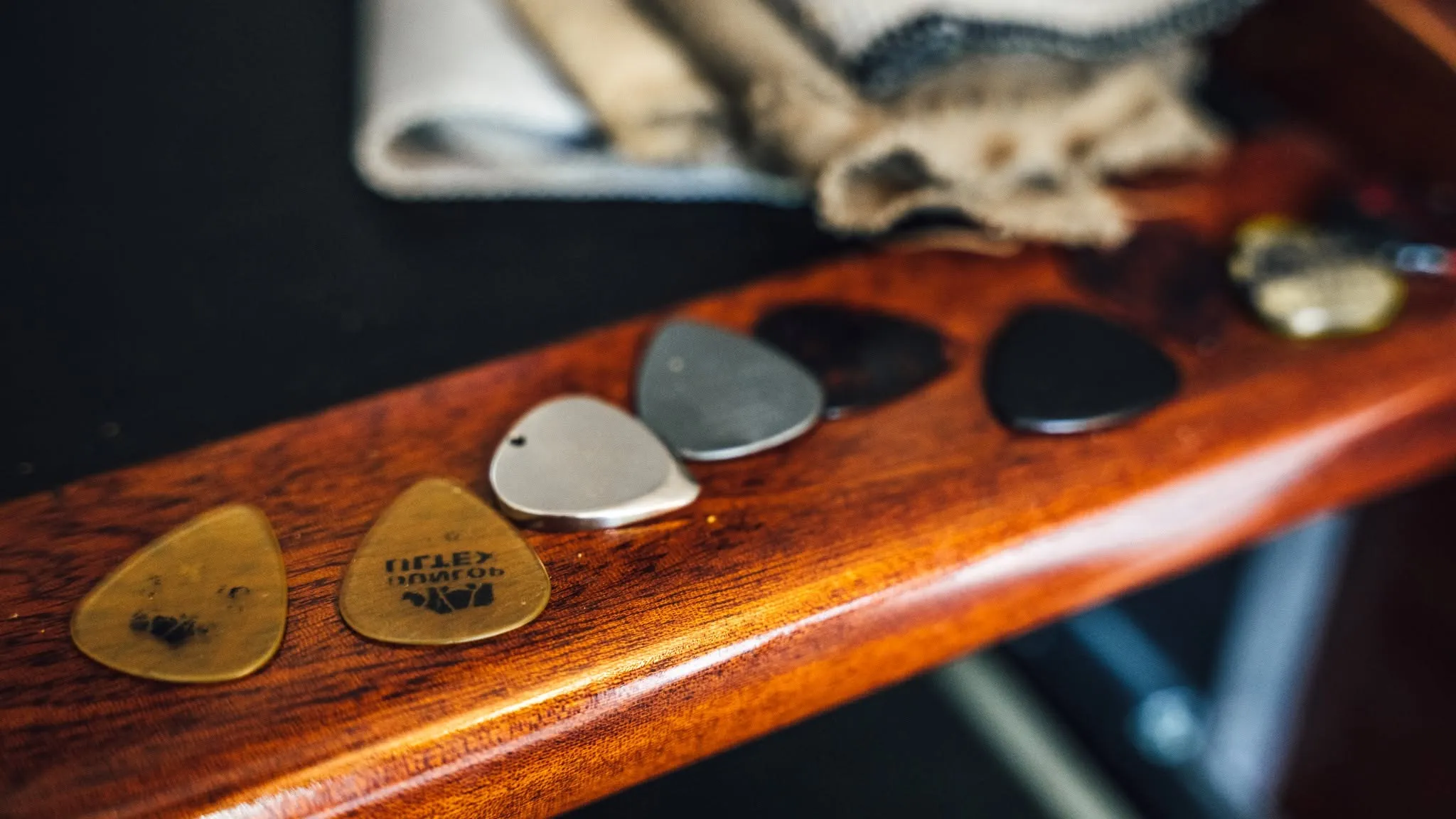
- Letting too much pick protrude into the strings; start with roughly 2–3 mm.
- Holding the pick so tightly that the motion becomes tense.
A four-week picking-hand practice plan
Use about fifteen minutes a day as a practical structure, not a guarantee of reaching a fixed level by a certain date.
| Week | Practice | What to observe |
|---|---|---|
| 1 | Relaxed wrist, muted strings, five minutes daily | No unnecessary forearm tension |
| 2 | D–DU–UDU at 60 BPM using a metronome | Same controlled range on up- and downstrokes |
| 3 | Alternate pick and fingers over C–G–Am–F | Consistent level between strings |
| 4 | Play a complete song slowly, then record yourself | A stable groove even when singing |
Week 1: a relaxed wrist
Practice small wrist motions and muted-string strokes for five minutes, with breathing and brief breaks. Check that the forearm stays comfortable.
Week 2: a basic rhythm
Play D–DU–UDU at 60 BPM. Keep each stroke controlled, including the upstrokes; the hand can continue moving on the silent subdivisions.
Week 3: different picking styles
Alternate pick and fingerstyle over C–G–Am–F for ten minutes, aiming for balanced volume from string to string.
Week 4: a complete groove
Choose a familiar song, such as Yellow, work slowly around 80 BPM and record yourself. Keep the accents intentional rather than increasing force everywhere.
Picking-hand self-diagnosis
| Symptom | Likely cause | Correction |
|---|---|---|
| Tempo keeps speeding up | Your attacks follow the energy of the song rather than the click | Return to 60 BPM; emphasize only beats 2 and 4 |
| The pick catches on the strings | The pick enters too deeply or the wrist is locked | Expose only 2–3 mm of the tip and loosen the wrist |
| The performance sounds flat | Every attack has similar intensity | Play lightly, then emphasize selected downstrokes |
| Your forearm tires quickly | Excess forearm tension or an overly tight grip | Practice two-minute passages with short breaks |
Move from exercises into a real song
As soon as the motion becomes more consistent, use it in a short song passage: a simple pattern, a short progression, a realistic tempo and a recorded take. Technical practice becomes musical only when it serves the song. This is also why Match & Play focuses on evidence from an actual recording rather than rewarding isolated repetitions.
Songs for practicing your picking hand
| Song | Focus | Suggested practice tempo |
|---|---|---|
| Wonderful Tonight · Eric Clapton | Fingerpicking | 70–80 BPM |
| Wonderwall · Oasis | Pick strumming | 80–90 BPM |
| Hotel California · Eagles | Hybrid picking | 72–76 BPM |
| Yellow · Coldplay | Pick strumming | 80–84 BPM |
The suggested tempos are practice starting points, not claims about each song's definitive recorded BPM. For easier material, explore our easy guitar songs.
Choosing the right approach
Your picking hand is not simply a volume control. It determines the attack, rebound and groove and may define much of a song's character. Decide whether the arrangement needs a pick, fingers, hybrid picking or a muted attack, and then work on consistency and contrast.