Every string reads in tune, you play a chord, and it still sounds off. It is maddening, and it is very common. The reason is simple once you see it: a tuner checks the open strings, and you almost never play open strings alone. Between those six notes and the chord you hear sit your fretting hand, the capo, the condition of the strings, the setup of the guitar and a compromise built into the frets of every guitar ever made. This page goes through them in the order worth checking, with the tuner in the middle of the page for the tests that need it.
What to check, in order
Start at the top. The first checks cost nothing and solve most cases; the last ones are either a job for a luthier or simply how a guitar works.
| Check | What gives it away | What to do |
|---|---|---|
| The tuning itself | Open strings do not agree, or the song does not match | Retune with a light attack, check the reference pitch |
| Your fretting hand | Chords get sweeter when you relax your grip | Less pressure, finger close to the fret |
| The capo | In tune without it, sour with it | Reseat it close to the fret, straight, not too tight |
| The strings | Dull sound, rough feel, tuner that will not settle | Fresh strings before anything else |
| Intonation | Open chords fine, higher up the neck sour | The 12th fret test, then the saddles |
| Action and nut | Hard to press, first frets sharp | A setup by a luthier |
| Equal temperament | One chord shape beats even on a perfect guitar | Normal; a small sweetening if it bothers you |
First, make sure it really is in tune
It sounds obvious, but a guitar can look tuned and not be. Three things fool a tuner reading.
- A hard pick attack. A string struck hard starts sharp and settles a moment later. Tune to that first instant and the string ends up flat. Pick softly and read the note once it has settled.
- Close enough is not in tune. The tuner below counts a string as in tune within five cents of its note. If you leave one string at plus five and its neighbor at minus five, the two are ten cents apart, and you will hear that in a chord. Aim for zero, not for the green edge.
- The wrong reference. The tuner can work at A = 440, 442 or 432 Hz. 440 Hz is the standard for recordings, lessons and backing tracks. If you are playing along with a song and only the song sounds wrong, it may not be at 440 at all: many songs are played a half step down, which the half step down tuner handles, and the reasons a few people pick 432 are covered in 432 Hz vs 440 Hz.
To hear what each open string should sound like, open the settings and turn on Open string sound. Tapping a string button plays its reference note at the pitch you selected, and from then on the tuner measures what you play against that string, even when it is several semitones off. Tap the button again to go back to automatic detection.
Your fretting hand: pressing too hard
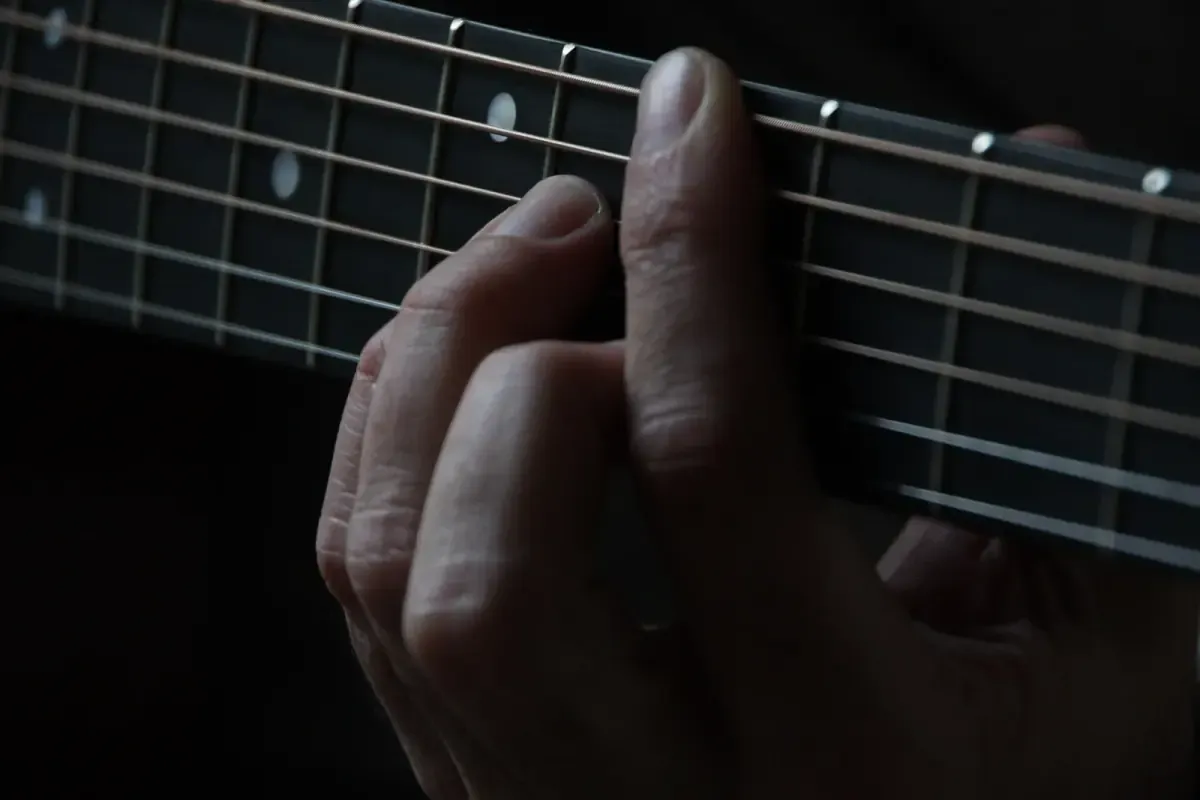
This is the most common cause of all, especially in the first year or two of playing. When you press a string down, it bends over the fret and stretches slightly, and a stretched string plays sharp. Press harder than you need, push the string sideways, or squeeze it in the middle of the fret space instead of near the fret wire, and the note climbs. On one string it is barely audible. In a six string chord, where each finger adds its own little error, the whole chord turns sour.
You can see it on the tuner. Leave the string buttons off, so the tuner detects freely, and play the G string at the 12th fret. Once with the lightest touch that still gives a clean note, then again squeezing hard. Watch the number climb as you squeeze. Then play a chord you know with a deliberately relaxed hand and listen: if it gets sweeter, you have found your problem, and the fix is in the hand, not the guitar.
- Put the fingertip just behind the fret wire, not mid-space.
- Press straight down, without pulling the string up or down.
- Look for the least pressure that gives a clean note, then a touch more.
- Keep the thumb and the hand loose; a clenched hand pushes sharp.
The capo
A capo is a very strong finger, and it makes the same mistake as a strong finger: it pulls the strings sharp. A capo clamped too tight, set in the middle of the fret space, or sitting at an angle across the neck can push a whole chord out of tune, often one or two strings more than the others.
Place it right behind the fret wire, straight across, with just enough tension for every string to ring clean. If the guitar is in tune without it and sour with it, reseat the capo before you touch a tuning machine. The guitar capo chart shows which shapes land in which key once it is on.
Worn strings
Old strings do not just sound dull. As they wear, corrode and pick up dirt in the windings, their mass is no longer even along their length, and an uneven string does not vibrate cleanly. It can read in tune open and still play sour when fretted, and the tuner reading tends to waver rather than settle. If the strings look dark, feel rough, or sound dead next to how they used to, change them before you diagnose anything else. Setting intonation on dead strings means adjusting a guitar to a faulty reference.
Brand new strings have the opposite problem: they keep stretching and going flat for a while. If the tuning drifts rather than sounding wrong while it is in tune, that is a different diagnosis, covered in why your guitar won't stay in tune.
Intonation: the 12th fret test
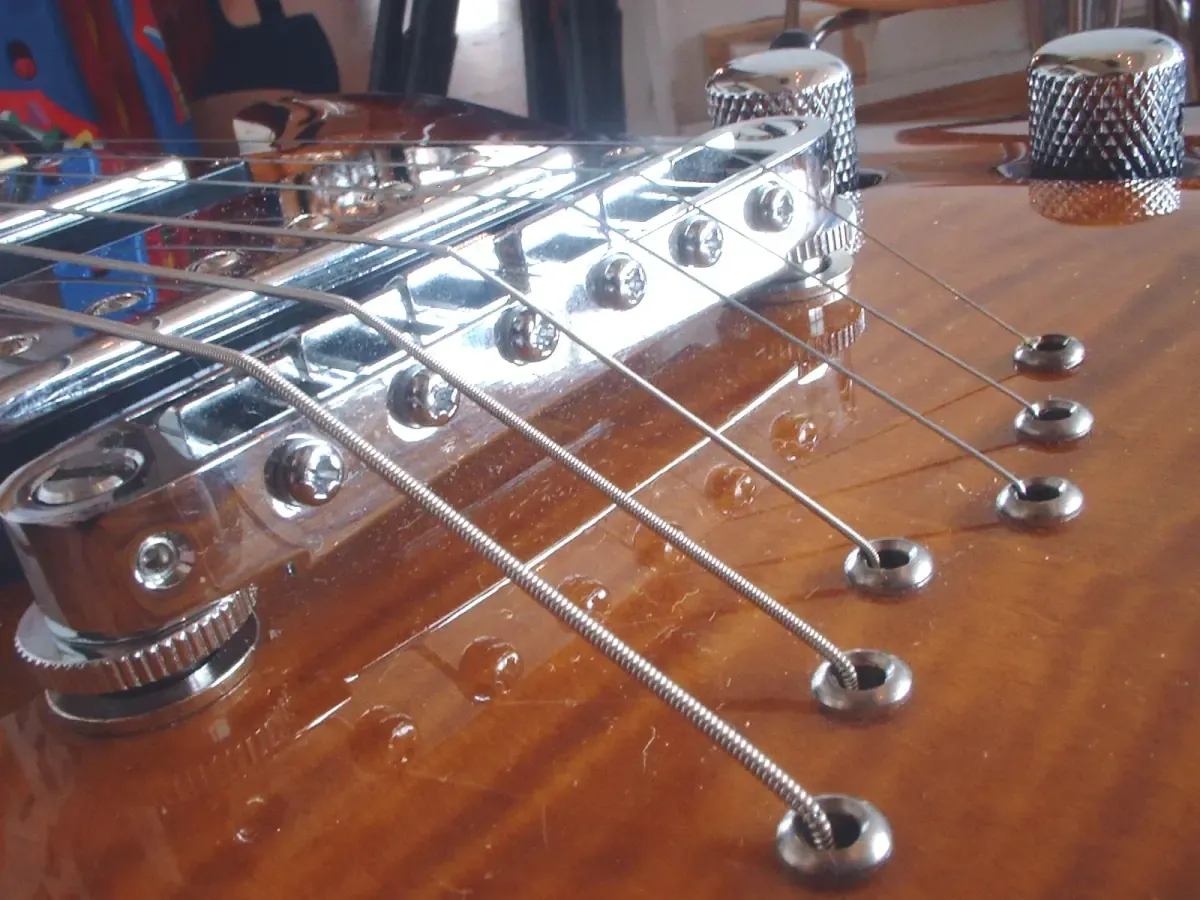
If open chords sound good and chords higher up the neck sound worse, the guitar's intonation is the likely culprit. Intonation is how well a guitar stays in tune as you go up the neck. A string pressed to a fret plays slightly sharp, because pressing it stretches it, so the saddle of each string sits a little behind the theoretical position to compensate. That is why the saddles on an electric guitar are staggered rather than in a straight line. When a saddle is in the wrong place for the strings you use, the fretted notes drift.
- Tune the open string to zero with the tuner above. Use strings that have already settled, neither brand new nor dead.
- Play the same string at the 12th fret, pressing normally, with the guitar held in playing position. It should be the same note an octave higher, and read in tune.
- If the fretted note reads sharp, the string is too short: move the saddle back, away from the neck. If it reads flat, the string is too long: move the saddle forward, toward the neck.
- Move it a little at a time, retune the open string after every adjustment, and test again. Then do the next string.
On most electric guitars, each saddle moves with a screw at the back of the bridge, and adjusting it yourself is safe if you go slowly. Recheck the intonation after a change of string gauge or of tuning, since both change how the strings respond. On an acoustic guitar, the compensation is shaped into a single saddle, and correcting it means reshaping or replacing that saddle: that is work for a luthier.
Strings too high: action and nut
If you have to press very hard for a clean note, it may not be your hand at all. When the strings sit high above the frets, every note has further to travel, every note stretches more, and every note plays sharper. A nut cut too high does the same thing near the headstock, which is why a guitar with a high nut sounds worst on the first frets, in exactly the open chords beginners play. Tiring fingers, barre chords that feel impossible and first-position chords that are sharp are the signs.
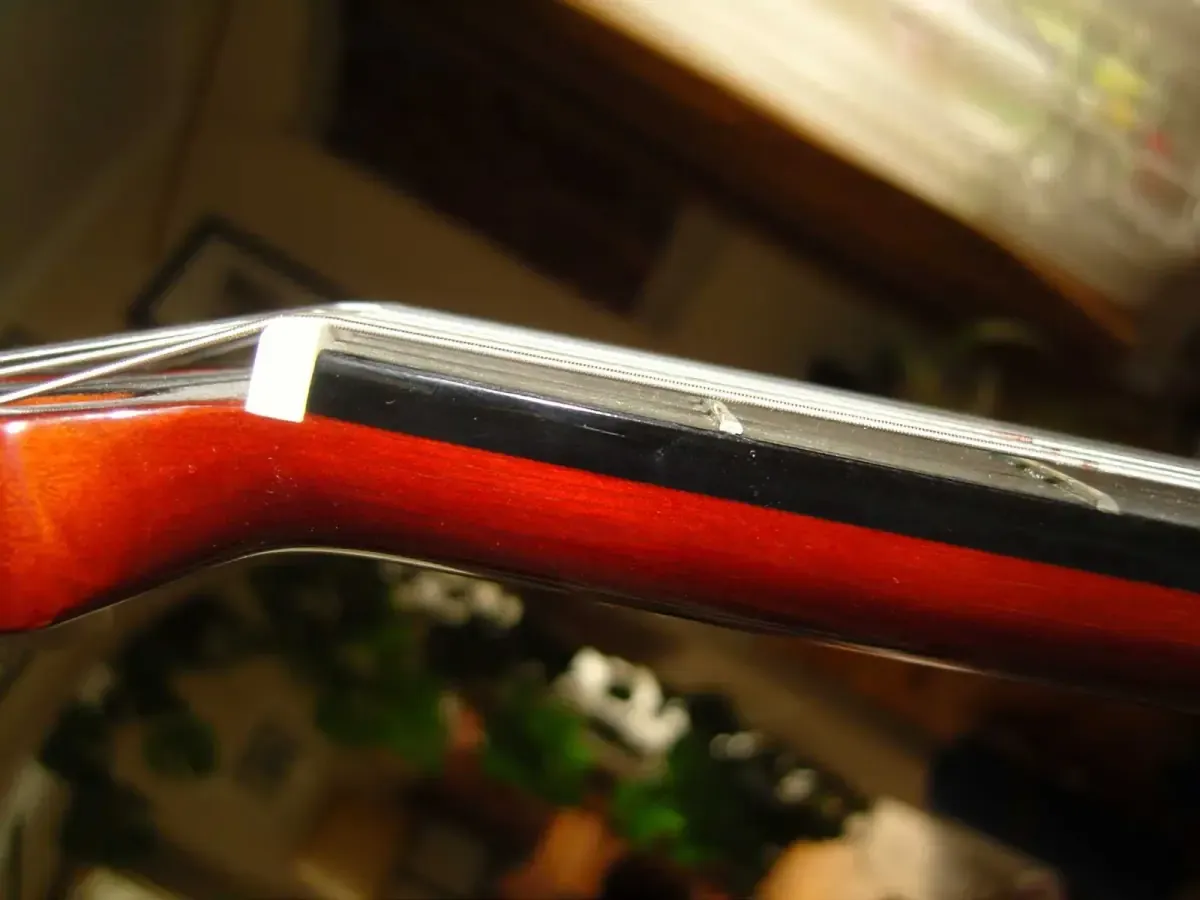
Lowering the action, cutting the nut and adjusting the neck are setup work. The truss rod in the neck in particular is not something to turn at random. A setup by a luthier fixes all of it at once and usually transforms a hard-to-play guitar.
Equal temperament: why some chords beat on a perfect guitar
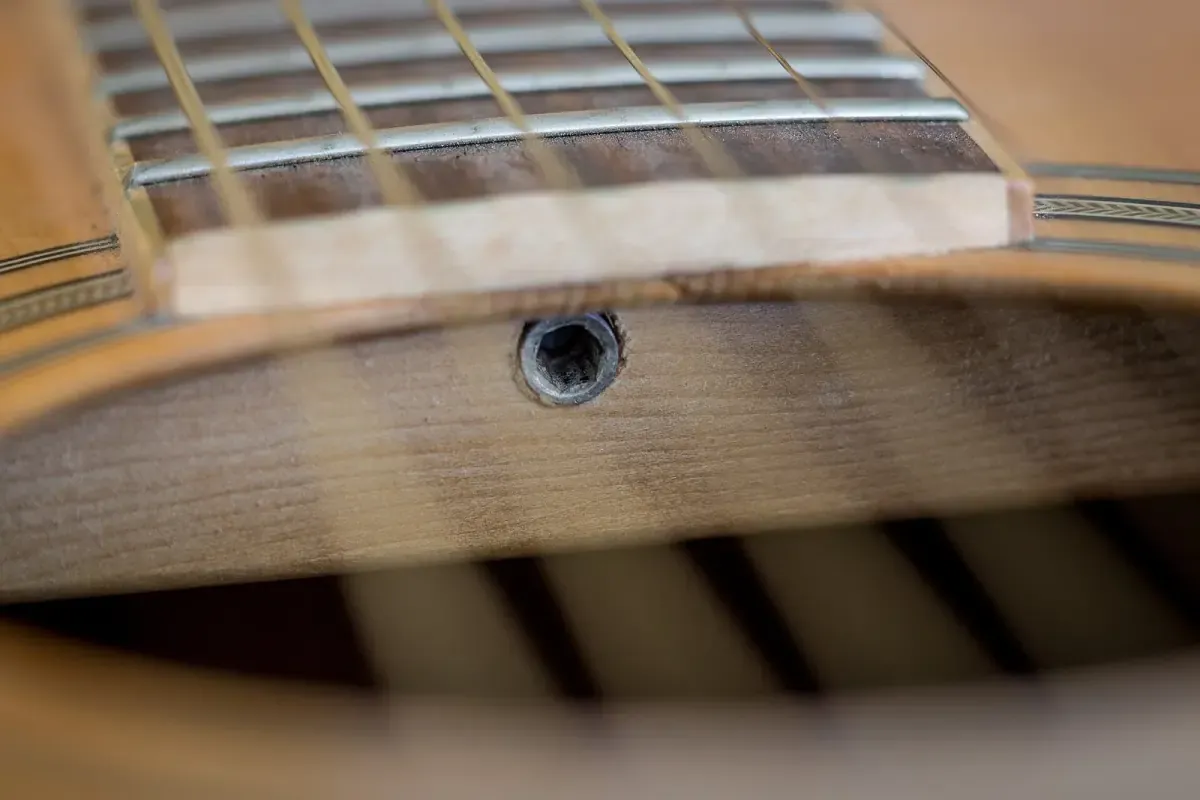
Even with perfect strings, a perfect hand and perfect intonation, some chords will sound slightly restless. That is not a fault. The frets of a guitar divide the octave into twelve equal half steps of 100 cents each. It is what lets you play in every key without retuning, and it comes at a price: apart from the octave, no interval is perfectly pure. The pure intervals, the ones that sound perfectly smooth, come from simple frequency ratios, and those do not land on the frets.
| Interval | Pure, in cents | On the frets | Difference |
|---|---|---|---|
| Octave | 1200 | 1200 | None |
| Fifth | 701.96 | 700 | About 2 cents narrow |
| Fourth | 498.04 | 500 | About 2 cents wide |
| Major third | 386.31 | 400 | About 13.7 cents wide |
| Minor third | 315.64 | 300 | About 15.6 cents narrow |
Fifths and fourths are off by about two cents, which nobody hears. The major third is the one that matters: it is about 13.7 cents wider than a pure major third. When two notes are slightly out of a pure ratio, the sound pulses, a slow wobble called beating. In an open G chord, the low G and the B above it beat roughly four times a second at A = 440, while the G and the D beat about once every three seconds. The fifth sounds still; the third shimmers. That shimmer is what people hear as a chord that is off.
Some players sweeten their tuning for it: they lower the string that carries the major third of the chords they play most by a few cents. The B string is the usual candidate, since it carries the third of an open G chord. It makes those chords smoother and others a little worse, which is the compromise in a nutshell. If you want to try it, tune normally, then bring the B string to a few cents below zero on the tuner, which shows the deviation to the cent, and listen to your chords.
Frequently asked questions
Why does my guitar sound out of tune even when it is tuned?
Why do some chords sound off but not others?
Can pressing too hard make my guitar sound out of tune?
How do I check the intonation of my guitar?
Why does my guitar sound out of tune with a song?

Who made this
Guitar Social Club is the work of Yohann Abbou, a guitar teacher in Paris. He teaches adults, which shapes everything here: people with limited practice time who want to know whether the problem is their hands or their guitar. The tuner on this page shows you cents rather than a green light for that reason, so you can watch a note move as you press. None of the tools asks you to sign up before it works, and the rest of our free guitar tools work the same way.
More about Yohann on his page, and about why Guitar Social Club exists.